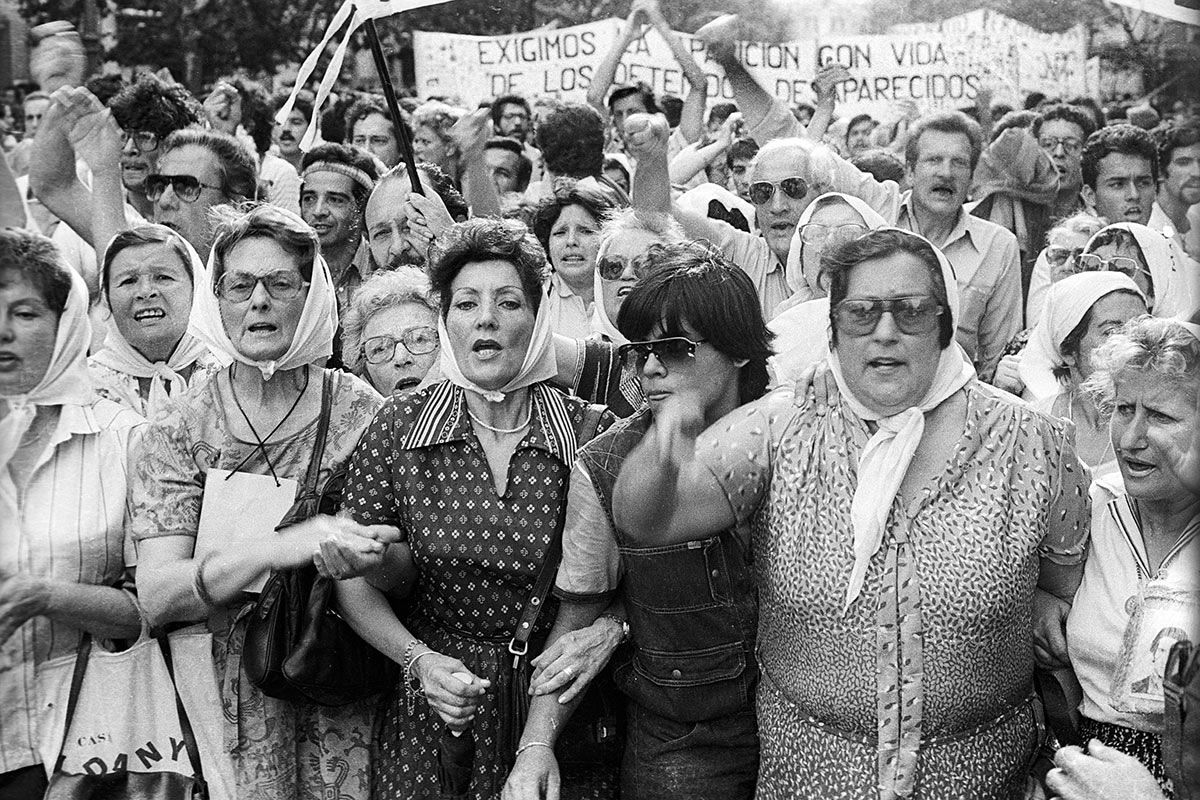
Hebe always declared that the birth of the Mothers had not been in the square but in the Stella Maris Church in La Marina, about 49 years ago. Some mothers of missing children had gathered there to talk to the priest Emilio Graselli, the vicar’s secretary, who did not stop ignoring them. At the exit, Azucena Villaflor said: “Enough, we have to do something; together we can, but apart we are not going to achieve anything. And it has to be in the Plaza de Mayo, where the most important things in the country happened.” They transformed pain into action. And they marched in Plaza de Mayo. In the first meeting there were 14. Within a year there were 200.
The verb “marche” is not random. Although they are popularly known as “rounds”, they choose to use the term “Marchs”. More than rounds, they are a political position, a demonstration of validity and struggle. The first meetings did not take place near the Pyramid, but in front of the Government House, around the Belgrano monument. Little by little, as the group grew along with the police harassment, they ran to the center of the square. “It was a kind of triumph, because there they were more visible, which was their objective,” says Demetrio Iramain, biographer and history teacher at the Universidad de las Madres. Every Thursday there were two or three new ones. “Are you coming for the same reason as me?” was the repeated question. Given the number of mothers they believed, the police were put on alert. They told them ‘you have to move around’. And then they started walking. The March of the Mothers.
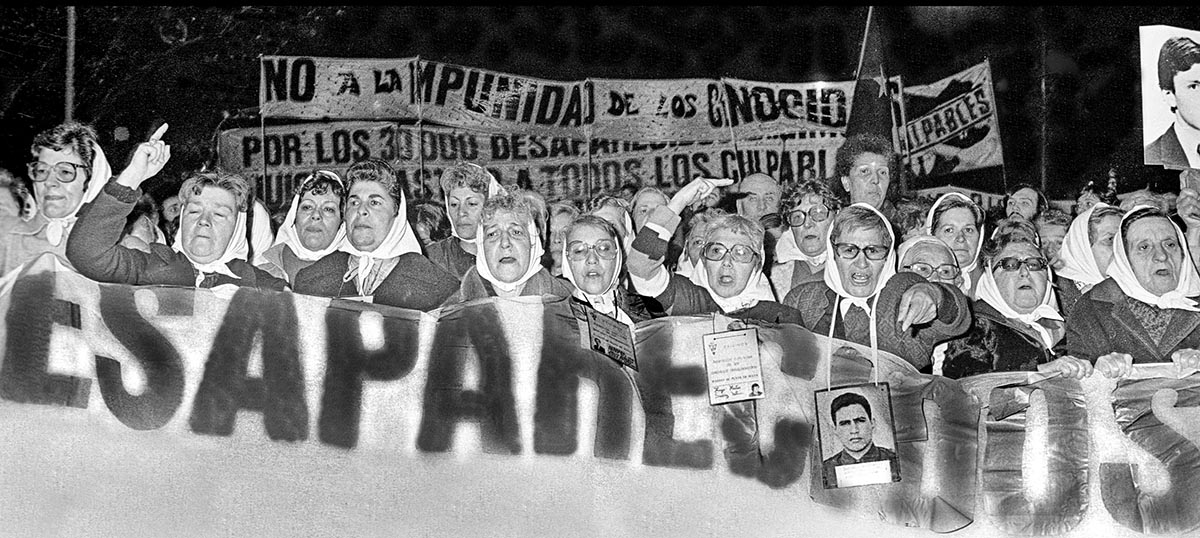
Photo: Hasenberg Quaretti Archive
The dictatorship’s response took place between December 8 and 10, 1977. After the infiltration of Alfredo Astiz, Azucena, Mary and Esther disappeared. There is another great debate between them: whether it was a good strategy to have been in the square for months, because they were obviously in danger. The position that ends up being imposed (and there Hebe re-emerges as a reference and leader) is that Azucena had evidently been right, they had to go to the square because that was where their presence bothered them, and that is why they had kidnapped three of them. They were organized, new references emerged, they became institutionalized.
By 1978 there were already hundreds of mothers. International repercussions came, such as the march broadcast on Dutch television simultaneously with the opening ceremony of the 1978 World Cup; requested in newspapers, the meeting in October 1978 with the president of Italy, Sandro Pertini. White scarves arrived that replaced nails as badges, after the pilgrimage to Luján. The walks in pairs in silence, holding hands, always going counterclockwise.
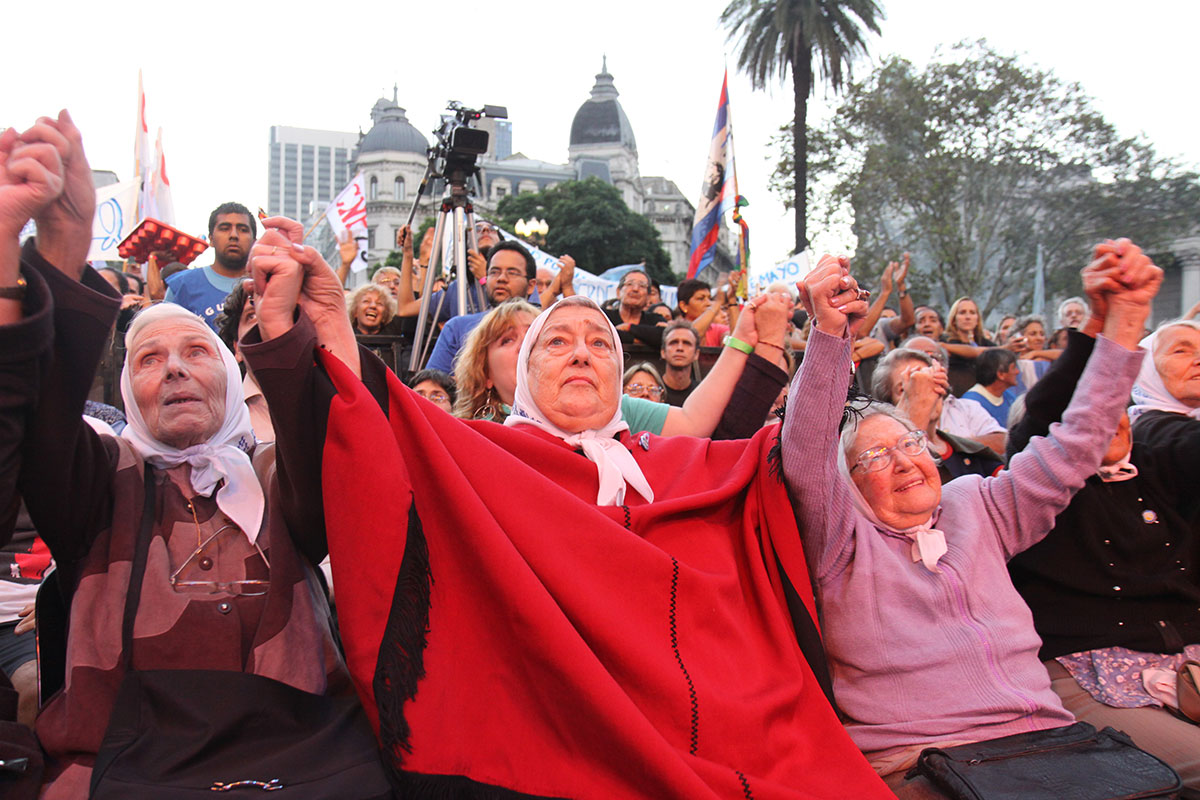
On April 30, 1981, they celebrated their 4th anniversary with a round that brought together 4,000 people. Faced with a climate of “political dialogue” promoted by the dictatorship, with the support of vast sectors of the party, the Mothers led the first March of Resistance. This is how Hebe explained it: “They were born in 1981 as a demonstration of confrontation, not for 30 minutes on a Thursday, but for 24 hours without rest, against the murderous power and the traitors.”
The Resistance Marches continued until 2006 (Alfonsín was one of the most agitated: ‘Resist what and who, if there was now a democratic power?’), and then they were resumed during Macri’s presidency. They returned in 2025, together with ATE. Already in 2016, Hebe focused on the need for the legacy to continue in young people and organized workers: “This March of Resistance is no longer ours, it is yours now, you are the ones who have to carry it forward.”