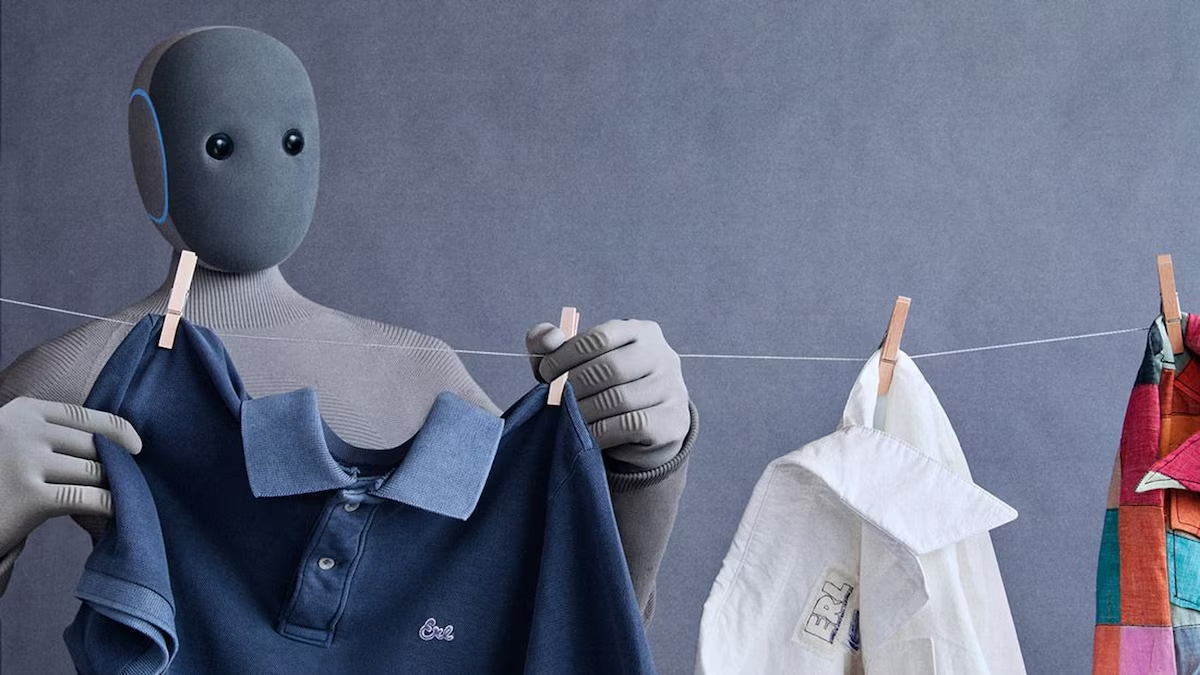
Science fiction is becoming reality in homes, and many Home robots are ceasing to be luxury devices to be acquired en masse. The reason? Free people from these tedious tasks so that they can dedicate the time they earn to what they really like. In this sense, all global and national data are optimistic. The report ofNext Move Strategy Consulting estimates that the global home robot market will reach US$11.98 billion in 2024 and projects to exceed US$34.11 billion by 2030, with an annual growth rate of close to 19%.
Large technology companies compete to launch increasingly sophisticated robots on the market, capable of performing from the most basic tasks to the most complex household tasks. In any case, far from being commercially available models, for now they are prototypes. All of them are equipped with artificial intelligence and humanoid features.
For example, the American company 1X Technologies presented NEO, “the first consumer-ready humanoid robot,” according to its manufacturer. With a design that evokes the legendary Robotina from The Jetsons, this 30 kilo robot comes with a washable fabric covering.
NEO promises to perform basic household tasks like wash clothes, vacuum, organize objects, open doors, clean the bathroom and maintain natural conversations with their owners. Its structure includes articulated hands and force sensors that allow it to lift up to 68 kilos and carry loads of 25 kilos.
The robot will arrive in the United States this year at a price of $20,000, although it will also be available for a monthly subscription of $499. Its international expansion is planned for 2027.
CLOiD It is the LG model, which was presented at CES 2026 as a bionic butler. Unlike previous devices, this robot has a mobile torso and two articulated arms with five-fingered hands, allowing you to manipulate objects with human dexterity.
In live demonstrations, CLOiD was able to removing milk from the refrigerator, preparing breakfast using the oven, as well as folding and stacking clean clothes in a perfect way.
According to the manufacturer, this humanoid has advanced vision and language models that allow it not only to see objects, but also to understand the context. He knows that a cup is fragile and that a garment must be folded a certain way. Plus, you can talk to family members, recognize their faces, and learn their routines to anticipate their needs.
The company has not given details about when it could arrive in Argentina.
Since no one likes to clean the bathroom, a robot was also created to solve this issue. Is called Hytron, manufactured by Primech AIand promises to eliminate 99% of bacteria in record time.
Equipped with 3D autonomous navigation, ultrasonic cleaning system and UV-C disinfection, Hytron can move around the bathroom without colliding with obstacles while deep cleaning and disinfecting surfaces.
This model will be available starting in May with an estimated price of $1,200.
In Barcelona, within the framework of the Mobile World Congress 2026 (MWC), the Chinese manufacturer Honor presented, among other products, its humanoid robot. “Although it is a product focused on serving users in scenarios such as shopping, company and assistance at work, at the moment no announcement has been made about its commercial strategy,” comments from the company, adding that they still do not have a sales price for this product that is designed for the office and home.
The models that are announced always come with the legend “available soon”, but until now there have been no specific launches. And this is something that goes back a long time. For example, Xiaomi was one of the forerunners in this field with the presentation of CyberOne in 2022. According to the manufacturer, this prototype is capable of detecting emotions and moving at 3.6 km/h. Another case is Punyo, from the Japanese automobile company Toyota. The idea is that it imitates the movements of human beings and was designed so that it can help people with different daily activities that “need more than hands and fingers,” according to the Japanese company.

Samsung is not far behind either. Its sphere-shaped smart home robot Samsung Ballie promised to hit the market in the first half of 2025, but is not yet available. It works as an advanced AI personal assistant that moves autonomously, projects images on walls or ceilings, and controls home devices using SmartThings. The firm promises to launch it at some point in Korea and the United States.
From Samsung they confirm that “Ballie is not yet marketed in any market in the world,” explains Matías Luchetti, DA (Digital Appliance) Product Manager for Samsung Argentina.
But how far are autonomous robots from real-world use? According to a recent report From the nonprofit research institute Epoch AI robots have very little chance of performing common household tasks on their own. “However, in other areas, autonomous robots are already being implemented on a large scale, such as in warehouses, where they pick up and place different objects,” the document states. And he justifies: “For robots to be useful beyond narrow and predefined tasks, they need to handle new objects, new environments, and new tasks without extensive retraining. This is the main obstacle: most demonstrations show robots optimized for specific tasks in specific environments.”
The business already exists, although the technology is not yet up to par. The Cleaning and lawnmower robots today move a combined market close to US$10 billion and could double in five years. They are devices with limited capabilities, but their widespread use makes it clear that there is a specific demand to automate repetitive household tasks.
The surveys agree that folding clothes and cleaning are the most desired functions. If a multipurpose robot could do both with more than 90% reliability, it would open up a mass consumer market even with prices close to US$20,000.
“The problem is that domestic robotics plays with different rules than industrial robotics. In a factory the environment is stable and designed for the machine; In a house, everything changes. Furniture that moves, new objects, unpredictable configurations. The real challenge is not strength or speed, but the ability to generalize without constant retraining. And there is the bottleneck today,” comments the document.
The researchers concluded that humanoids are typically 3 to 10 times slower than humans. “However, a robot that works 20 hours a day makes up for its slowness in each task, and in domestic contexts, a robot that works while the user is away could be five times slower without losing its value.”
While the world’s large technological manufacturers compete to launch the first viable domestic humanoid, home automation already has a more modest but real version in Argentina, made up of smart vacuum cleaners, kitchen robots, and pool cleaners. The promise is more limited, but the demand is concrete.
Samsung is one of the actors that has been building this ecosystem in the country. “SmartThings’ active user base doubled during 2025, and today more than 20% of the refrigerators and washing machines that the company sells in Argentina already integrate connectivity. If you look at the available offer, the change is even more marked: more than 60% of its models already have this technology, which shows that it is no longer concentrated in premium versions to form a structural part of the portfolio,” says Luchetti.
But does the Argentine consumer really use that connectivity, or does he buy it and not activate it? According to Luchetti, the answer depends on the case, although the trend is positive. “Functions such as monitoring energy consumption, remote programming of washing cycles or management of refrigeration temperatures They are beginning to join in an increasingly common way,” he explains. And he adds a generational component: “Today we are used to managing almost everything from our cell phones. For a generation that already lives in that digital ecosystem, it is natural to want to have the same level of control over the home.”
The barriers to adoption, according to Luchetti, are less technical than one might think. “Adoption is more a matter of habit than a limitation of price or infrastructure. And something important is that connectivity is an added value: if the user decides not to use it, the equipment works exactly the same as a traditional appliance.”
Newsan is advancing along the same lines with Home Sync, its application to manage smart home appliances from your cell phone, which already registers 5,813 users and 3,841 connected devices. “The most relevant data is not only the sale, but the use: 45% of users open the app at least once a daywhich suggests a real integration of these devices into the domestic routine,” the company explains.
In the function-specific robots segment, growth in 2025 was sustained. Fernando Avedano, Brand Manager of Aiper, explains that Argentina has an estimated park of 1,300,000 swimming pools. “The pool robot is no longer a niche product to become an investment associated with saving time and maintenance. Prices range from $300,000 for entry-level models to $3,700,000 for high-end equipment,” he says, and clarifies that projections for 2026 anticipate a more moderate expansion, in line with the volatility of local consumption.
The trend, then, is not yet for multipurpose humanoids, but for the consolidation of an ecosystem of connected devices that can be turned on, programmed and monitored from the cell phone, and that are beginning to turn home automation into an everyday practice rather than a futuristic promise.