Western equine encephalitis returned to the center of the national health agenda in recent months, since the beginning of the epidemic outbreak in the country, which occurred at the end of last year.
Senasa reported on March 8 that it registered 1,470 positive outbreaks. According to official information, there were seven people who died from this disease, in different places in Argentina.
In Bahía Blanca, meanwhile, this Friday it was reported the first case detected in the city: This is a 65-year-old man who lives in a semi-rural area, indicated the Municipality.
The country is currently facing an outbreak of this infection, transmitted by a type of mosquito. This is the reappearance of a viral infection, which belongs to the alphavirus genus, which had previously caused outbreaks in animals and humans.
On November 28, the National Ministry of Health issued an alert to health centers and hospitals to identify suspicious cases in humans and attack the pathology in time.
The risks of equine encephalitis in humans
Ricardo Teijeiro (MN 58065), infectologist at the Pirovano Hospital and member of the Argentine Society of Infectious Diseases (SADI), told Infobae that equine encephalitis is a viral disease called zoonosis. “It is transmitted by mosquitoes and from birds to humans. It is not transmitted from human to human,” he commented.
“One has to be in contact with sick equine cattle, with birds that can transmit it. It is not that easy. Now the most frequent thing is asymptomatic disease, without symptoms or very mild, or symptoms that evolve in a week to ten days. In general there is no greater risk. For each case that is diagnosed, it is estimated, in children, that there are about 50 or 60 asymptomatic cases; and in adults, for each case, there are more than 500 asymptomatic cases. So it is not a high-risk disease,” he added.
Furthermore, the expert pointed out that “all viral diseases have risk groups where they can evolve poorly and always, in general, they are the same older adults, the immunosuppressed, those who have immune mechanisms that do not respond adequately.”
The mosquito that transmits this disease is the “Aedes albifasciatus” (Illustrative image)
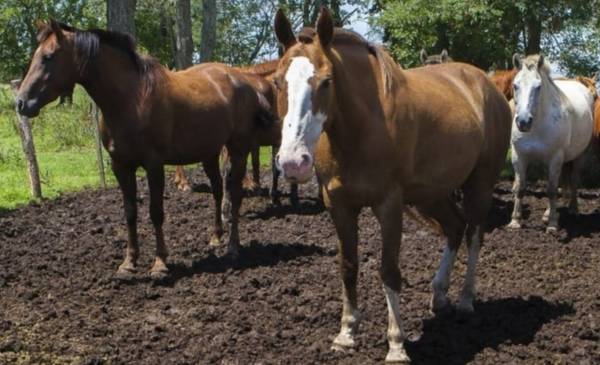
Meanwhile, Adrian Diazresearcher at the Institute of Biological and Technological Research of Conicet, one of the scientists working on the analysis of samples from infected animals, had said that “the people at risk are those who are in close proximity, with horses. Those who carry out rural activities or are in these environments, because here the mosquito vector plays a main role, which, based on the evidence there is, is the Aedes albifasciatus”, in conversation with that same medium.
“Like all emerging viruses, they have high mutation rates. They can be varying all the time and with this they acquire an adaptive capacity that gives them the chance to emerge with a strain or a viral population of greater virulence, which replicates better in some vector than another, or which amplifies better in some host than another. And that gives it the chance to increase the probability or risk of an epidemic. It is very difficult to give an answer regarding this. It is very dynamic and we do not know very well where the pattern may go. of evolution and adaptation of this viral strain or of this virus that is circulating,” added the expert.
Furthermore, Díaz stressed that the human is not an amplifier and neither is the horse: “Therefore, the probability of there being an outbreak or an epidemic is low. Is it impossible? No, it is not impossible. An outbreak can occur, but for this to occur in the human population, or for an epidemic to arise, there has to be a coincidence, a synchronization of factors, which at the moment would not be occurring.”
“In general, the risk is low because the natural reservoirs of this viral disease are rodents and birds,” said the infectious disease specialist. Rogelio Pizzi (MP 30.128), dean of the Faculty of Medical Sciences of the National University of Córdoba (UNC) and head of the Latin American and Caribbean Association of Faculties and Schools of Medicine (Alafem)
“When the mosquito Aedes albifasciatuswhich is the vector, bites and inoculates the horse or, failing that, the human; generally, the viral load is low. In other words, the risk is low, that’s why the people who are compromised generally have some comorbidity,” he said in dialogue with Infobae.
What are the symptoms of equine encephalitis and what are the warning signs?
Teijeiro explains that the symptoms can be very mild. “You can have symptoms such as fever, headache, muscle pain, weakness, refusal to eat, and neurological symptoms, vomiting, intense headache, typical of encephalitis symptoms. But the most important thing for the diagnosis is the epidemiology. You have to have been in contact in an area where the virus is circulating or in a rural area with equine livestock. And that is the main thing to think about the diagnosis,” he said.
“The symptoms in humans are: fever, fatigue, general malaise, muscle pain and there may be some respiratory signs. Any of these have to alert us and quickly go to the doctor or the nearest health center, in addition to having the epidemiological component, that is: a person lives in the countryside, is in contact with horses and, as this flood mosquito is called, there was a great proliferation due to the rains due to climate change and changes in rainfall regimes,” Pizzi said.
And he maintained that, to combat this mosquito, “they are the same health regulations that we must follow to combat the Aedes aegyptiwhich is the transmitter of dengue. That is, removing debris, not leaving water accumulation on the perimeter of the house and keeping it clean, using mosquito nets. Meanwhile, for people who work in the field and in epidemiological areas with epidemic outbreaks, use long-sleeved shirts, light clothing, mosquito nets and repellent, as indicated, and apply it periodically every six hours.” (La Nueva. with information from Infobae)