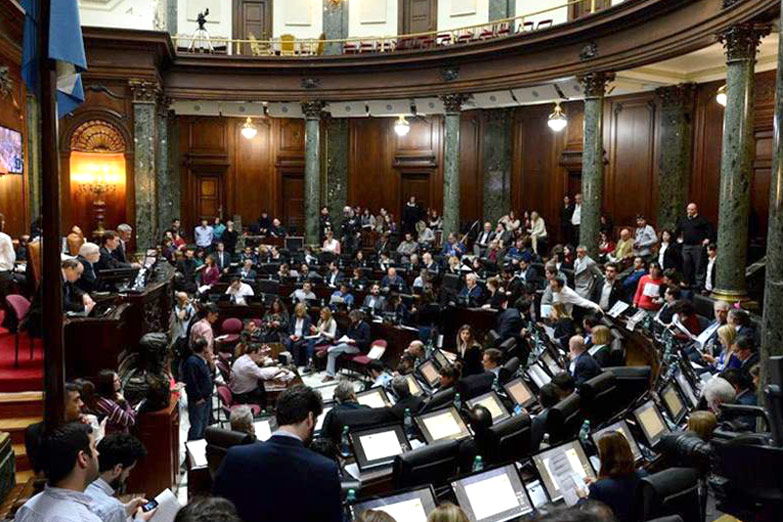
Only 14% of the judges of the provincial Supreme Courts throughout the country allowed access to their sworn asset statements, following a request for access to information requested by Noise –member of the Federal Network of Journalism and Innovation– and Connect between April and May 2025.
This is what happened with the maximums magistrates of six provincesalthough Only in two cases did they make information available for all of their members.. In the other four there were partial responses. As the main argument to deny public accessibility, the vast majority of authorities hid behind the fact that they comply with their obligation to local organizations, but in a sealed manner.
The obligation of provincial magistrates to present sworn statements is regulated by laws of local public ethics, by the constitutions of each province or by specific laws on sworn declarations that include members of the Court of Justice, officials and magistrates of the local Judicial Branch.
I only know was able to access the sworn statements of only 19 magistrates. At the same time, in two provinces it was possible to access the DDJJ of all its members: they were those of Cordova (7), which responded to the request for access to information presented, and Mendoza (7), which has them public and accessible on the Public Ethics Portal.
In four other provinces there were partial responses. In Catamarca Only Minister María Fernanda Rosales Andreotti responded. In The Pampaonly Minister Fabricio Ildebrando Luis Losi. In NeuquenMinister Gustavo Mazieres shared the link to the complete file of his appointment, which included his DDJJ. In Land of Firethe ministers Javier Muchnik and Edith Miriam Cristiano.
In Formosa there was no official response, and the website shows the DDJJ of 2 of the 5 ministers, but old: that of Ariel Gustavo Coll, from 2016; and that of Marcos Bruno Quinteros, from 2012.
There were also responses from the ministers of the Court of Salta, Río Negro, Entre Ríos and Chaco, although in all cases they explained that the DDJJ were duly presented to the Government Notary Offices, Administrative Investigations and Public Ethics Offices, General Accounting of the Judiciary or Accounting Courts; in which case they referred the query to these organizations.
In Entre Ríos, it was also clarified that the DDJJ are “secret” and can only be opened by the magistrate himself or at the request of a judge in the framework of a criminal investigation.
The supreme courts of Buenos Aires, Chubut, Corrientes, Jujuy, La Rioja, Misiones, San Juan, San Luis, Santa Cruz, Santa Fe, Santiago del Estero and Tucumán did not respond to the request. Nor that of the City of Buenos Aires.
The data corresponds to the Cortes as they were formed as of May 2025.
Investigation into political ties of judges
DDJJ’s requests to magistrates were made at the same time that they were asked for information about their work history, in order to determine their political ties prior to their arrival in the judicial office.
That investigation of Noise and Connectspublished on August 8, 2025, revealed that of the 138 judges of the Supreme Courts throughout the country, 88 register some political link and/or previous work with officials and/or local governments before occupying those positions.
In the case of the Federal Justice, it is the Public Ethics Law which establishes that the magistrates of the Judicial Branch of the Nation are obliged to make the sworn declaration of their assets. The objective is that there is control by the State and citizens regarding the assets of public officials and this information can be used to monitor possible crimes of corruption or illicit enrichment.
Furthermore, the Inter-American Convention against Corruption (Law 24,759) and the United Nations Convention against Corruption (Law 26,097), to which Argentina adhered, provide for the incorporation of “systems for the declaration of income, assets and liabilities of people who perform public functions, making their publication possible when appropriate.”
Hidden or secret information
In all cases, the publicity of this documentation could contribute to strengthening the weakened public trust and legitimacy of the Judiciary: according to data from the regional consulting firm LatinobarómetroIn our country only 22% of the population trusts Justice.
“The Judiciary is always the darkest of all powers in terms of accountability. It is necessary for those in charge of administering justice to raise the standards of transparency, and knowing the sworn declaration of the judges is essential to know if there is an abnormal patrimonial evolution, or if there could be a conflict of interest,” warned Pablo Secchi, director of the Poder Ciudadano foundation.
For Fernando Ávila, president of the Criminal Thought Association, this survey found “very valuable information and it is very good to be able to quantify it,” although he warned that it does not attract attention.
“If we have highly questioned institutions, it is necessary to work to rebuild those links that have been broken with society. The generalization of this warns us that there is a feeling of ‘anything goes’. This is because ministers do not feel an inclination or vocation to work so that this link of delegitimization is repaired. There is also no institutional or social demand, nor any reproach that pushes us to work on transparency,” he noted.
Update 10/21/25: the sworn declaration of assets of María del Carmen Battaini, judge of the highest court of Tierra del Fuego, which had not been attached in the first sending of response to the request for access to information, was added to the list.
This content is part of the Federal Network of Journalism and Innovation (RPI)alliance promoted by Checked which unites media from 5 regions of the country to contribute to the expansion of innovative journalism and counteract information deserts.