“All wars,” said Graham Greene, “have a leading hotel.” Those who read The comedians (1966) they know the Oloffson Hotel, located in Port-au-Prince during the Papa Doc dictatorship and the terror of the Tonton-Macoutes in Haiti. The Hotel Nacional de Cuba is the scene of the end of the Batista regime, while Our man in Havana (1959) plays the spy between a daiquiri and a chess made with liquor bottles. Although none surpasses the Intercontinental Hotel in Hanoi during the Indochina War. According to Greene, it was enough to sit for a while on the terrace of the Hotel at dusk to listen to how the French officers commented on the upcoming offensive, the objectives sought, the troops committed. Then it was enough to go up to the room to write the news about what would happen, which a friendly pilot would take to Hong Kong.
It is in Hong Kong where Pepe Escobar, “our man in the East,” seems to reside. Although he began as a music critic in the press of his native São Paulo, from the nineties onwards he became familiar with the concert of eastern nations, from all the shores of the Mediterranean to the China Sea without forgetting the coasts of Vladivostok. Find a melody of dissonant notes according to places and customs, harmonies difficult to execute due to past histories and recent interests, all at the rhythm that the West wants to impose, an impossible in itself. What a challenge. All that remains is to combine deserts and palaces, arrests and releases, words that are news. Like the article that Pepe Escobar wrote on August 30, 2001: “Stop Osama! Now!” Subsequent events earned him fair recognition. He is currently editor of Asia Times and runs TheCradle.co. –indispensable reading.
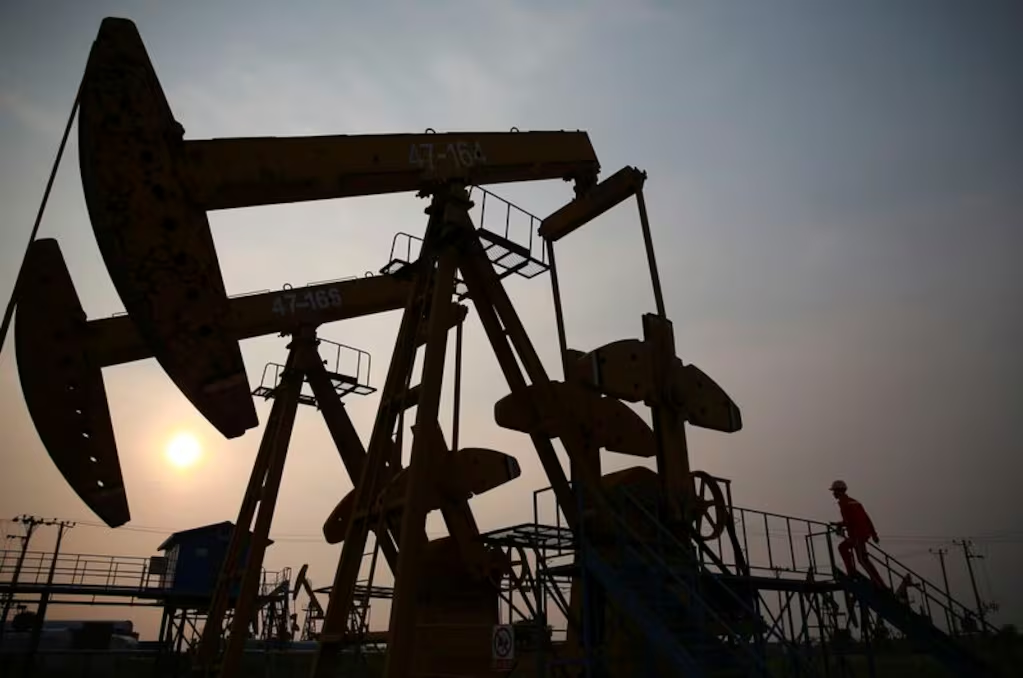
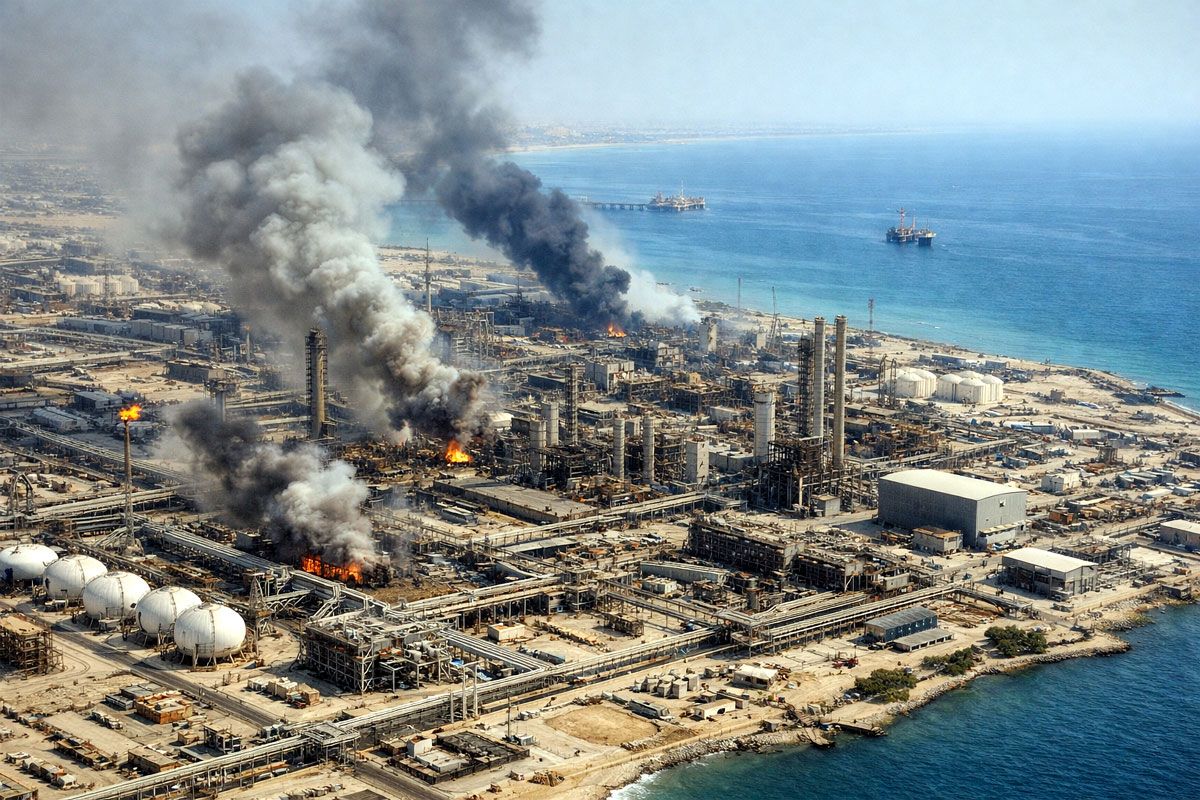
Now Pablo Escobar tells us: “Iran is advancing in a total war against Israel.” Indeed, the Western attack on the South Fars fields on March 18 marks another point of no return in the confrontation. South Fars, which Iran shares with Qatar, is one of the most important natural gas reserves on the planet, which supplies Iran and also other countries in the region, such as Turkey. So far, Persian oil facilities had not been attacked, given the expected Iranian military response. That didn’t take long to wait. This is how the Ras Laffan refinery facilities in Qatar “were the target of missile attacks, causing large fires and considerable damage,” according to QatarEnergies. Luckily there were no victims. Well, yes, a significant casualty. An LNG train.
What’s that? “An LNG (Liquefied Natural Gas) train,” Pepe Escobar tells us, “consists of components designed to process, purify and convert natural gas into LNG. They are called “trains” due to the sequential arrangement of the equipment (compressor trains) that are used in the industrial process to process and liquefy natural gas.” “In practice,” he continues, “these are facilities linked to the United States and the West, so they constitute legitimate targets for Iran.” What happens, he says, is that “there are only 14 trains in the world, and it is not an exaggeration to say that Western civilization depends on all of them. Replacing a train takes between ten and 15 years. These 14 trains are easily within the range of Iran’s ballistic and hypersonic missiles. At least one of them was destroyed during the Iranian counterattack. That is how serious the situation is.”
As for the closure of the Strait of Hormuz, which has gained international fame, it is due more to the financial panic of Western insurers than to Iranian measures. Any ship that pays in petroyuans and circulates through Iran’s territorial waters will not receive any damage. In the future, Escobar points out, the Iranians are thinking about establishing a toll that compensates for the losses caused by the Western blockade, something unthinkable before the war. But there is more. The power of Israel, he tells us, is that it is a fortress. But as a strength it has weaknesses: supply. Escobar points out the five desalination plants; the Orot Rabin power plant; the ports of Haifa and Ashdod, “essential for Israeli imports of 85% of the wheat it needs; and the energy decapitation: focused on the Haifa refineries, the only Israeli source of refined oil, and an even more key target after the attack on South Pars.” All this in the context that Iranian missile production is cheaper than possible Israeli containment, especially in the face of hypersonic attacks. That is complicated in a war of attrition, where the initiative seems to have passed to Tehran’s side. The Iranian attack on the Western base in Diego García is more symbolic than effective, but 4000 km away it is worth deciphering the signs.
We will never know what would have resulted from an impossible conversation between Graham Greene and Pepe Escobar, nor where in the world it would have been. Without a doubt, in one where the story takes place. Greene would have offered him a drink created by himself in Hanoi times: a measure of London dry Gin, a touch of Noissy Prat, a suspicion of Creme de Cassis. We don’t know what Pepe Escobar would have thought. A drink never as bitter as what is already underway. «