
Beyond the fact that the world focus is on Artemis II and the return to the Moon after 50 years with the presence of a microsatellite manufactured by national universities, the Argentine space sector is going through a crisis caused by cuts from the national government. In this sense, The 2026 budget decreased by 20 percent compared to 2025 and accumulates a loss of 40 percent compared to 2023. With resignations and covert dismissals, more than 10 percent of the staff left the National Commission for Space Activities (Conae), the national space agency.
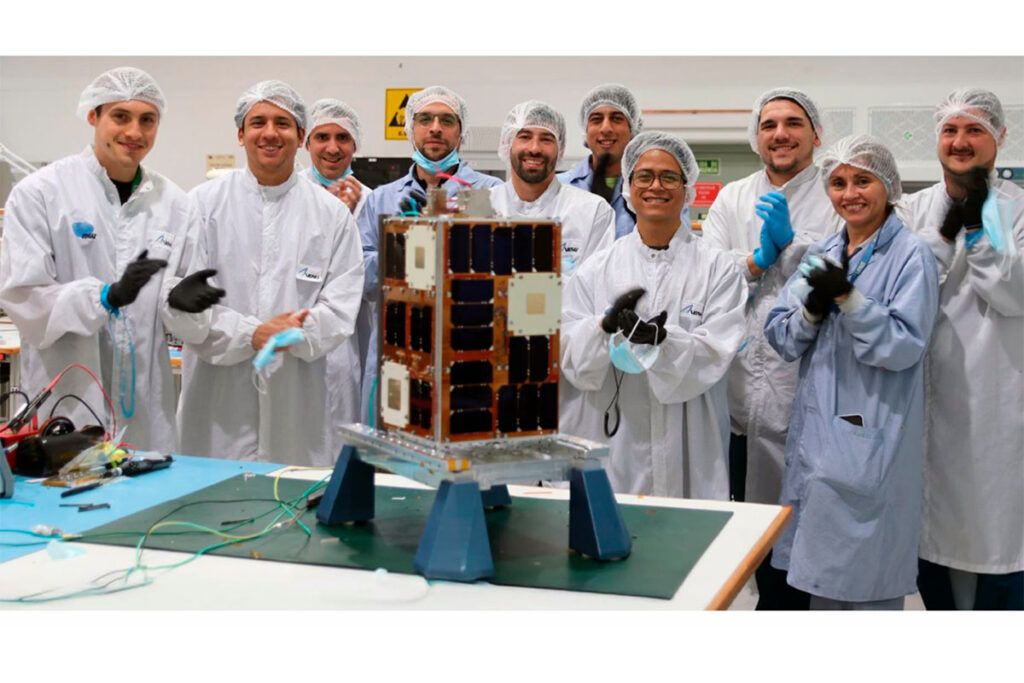
Faced with this situation, its workers not only denounce the brain drain and low salaries, but also warn about the obsolescence of infrastructure, the abandonment of projects and the loss of accumulated knowledge. However, the Executive Branch claims its own space plan, which highlights the performance of Noel de Castro, a biomedical engineer who could become the first Argentine to travel to space, and the participation of the ATENEA microsatellite. (carried out by Conae together with public institutions and universities) in NASA’s Artemis II mission.
Milei’s attack on the space research sector
While the national government dreams of the creation of a National Space Hub, hangs individual medals and celebrates the inclusion of the microsatellite made by scientists, teachers and students from public institutions that are defunded and systematically attacked, a Conae worker explains what the reality of the sector is. “Since the beginning of management, The government did not make the necessary purchases to replenish the Conae technology park and its budget plummetsas in the rest of the science and technology organizations,” he says. Emiliano Baumresponsible for Information Technology in the earth stations area, in dialogue with the Scientific News Agency of the National University of Quilmes.
And he continues: “Most of the projects are practically paralyzed, with the exception of SABIA-Mar, which is in its final stage, and the Belgrano 2 Base in Antarctica. The Tronador project, an emblem that would allow the country to complete all stages of the space cycle, was definitively deactivated”.
With a budget 40 percent lower than that of 2023, Conae workers demand the incorporation into permanent staff of personnel whose contracts expire at the end of March, the salary recomposition, the continuity of projects and the allocation of the necessary budget for its execution. To take dimension, while in December 2023 the staff was 294 people, it is now 254. Contrary to the supposed reduction of the State, the latest income was from officials with no experience in the sector.
“Practically all worker casualties correspond to technical-scientific personnel. This It represents an immense loss of capabilities that puts the organism in check and seriously compromises its central functions.. Furthermore, it generates an enormous workload for the personnel who decide to stay to resist and sustain the operation of the infrastructure and the projects, at the expense of their own health and quality of life,” highlights Baum.

More fiction than science
Through artificial intelligence, the astronaut candidate published a photo on her social networks where she is seen standing with the suit and the Argentine flag in front of the National Congress. Under the title “making the Argentine space project a reality,” de Castro highlighted the level of Argentine scientists, but warned that “science became trapped in structures that distanced it from its true purpose”.
“Today I am beginning to see something different. I am beginning to see a change. Science has to be at the service of the country, its people and its future. It has to have a clear, transparent direction and with real objectives,” he added on his Instagram account. In addition to meeting with Peter Lamelas, United States ambassador to Argentina, the astronaut candidate presented a project before Congress to declare the Argentine space sector of national strategic interest and create a special promotion regime.
For its part, the government presented the Bases for Argentine Spatial Development at the end of 2025. During its launch, the Secretary of Innovation, Science and Technology, Darío Genua, said that the country needed a new plan “that lives up to the technological transformations we are experiencing.” In both cases, The focus is on the role that private companies, entrepreneurs and “Argentine talent” could play..
At the same time, the government highlights as its own achievement the inclusion of the ATENEA microsatellite in NASA’s Artemis II mission. Nevertheless, This satellite was designed by public institutions and universities that are going through a budget crisis caused by the Executive Branch itself.. While the story shows the national government at the head of a sovereign space plan, the data show that the sector is one of the most affected in the attack suffered by science, technology and higher education.