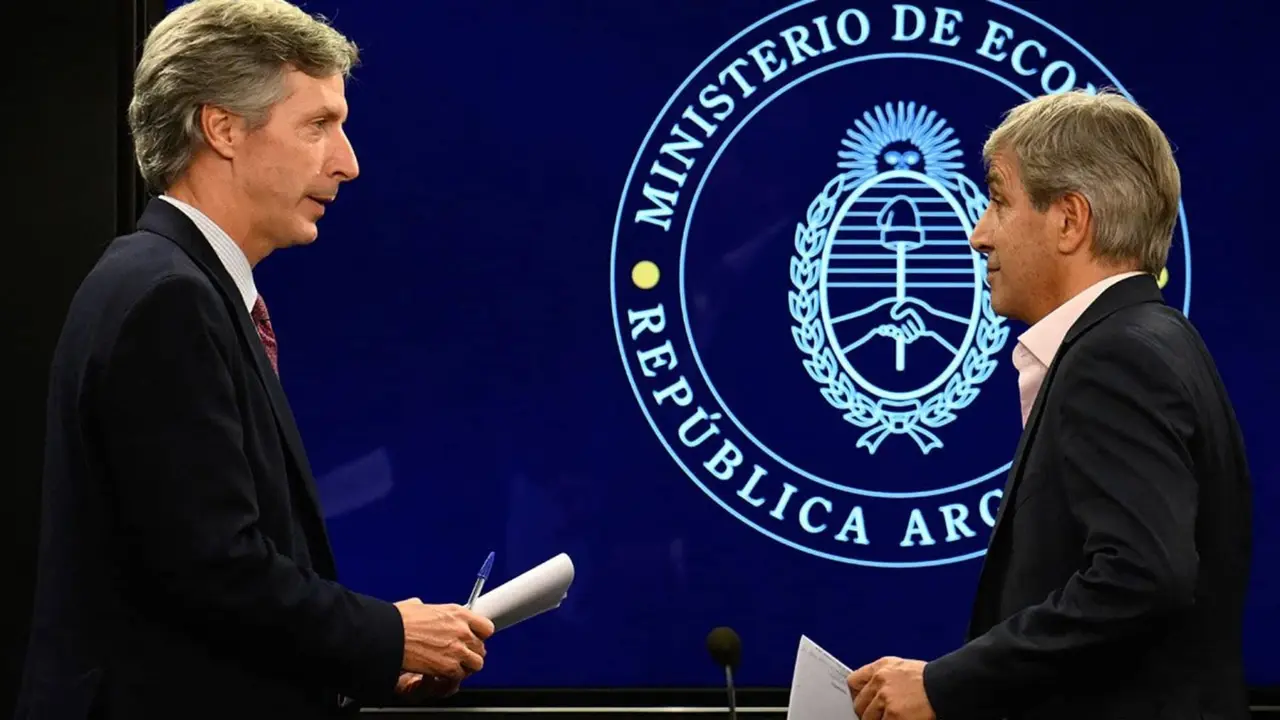
Minister Luis Caputo ruled out an exchange delay, despite the fact that the wholesale exchange rate continues below $1,400 and the Inflation remains around 3% monthly.
The head of the Treasury himself admitted that the March CPI ended higher than previous months, as a result of the rise in fuel prices due to the war in the Middle East.
The central fact is that The exchange rate is around $1,400 and, in real terms, is already at low levels within the Milei era.
Dollar: the short-term scenario
If the exchange rate remains in that area – with inflation of around 2.5% monthly -, Towards the middle of the year it could return to values similar to those of November 2023, prior to the initial devaluation of the current administration.
“The dollar adjusted to today’s prices is trading close to the minimum levels recorded during Macri’s administration,” said economist Salvador Vitelli.
Vitelli himself calculated some reference values, to take into account and compare the current scenario with the past:
- The 2018 “sudden-stop” reached a maximum that today is equivalent to $2,400
- Post-PASO19 is equivalent today to $2,568
- The October 2020 run is $4,555 today
- The debt crisis of 2022 is $3,900 today
- The 2023 pre-election run is today $4,646
- The $800 of the December 2023 devaluation today is equivalent to $2,676
- The pre-devaluation $350 is today $1,236.
That is to say: the current exchange rate is only 13.2% above the value shown by the “Massa dollar”just before the December 2023 devaluation.
Trade surplus: is the rain of dollars coming?
For this year, the Government expects a high supply of foreign currency. The trade surplus in 2026 could exceed US$20 billion, with exports around US$95,000 million and imports that hardly exceed US$70,000 million, according to an estimate by the consulting firm MacroView.
to that offer The income of financial dollars from company debt is added, via issues of negotiable obligations and external loans. This flow, although more volatile, also contributes to reinforcing the availability of foreign currency.
With this level of supply, the market manages to simultaneously supply two very demanding demands: that of the public sector — which needs dollars to pay debt maturities — and that of people, who buy foreign currency for savings and tourism.
This last point is key to understanding the current dynamics. Private demand remains very high. Between December and March, people bought about US$2.5 billion monthly. Extrapolated, it is equivalent to about US$30 billion annually, a number that in another context would be clearly destabilizing.
However, the exchange rate does not rise. On the contrary, it remains stable or even with a nominal downward trend. This does not respond to a direct intervention by the Central Bank to “step on it”, but rather to the fact that The supply is enough—for now—to cover all demand.
Why is exchange rate stability maintained?
Unlike other times, when a delay in the exchange rate was seen as a short-term risk, the current scenario looks stable. At least for the next few months, with the expectation of the liquidation of a record harvest, which could exceed US$40,000 million.
Besides, The Central Bank has been buying dollars on a sustained basis. In the first quarter it accumulated more than US$4.4 billion, which was allocated entirely to the payment of external debt. This makes reserve purchases a central piece of the year’s financial scheme.
The problem is that, even with these purchases, the net accumulation of reserves would be limited. The exchange surplus is largely used to finance the Treasury, which reduces the margin for genuine accumulation.
Imports, among the keys
An important part of the exchange rate tranquility rests on an extremely low level of imports.
In February, for example, payments for imports were only US$4,048 million, a very low floor that reflects more an economy with recessive features and overstocking than a healthy situation.
This point is key: importing little helps sustain the surplus and, therefore, keep the dollar calm.
But at the same time it is a sign of weakness in the level of activity. In other words, part of the exchange rate balance is explained by an economy that has not yet started.
Forwards, The base case suggests that there should be no shortage of dollars in 2026. Export strength acts as an anchor and import demand, as long as it remains contained, will not put pressure on the exchange rate.
The magnifying glass, in any case, will be on the second semester. It’s still missing.