
Representatives of the banking sector met last week to explore a path that until now did not appear as a concrete possibility.
Thus, they begin to work on a direct financing as a mechanism to resolve record defaultswithout waiting for indebted families to find their way out of a labyrinth that, with current rates, closes faster than it opens.
The meeting that opened a window of hope
Last week, representatives of the banking sector sat down to discuss an approach different from the one that has predominated until now: instead of tightening origination criteria and waiting for defaults to stabilize on their own, they evaluate implement direct financing schemes aimed at resolving debts.
The data was disclosed by the economic journalist Carlos Burgueño in the “Economía de Quincho” stream, a space that he shares with other experts, charged greater strength in the last hours.
The logic behind the proposal is that the bank credit, at rates lower than those of the non-banking marketcan replace costly debts that are currently in an irregular situation, allowing debtors regularize their situation and that the entities recover their portfolio which could otherwise become unrecoverable.
Damián Di Pace, economic analyst and director of Focus Market, has been analyzing this scenario closely. “Refinancing the arrears in the debts of Argentine families is key to stabilize both the domestic economy and the financial system as a whole.”
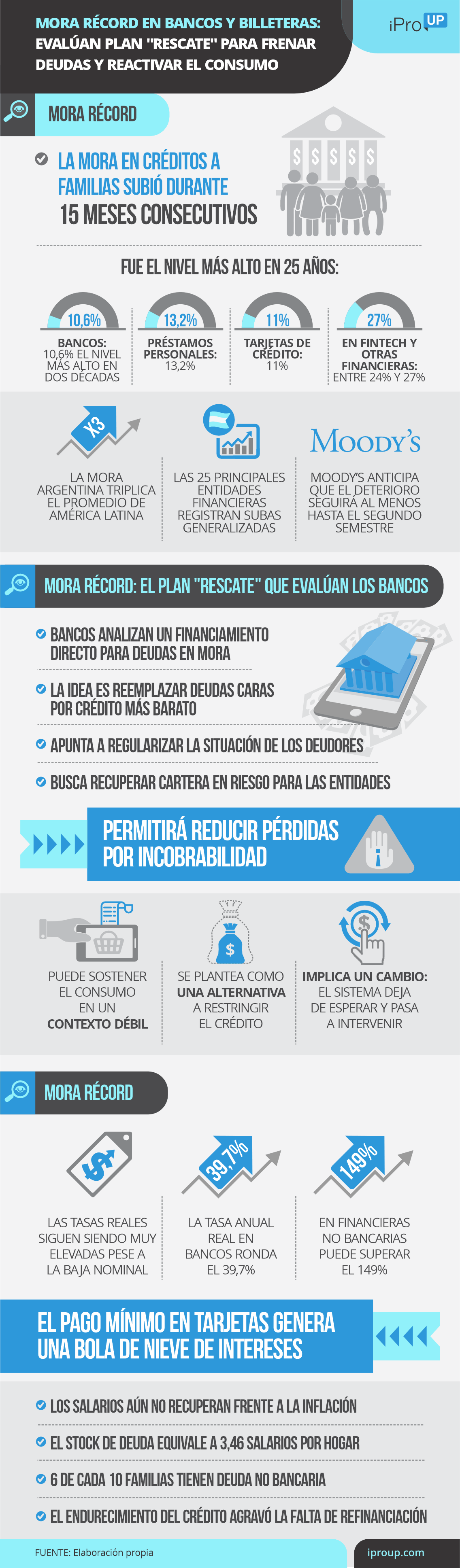
The keys to the record default and the plan that the industry analyzes
For the analyst, this “allows alleviate the immediate burden on households, avoid the deepening of over-indebtedness and sustain consumptionwhich is one of the main drivers of economic activity”.
The argument is not only social. “There is a mutual benefit here because it gives credit institutions the possibility of recover portfolio at risk, reducing losses and improving predictability“says Di Pace.
The specialist considers that “in a context of inflation and income volatility, Well-designed refinancing schemes contribute to a more orderly and sustainable recovery“.
The non-payment crisis in figures
The Argentine financial system has reached a point where it is no longer enough to wait for the market to sort itself out. The Delinquency in loans to families rose for the fifteenth consecutive month:
- came to 10.6% in banksaccording to BCRA data, a level that has not been recorded since the exit of Convertibility in 2001
- In fintech and virtual wallets, irregularity rises to 27% according to the consulting firm 1816
The numbers that describe the credit situation of Argentine families are, in any context, extraordinary. In a single year, defaults on bank loans to households went from 2.67% in January 2025 to 10.6% in the same month of 2026: almost four times.
It is the highest point for two decades and the phenomenon affects the entire system. The 25 main financial entities in the country registered increases in irregularities of their credit portfolios to individuals.
If the focus is on the personal loans, default rises to 13.2%. In the credit cards, at 11%. In the non-banking universe (fintechs, virtual wallets, consumer finance companies) the consulting firm EcoGo calculated an irregularity of the 23.9% in January 2026, while 1816 places it above 27%.
To have a dimension of the problem in a regional perspective, Brazil registers a default of 5.2%, Colombia 5.1%, Mexico 3%, Chile 2.6% and Paraguay 2.3%. Argentine defaults almost triple the Latin American average.
The rating agency Moody’s warned in its latest report that the situation will not find an apartment until well into the second half of the year. The deterioration, he said, will put pressure on the profitability of the financial system mainly through higher bad debt charges, which already reached 3.4% of net assets in December 2025.
Real rates: the knot that hangs
Understanding why defaults rise requires understanding the real cost of credit in Argentina. Nominal rates showed some downward trend. But in real terms, the cost of money is still suffocating.
In February 2026, the Average TNA for personal loans in banking entities was 69.7%equivalent to a nominal TEA of 96.8% and a real TEA of 39.7% discounting inflation for that month.
In non-financial entities, if the Average TNA is historically 90% higher than bank (according to 1816), actual TEA can exceed 149%.
When the Total Financial Cost (CFT) is added, which incorporates insurance, commissions and taxes, the weight on households’ pockets is much greater: in banks already exceed 150% annually, with limits of up to 350% in some products.
The minimum payment trap illustrates the dynamics well: the Interest rates applied to refinance card balances average 4% per month. Whoever pays only the minimum does not reduce the capital owed; It only accumulates interest that grows month by month. With salaries that have not yet fully recovered ground against inflation, the result is predictable.
The risk that no one wants to name
The Argentine financial system today has sufficient capital to absorb the current level of delinquencies without immediate systemic risk. The BCRA indicated that the indicator composed of the irregular portfolio net of provisions is located in the 1.5% of Computable Patrimonial Liabilitybelow the average for a large sample of countries. The Banks covered 89.2% of their irregular portfolio in January with forecasts.
But there is a phenomenon that the banks know well and that complicates the exit: when the default increases, the banks restrict credit. Thus, the portfolio denominator stops growing while the numerator of default continues to increase, which accelerates the ratio. It is a circle that feedback and that can only be broken if there is an external instrument that interrupts the dynamic.
Focus Market data adds a dimension that goes beyond formal loans: 6 out of 10 Argentine households have non-bank debt. The average stock of bank debt per household is equivalent to 3.46 salaries in the registered sectorwhen in 2023 it was only 1.43 salaries.
In three years, the Typical debt doubled in terms of income. And the non-payment of basic obligations (expenses, educational fees, services) grew again at the start of 2026 after two years of improvement. Default is not just a fact of the financial system. It is a photo of the real purchasing power of Argentine families.
What differentiates the current moment from previous episodes of high arrears is not only the level that the indicator reached, but the convergence of factors that support it:
- Real positive rates that make fees more expensive in real terms as inflation goes down
- Salaries that did not finish recovering
- An expansion of credit that incorporated segments with less history
- Subsequent tightening of the conditions of origin that closed the door on refinancing just when it was needed most
In this scenario, last week’s meeting between bank representatives to explore direct financing as a default management tool is not a minor fact. It is the sign that the sector is beginning to assume that waiting is not a sufficient strategy.
If the schemes that are on the table are implemented, the impact could be double: relief for families that today allocate more than 50% of their income to paying debts and portfolio recovery for entities that would otherwise end up absorbing losses. A mutual benefit that, paradoxically, the market could not build alone.