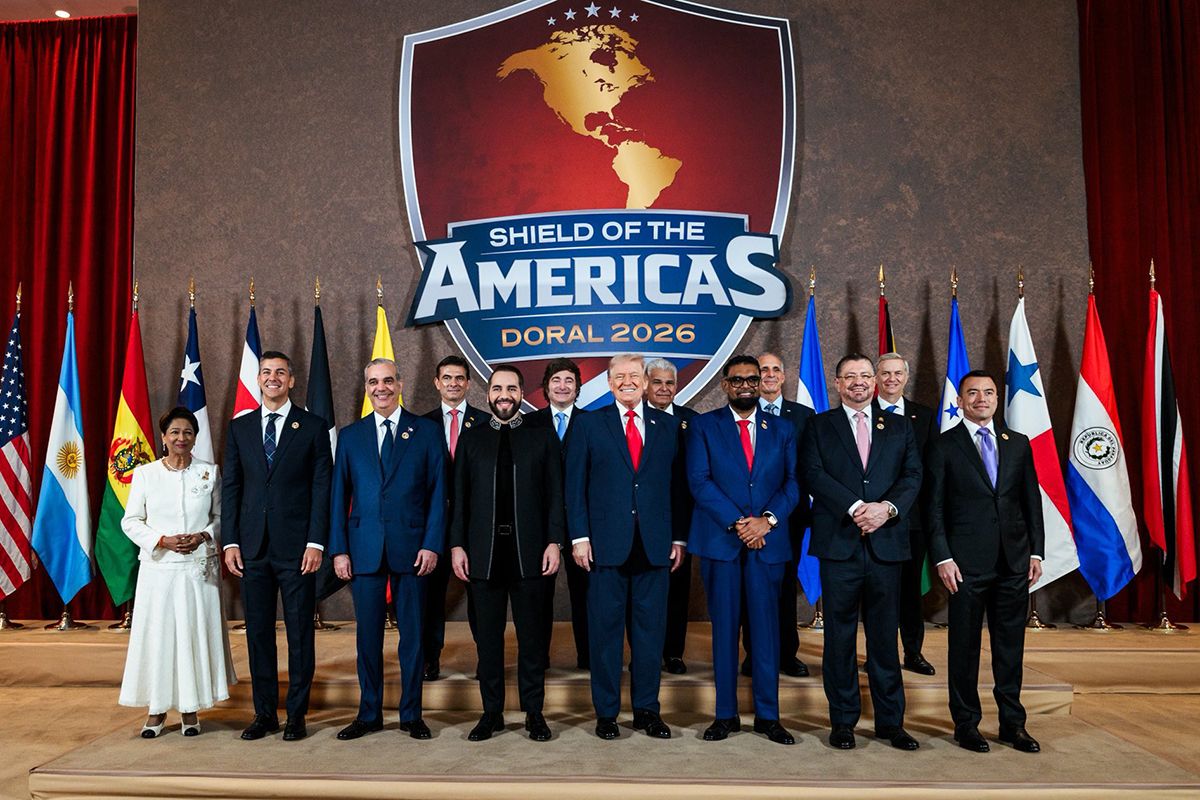
In an unusual combination of informal diplomacy and controversial sense of humor, Donald Trump summarized in one sentence the tenor of his relationship with the dozen Latin American presidents whom he invited to Miami for the launch of the so-called “Shield of the Americas,” a military coalition to eradicate drug cartels and terrorist groups in the Western Hemisphere. “I’m not going to study your damn language because I don’t have time,” the Republican president told them. The statement went viral in seconds, but perhaps the most revealing was the reaction of the right-wing leaders present: far from being offended, they celebrated what the international press described as an insult.
The political gesture serves as an introduction to analyze the meeting held on March 7 at Trump National Doral, a golf and resort complex owned by the American president. International observers pointed out that the event was nothing more than an act of political subordination, in which leaders of the region sympathetic to Washington were limited to receiving unilateral guidelines, posing for an official photograph and receiving a pen as a commemorative gift.
The summit brought together twelve countries – Argentina, Bolivia, Chile, Costa Rica, Dominican Republic, Ecuador, El Salvador, Guyana, Honduras, Panama, Paraguay and Trinidad and Tobago -. The absences, however, speak for themselves: Brazil, Mexico and Colombia were not invited. According to its authorities, the decision responded to the fact that the meeting was not designed to agree on genuine security cooperation, but rather to endorse an ideological alignment with little room for dissent.
The “Shield of the Americas” was presented as a complement to the so-called “National Security Strategy”, implemented from the end of 2025. The initiative was explicitly described as a “Trump corollary to the Monroe Doctrine”, that historic proclamation of 1823 that established the hegemonic claim of “America for the Americans.” Difficult to be more explicit.
In this context, Cuban President Miguel Díaz-Canel described the summit in Florida as “reactionary and neocolonial,” and warned that it committed the attending governments to “accept the lethal use of US military force to resolve internal problems.” He also pointed out that the initiative contravened the Proclamation of Latin America and the Caribbean as a Zone of Peace, constituted a setback in the process of regional autonomy and sought to decouple the region from its structural membership in the Global South.
His Colombian counterpart, Gustavo Petro, adopted a skeptical tone and observed that if the objective of the meeting was to coordinate the regional fight against drug trafficking – as Trump formally announced -, his country “has the greatest experience, since it has built a security coordination with 75 police forces from around the world, including the United States.”
Chinese analyst Wang Youming summarized the meaning of the summit by maintaining that, “presented as a coalition against drug trafficking, it was a meeting of ideologically aligned presidents to reinforce control over what Washington considers its strategic territory, in addition to legitimizing future interventions.”
Recent history supports Wang. In January, Trump ordered military action against Venezuela to arrest, outside of international legal procedures, President Nicolás Maduro on alleged drug trafficking charges. The US president himself later relativized that justification by explaining that his real objective had been to control the flow of Venezuelan oil. “We are slaves to our words,” they warn from Cuba, a country that has been the target of new threats from the US president.
In line with his boss, Secretary of State Marco Rubio also did not use euphemisms during his participation in the Munich Security Conference in February. For Trump’s main collaborator, the new direction of the United States not only constitutes a “reinforcement of the Monroe Doctrine,” but also vindicates that “golden age” of European imperial expansion, a period that contemporary historiography recognizes as a stage of colonial violence and exploitation.
Beyond public statements, international analysts pointed out that the conflict in Iran led Trump to omit references to China during the Miami summit, despite his known intentions to limit relations between the Asian country and Latin America and the Caribbean, a region that Washington considers its priority area of influence. Silence, in this case, was also a message.
China, for its part, did not remain silent. Foreign Minister Wang Yi took advantage of the Two Sessions stage to reiterate Beijing’s position: “The path of the Latin American countries must be chosen by their people, and the choice of friends must be made by the countries themselves. We never get involved in geopolitical plans or ask others to take sides. “Cooperation between China and LAC does not target third parties nor should it be interfered with by third parties.”
The dilemma for Latin America is old but it is raised again between sovereignty or subordination. The twelve governments that attended opted for the latter: in exchange for a protocol instance, they supported a document that transforms the fight against drug trafficking into a framework of action that could facilitate US intervention. The alternative of greater autonomy is emerging from the absences – Brazil, Mexico, Colombia – and from the position of China and other international actors.
Rubio’s speech in Munich evoked the Berlin Conference of 1884, where the European powers outlined the division of Africa without African participation. Decades later, the Florida summit attempted something similar by defining guidelines for the region with the participation only of governments aligned with Washington’s interests.
The “Shield of the Americas” appears designed to preserve US hegemony, exposing the region to potential external interference and political alignment that limits its room for international maneuver. Meanwhile, the contemporary international system is trending towards a multipolar configuration, and emerging countries continue to fight to expand their participation in global decisions.