A journalistic investigation generated a stir in the world: the New York Times claims to have identified Satoshi Nakamoto, the creator of bitcoin. Although the accused quickly came out to deny these accusations, the news spread everywhere and so did curiosity to know more about this man.
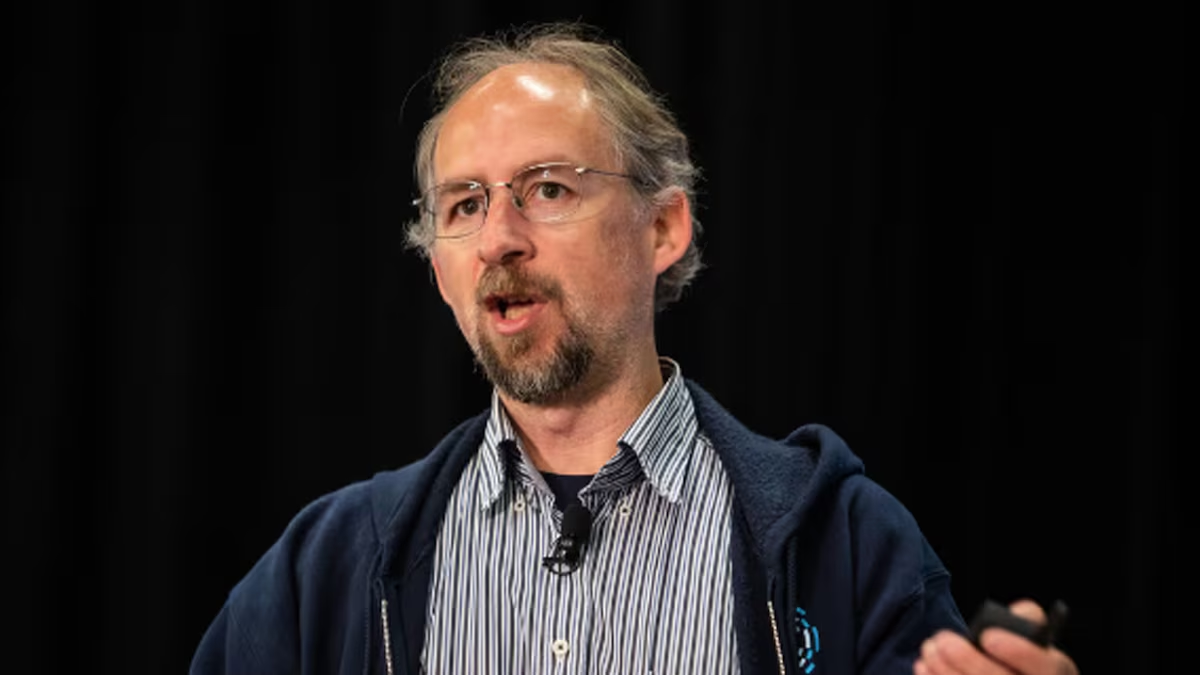
The supposed creator of bitcoin would be Adam Back, a 55-year-old British computer scientistPhD in Computer Science from the University of Exeter, co-founder and CEO of Blockstream and bstrco. In addition, he defines himself as a cryptographer and inventor of Hashcash (bitcoin mining).
As detailed The New York Times, Back was born in London in 1970. He grew up in a family that moved repeatedly, with a businessman father and his mother, who worked as a legal secretary.
His interest in cryptography began in high school, although he learned to program at the age of 11, with a Timex Sinclair computer. This enthusiasm increased during his university years, when a classmate introduced him to PGP, a free encryption program used by antinuclear activists and human rights groups to protect files and emails from government surveillance.
His doctorate was also linked to these issues and even developed ideas closely related to bitcoin: the topic of the thesis was distributed computing systems, a set of independent computers that appear to the user as a single coherent system, but that work between several nodes (readers more familiar with the topic will have identified in this description bitcoin’s operating mechanisms).
His professional career includes a stint in several technology companies, including Microsoft, EMC, VMware and Zero-Knowledge Systems. Besides, It is recognized as cypherpunk, a group formed in the early 1990s and defined by New York Times as anarchists who wanted to use cryptography —the art of securing communications through code— to free individuals from government surveillance and censorship.
He white paper of bitcoin – the founding document that described the operation of this cryptocurrency – was announced in a decentralized cypherpunk forum, which Back joined in the summer of 1995. In addition, Satoshi himself cites in the document one of Back’s main contributions to the crypto ecosystem, the invention of Hashcash“a statistical problem-solving system that Satoshi used for bitcoin mining,” as defined by the New York Times.
Although the investigation by journalists John Carreyrou and Dylan Freedman is not decisivebrings together many historical clues and coincidences (Back was already talking about ideas similar to bitcoin before the publication of the white paper), technical, linguistic (such as repeated writing errors and similar writing styles) and ideological (such as old internet messages, emails and files cypherpunk) that direct all suspicions towards him.
The accused himself responded on networks and pointed out that he is not the person behind the figure of Satoshi Nakamoto. He explained that he was also one of the first to focus intensely on the positive implications of cryptography for society, but indicated that it is a “combination of coincidences and similar phrases from people with similar experiences and interests.” He also added that he does not know Nakamoto’s identity: “I also don’t know who Satoshi is and I think it is good for bitcoin that it is like that, since it helps bitcoin be seen as a new asset class, the mathematically scarce digital commodity.”
X’s conversation refutes one by one several of the arguments that the investigation by journalists John Carreyrou and Dylan Freedman point out. One of them alludes to the fact that the foundations presented speak of the fact that the data collected speaks of a cognitive filter that reinforces previous ideas:
“For your date”I’m not saying I’m good with words, but I did talk a lot on these lists, honestly.», the broader context was my observation that, since I was heavily involved in the list and was known to have an active interest in e-money, there is some confirmation bias as you find my comments frequently on that topic. Due to the volume of my posts, I was more likely to comment than other people with similar interests, but who posted 20 times less. I offered this to John as an explanation of why “It can be considered a form of confirmation bias, which should be corrected statistically,” says Back in X.
It is not the first time that someone has been pointed out as being responsible for bringing Satoshi Nakamoto to life. In 2014 the magazine Newsweek published research in which he stated that Dorian Satoshi Nakamoto (a homonym of the name used to sign that initial document describing how bitcoin worked) was a real person. It was about an engineer who was 64 years old at the time and lived in California, but who assured that the research was erroneous. Another accused was Peter Todd, who also denied being Satoshi. Since then, several people have come out to say that they are indeed Nakamoto, but they were never able to prove it.
The relentless search has to do with discovering who had one of the most important financial ideas of the century, which created an industry that moves fortunes from nothing. And at the same time, he is the owner of one of them: because he is the creator, the person or people behind the cryptocurrency reserved 1.1 million bitcoins in his name, which today represents a fortune of about US$70,000 millionassociated with a wallet that has not had any movements since 2009.