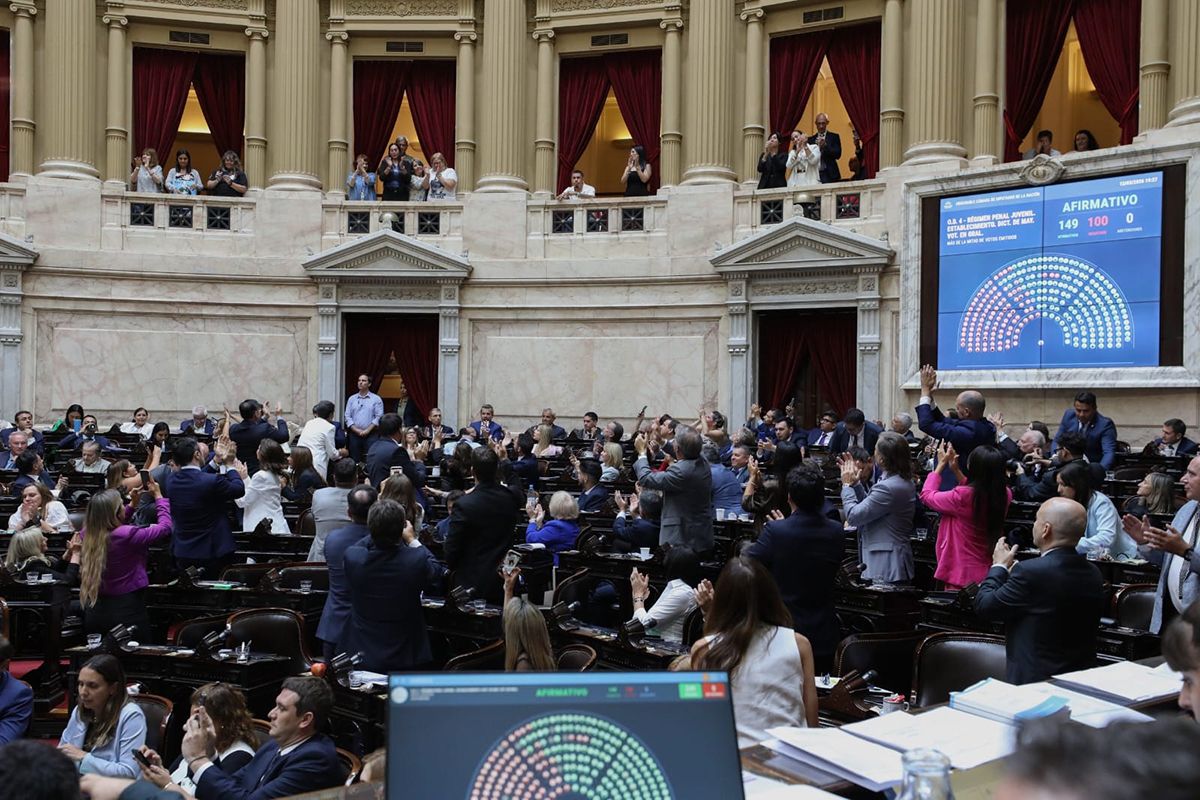
The recent sanction of Law 27,801, which establishes a new Juvenile Criminal Regime and reduces the age of punishment from 16 to 14 years, updates a recurring debate in the Argentine public scene. Indeed, the punishment of adolescent and youth criminal conflict has been one of the most debated and controversial topics since, at least, the beginning of the 20th century. Whether it was because it was considered that the punishment could not be identical to that received by adults, that the sanctions should be corrective and not just expiatory, that the indistinction between adults and young people only meant an accentuation of the “antisocial tendencies” of the latter, or that the confinement of young people is a valid alternative for social defense, the issue of how to punish young people who commit criminal acts and why to do so has given rise to different discussions and conflicting positions that are far from settled. At the same time, the question of at what age it is possible to criminally prosecute adolescents has gained strength every time the issue of security is established as a social problem.
Not coincidentally, since Javier Milei’s government took office, the issue has once again come to the fore and overshadowed other discussions about how to address adolescent socio-penal conflict and the public policies that should be implemented to guarantee rights and test crime prevention strategies. This was not random, because the ways in which a society punishes its young people reveal broader political projects about social order, security and the management of inequalities. Thus, in a scenario marked by a reconfiguration of social sensitivities regarding crime, juvenile justice has become, once again, a strategic terrain for the advancement of punitive policies and for the redefinition of the socially acceptable limits of punishment.
Beyond the clichés
In this framework, the debate around lowering the age of punishment works like a fetish: it concentrates public attention, organizes opposing positions and simplifies the problem, while displacing other discussions. The centrality that this measure acquires—even when there is no evidence to indicate that our country is witnessing a sustained increase in youth participation in crime—contributes to making broader processes linked to the living conditions of adolescents, the forms of state intervention and the inequalities that cross their trajectories invisible.
In fact, a good part of the arguments that have circulated in the debate – both in favor of and against the lowering – were organized around figures and slogans that sought to settle the discussion on the need to lower the age of punishment to 14 years or to maintain it at 16. Thus, on the one hand, from clichés such as “adult crime, adult punishment” or “he who does it pays” narratives were recreated that obstruct reflection and that They carry the force of a uniformizing treatment that does not admit supposed “privileges,” as if the rights and the resignation of the punitive criminal claim towards people who, because they are growing, enjoy extra protection, were such. A treatment that boasts of violence and cruelty while equating 14 or 15 year old children with adults.

On the other hand, one of the main arguments used to oppose this measure by different human rights activists, particularly those linked to children’s rights, has been the conclusive evidence of the very low participation in crimes of adolescents under 16 years of age. Now, even though the first arguments stereotype a population and are fallacious, and the second attempt to dismantle – with verifiable data – the excessiveness of expanding the penal system, the discussion in these terms tends to simplify the problem. This is because attention is shifted from the specific practices through which youth conflict is governed.
The research that we have been developing in the field of juvenile criminal justice shows us that the daily functioning of these institutions cannot be reduced to the dichotomies that structure public debate. In judicial, administrative and territorial practices, heterogeneous interventions are deployed, crossed by tensions between punitive, protective, socio-educational and, in some cases, restorative logics. These experiences show that the responses to youth conflict are multiple and situated, that is, dependent on the social, material and institutional conditions of each territory.
In this sense, the focus on the age of punishment overshadows other central problems and challenges such as the conditions of implementation of the measures, the availability and quality of socio-educational devices, inter-institutional articulations, policies for access to health and mental health, educational inclusion and the ways in which adolescents themselves and their environments are involved in these processes. It is in these areas where, to a large extent, the real scope of public policies and the possibilities of constructing interventions that are not reduced to punishment are played out.
Instead of expanding rights or strengthening these alternatives, the recently approved reform is part of a broader trend of expansion of the penal system as a privileged response to complex social problems. In this way, it not only updates old forms of intervention, but also consolidates a horizon in which punishment appears as an obvious solution, even when its effectiveness has been widely questioned. This reform thus enables the punishment of those adolescents—many times almost children—coming from popular sectors, with interrupted school trajectories, inhabitants of stigmatized neighborhoods and going through persistent processes of social exclusion. Young people whose lives take place in contexts marked by precariousness, stigmatization, territorial segregation and the fragility of many of the institutions that should support their trajectories, care for them, and generate spaces for inclusion. Young people who, instead, grow up through recurring experiences of control, exclusion, police harassment, suspicion and stigmatization. And it is precisely on those lives—and not on others—where, based on the approved reform, criminal intervention will be deployed.
The new punitive turn
Since the end of the 19th century, crimes committed by minors became a major political problem. The moral panics of the early 20th century in Argentina—as in other countries in the region—were directed toward children and young people from popular sectors, seen in advance as future criminals based on their living conditions and the supposed “lack of family guidance.” In this context, legal reforms occupied a central place, and the solution was believed to be found in the construction of a differentiated regime for children who committed crimes, on the basis that their equality with adults would only lead to the production of professional criminals. Today, however, under the cliché of equalization – “adult crime, adult punishment” – an inverse operation is promoted: erasing these differences in the name of a supposed punitive effectiveness. The paradox is evident. Not only are principles that historically justified a specific treatment and that today make up the corpus iuris of human rights, but it is done by ignoring the persistent failure of punitive policies, incapable not only of reducing crime, but also and fundamentally of guaranteeing decent living conditions for children and adolescents.
The current punitive consensus is not deployed on empty ground. It is part of a context of growing legitimization of repressive responses and revaluation of the “iron fist” as a privileged form of intervention against crime. The appeal to forms of criminological populism—that is, to simplified responses that identify in young people from popular sectors the privileged subjects of the broader punishment of the modalities of state intervention in social conflict—not only updates old biases of the penal system, but deepens them. In this sense, lowering the age of punishment is not an isolated measure, but rather part of a reconfiguration
Far from accounting for a retraction of the State, as contemporary neoliberal rhetoric proclaims, these policies demonstrate, in the terms proposed by Guillermo O’Donnell, the persistence and expansion of some of its “faces.” In particular, that more coercive, selective and punitive aspect that the most disadvantaged sectors have historically experienced differentially. Thus, while state devices aimed at social protection, the guarantee of rights and inclusion are retracted or weakened, those interventions focused on control, surveillance and punishment are consolidated and strengthened. The “chainsaw” does not imply a homogeneous reduction of the State but rather operates selectively: it cuts where it involves rights and expands where it involves coercion.
In this scenario, it becomes particularly relevant to sustain and deepen the work at the margins of the State, in municipal devices and programs, in social and territorial organizations. It is in these spaces – often made invisible – where it is still possible to dispute meanings, temper the most harmful effects of these policies.
From our ethnographic work in these areas we have known many of those spaces and agents dedicated to the management of adolescent crime, as well as these young people and their families. In this way we were able to document the tensions, dilemmas and strategies they try to implement. This is why we believe that, in a context of increasing legitimation of punitive responses, producing situated knowledge about these local dynamics is essential. Not only to discuss the assumptions that structure the public debate, but also to make visible the complexities of the field of juvenile criminal justice and contribute to the construction of institutional interventions that recognize adolescents as subjects of rights, instead of reducing them to objects of control and punishment.
*This note is part of an agreement between Tiempo and the Institute of Anthropological Sciences of the UBA. It is also published in the Diarios de Campo outreach project..
**The authors are part of the Team Bureaucracies, rights, kinship and childhood from the Political and Legal Anthropology Program of the Institute of Anthropological Sciences of the UBA.