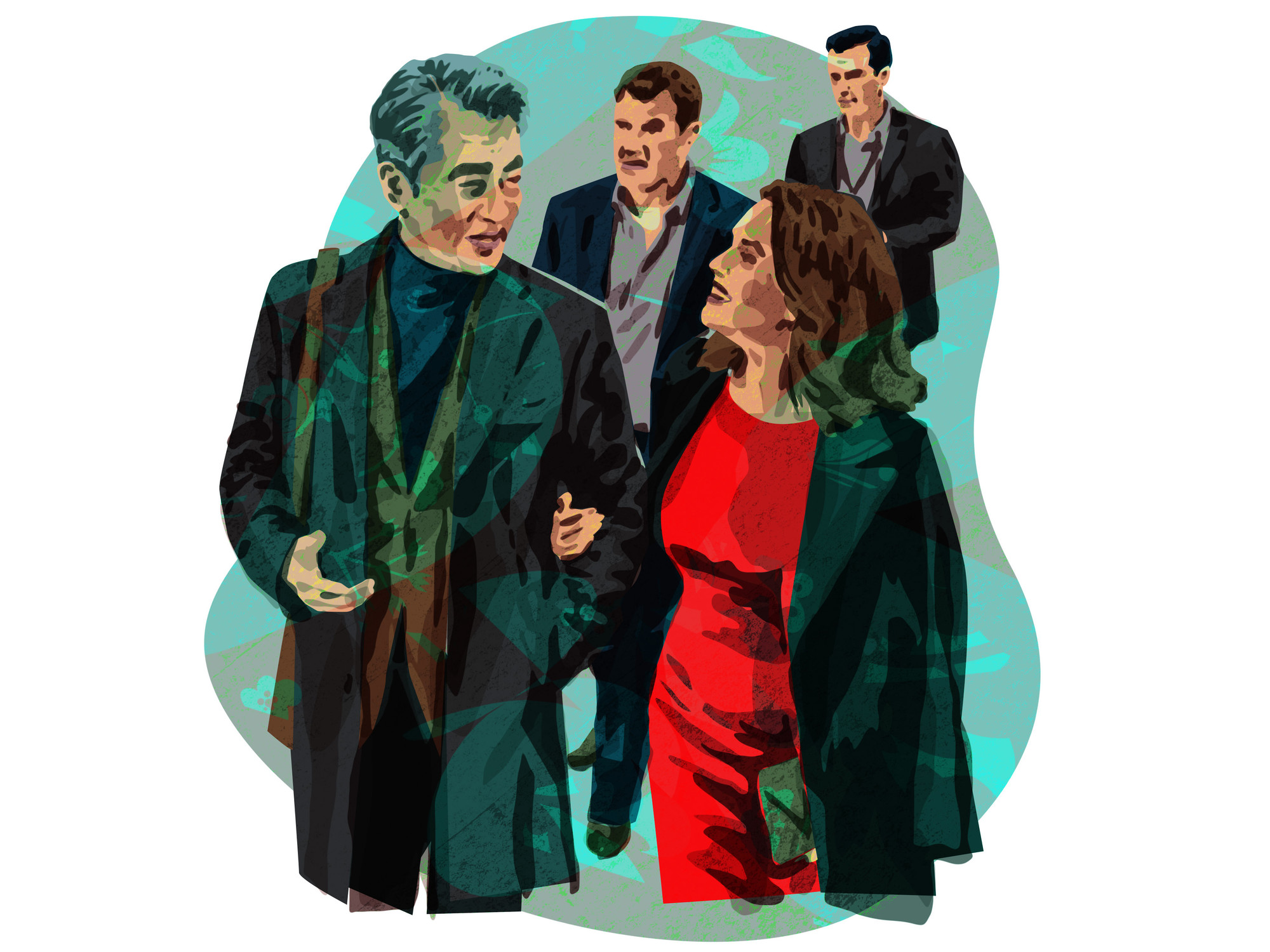
Professor Luceno knew that he had the upper hand in the debate that morning, in the Salón del Arbol, at the Universidad del Ande. They brought together professors of Political Science, History and Sociology, with many other academics, essayists and interested parties. A bunch of journalists covered the event.
Even in North America it would have cost Luceno his position dearly. Much more so in that remote University of that lost province of a South American country. The landscape was wonderful and Luceno appreciated it. But if their colleagues, in a metaphor, were part of the environment, they would be considered hostile rubble, risky reliefs, dangerous fauna. It happened in almost all the study houses in the field.
For Luceno, Nixon had been an outstanding North American president. And Watergate, a not so serious crime, for which he had paid a disproportionate price. According to Luceno, Nixon had reasonably withdrawn most of the American troops from Vietnam, without escalating the war or causing a defeat; even signing a peace agreement with the communists in Hanoi, fragile but maneuverable.
He had defused the strangled rivalry with the Soviets – always on the verge of nuclear tragedy -, without giving up the defense of the interests of liberal democracies. And he had resumed relations with Mao’s China – in the abyss since the 1949 revolution -, generating in turn, from this bold and unforeseen movement, an alchemy of peace between Russians, Chinese and Americans; again, without lowering our arms in defense of the expansion of democracy, gradual, at times imperceptible, but constant and consistent. Indeed, Nixon had planted one of the foundation stones of triumph in the Cold War.
In addition, he had launched the first manned expedition to the Moon, including a moon landing. In contrast to those achievements, the break-in of a group of spies into the Democratic headquarters of Watergate, in an illegal event that had left no victims or major damage, did not qualify as a mortal sin that merited the first resignation of the White House in its entire history.
Kennedy had undoubtedly committed even worse transgressions, but with much greater consideration from the American establishment. There were not two journalists during JFK’s tenure who had followed any of his defections with sufficient rigor. Watergate was a tragedy, not because of the event itself, but because of what it had cost. There was no way to defend Nixon against that accusation, but common sense claimed that the punishment had been senseless.
A few years after his resignation, no more than five years later, Nixon returned to the fray as a thinker, writer and advisor. His geopolitical outlook continued as lucid as when he was in power, now with the advantage of the calm observation that the plain allows.
Nixon continued to share ideas from his home, which from the White House pacified the world during his mandate, and from his own home provided discreet but consistent directions for a generation in a perpetual state of bewilderment, like everyone else. That was broadly speaking Professor Luceno’s position for the imminent debate on the five-year period 1970/1975 in the USA, coinciding with the new space visit to the Moon that the Americans had launched. Those involved went to the Tree Hall of the Universidad del Ande.
But Professor Luceno would not have imagined that, as part of the delegation of exponents, Clarisa, his ex-wife, would be present. The young woman – she still was, she must not have been over forty – arrived in the company of Lin Fua, the Chinese philosopher, exiled in California since the mid-90s, but with a slight halo of provocative sympathy for Maoism, in the manner of Zizek for classical communism.
The Chinese man must have been well past 60, but he seemed much more alive than Luceno. That body had been amply worked out in the gym, with the free time that fame, anabolics, and the money that the sale of his books brought him… (and something that he had apparently also stolen from his hometown in China, of which Luceno did not remember the name).
How had they met Clarisa? Luceno did not know it, but she had left him for the philosopher. Luceno had read somewhere that Lin Fua was from Manchuria, but he couldn’t remember the name.
Manchurian? Manches? The only time I had heard about it was the title of the movie The Manchurian Manabout an American presidential candidate who was actually an agent of the Chinese, who had been previously brainwashed. At that time, the “brainwashing” that the Chinese could carry out, through techniques such as “the drop that pierces the forehead,” was much more feared than the Russians in that area. Full cold war.
Nixon had been one of the preeminent thinkers who had managed to dissect the anti-communist hysteria from the real danger that specific communists, led by Moscow or Beijing, actually represented for the free world. The opposite extreme was Senator McCarthy.
“Manchu,” Luceno’s memory finally shouted, as he saw the oriental philosopher enter after Clarice, as if she were his assistant, preparing the ground for his elegant walk. Although Clarisa knew from checking the program when she saw it, she was also announced as a participant.
One of the speakers who would surely take aim at Luceno was the Russian Putinist professor/historian, Mario Piokopov.
Luceno could not imagine the reason for the specialist’s prosaic name in Spanish. It was as if Lenin had been called Pepe. Finally, Mario Piokopov asserted that September 11, 2001, the demolition of the twin towers by Al Qaeda, had been a concerted operation between Bin Laden and the Americans since the USSR invaded Afghanistan in 1979. The mere fact that they allowed such an orate to participate in an academic debate was to Luceno proof of the decline of the epistemology of the social sciences in the 21st century.
The professors, academics, historians and essayists were spread out along an oval table, made of some polished wood or Formica, surrounded by a circle of seats, most of which were occupied by journalists, advisors and the specialized public. An unknown bird squawked in the distance, from the imposing silence of the snowy peaks.
The first exclamation, like a muffled sneeze, came from one of the seats. Then, one of the members of the oval table looked at their cell phone with apprehension. Gradually, as if it were one of those great nonsense from a streaming series, all attendees shared a piece of news that was spread through different media: Chinese philosopher Lin Fua was accused of having plagiarized his most successful book, Plato’s Parable. Apparently, he had stolen it from Renzo Grafo, the no less relevant Italian philosopher, who had left a letter describing the intellectual crime post mortem. Clarisa, Grafo’s secret partner, prior to her courtship with the Manchu, had been Lin Fua’s accomplice in the embezzlement. Grafo had just died, it was not known if he was poisoned or from an incurable disease.
This story will conclude next week.