When Mercado Libre presented its results for the fourth quarter of 2025, the data that stood out in the communications was credit quality. Your non-performing loan or NPL ratio (non performing loans) from 15 to 90 days reached a historical minimum of 4.4%, reflecting a portfolio that grew 90% year-on-year to US$12.5 billion.
The metric was praised by analysts as evidence that aggressive growth in loans was not accompanied by a deterioration in borrower selection. But that figure is regional and consolidates Brazil, Mexico, Chile and Argentina into a single number. The problem is that in our country it has its own data set and they tell a different story.
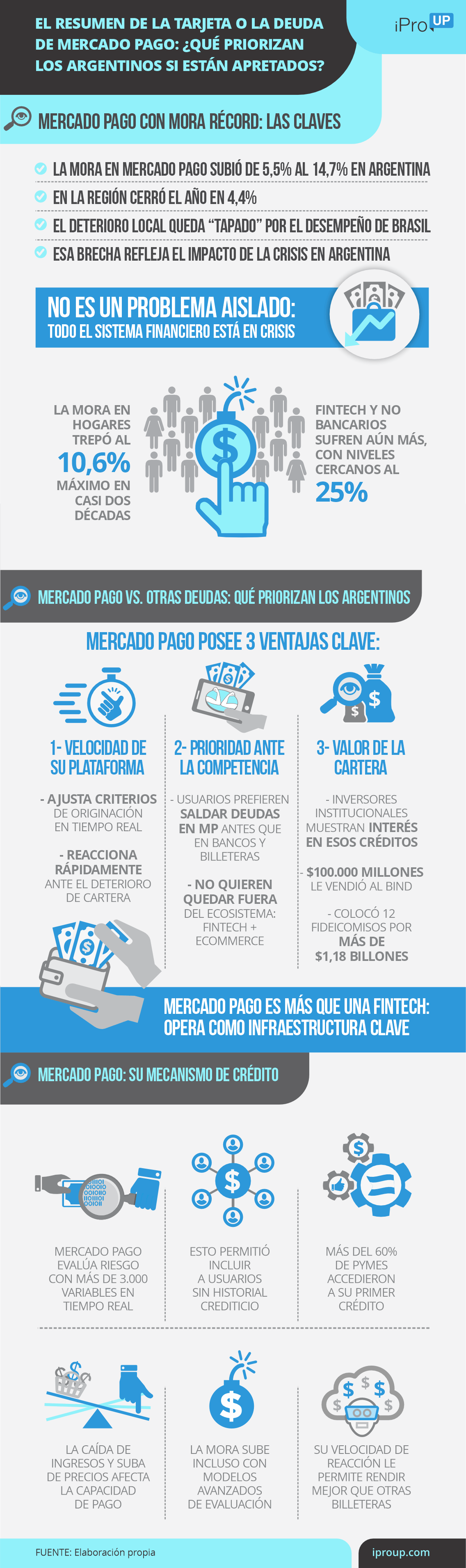
According to the Debtors Center (CENDEU) of the Central Bank, The Mercado Pago irregularity ratio in the country rose from 5.5% in January 2025 to 14.7% in January 2026. In twelve months, it almost tripled.
The global 15-90 NPL of 4.4% (which includes the healthy Brazilian market where the first installment default rate hit historic lows) acts as a counterweight that softens the local deterioration. The gap between both figures is not an accounting error, it is the imprint of the Argentine crisis on the portfolio of the largest fintech on the continent.
A system that collapsed, not an exception
To understand the situation of Mercado Pago in Argentina you have to look inside the system. The latest Report on Banks from the BCRA showed that larrears on loans to households went from 2.67% to 10.6% in just one year, the highest level in almost twenty years. The personal loan segment marked 13%; bank credit cards, 11%.
Non-banking entities and digital wallets suffered even more. Delinquency in that segment approached 25%. Orange Card closed 2025 with an irregularity of 35.7%, Cencosud reached 25.5% and Credicuotas reached 25.4%. Ualá, despite reports that spoke of between 40 and 60%alerting the entire system, claims to be around 17%.
The keys to late payment in Mercado Pago
Mercado Pago, with 14.7%, was in an intermediate step above digital banks such as Banco del Sol (6.2%) or Banco Columbia (7.4%), but significantly below the average for non-bank credit.
The company itself recognized the deterioration but framed it in the general trend. According to their spokespersons, the ratio is comparable to that of private banking, “even when we include segments that the traditional system usually considers higher risk.” The argument has statistical support, since The problem is not Mercado Pago, it is Argentina.
The scoring model and its real limits
Mercado Pago built its lending business on a structural advantage: access to behavioral data that traditional banks don’t have. The platform explains that its risk assessment model analyzes more than 3,000 variables and is updated in real timeincorporating transactional information from the ecosystem that allows you to qualify users without prior banking history.
“That capacity for origination is real and allowed More than 60% of SMEs and entrepreneurs that operate in the ecosystem have their first access to credit in Mercado Pago“says consumer expert Gabriel Meloni.
For the economist Sergio Del Fabro, “The problem is that no scoring model predicts a recession with inflation that simultaneously hits incomes and prices.” When families’ payment capacity contracts systemically, the 3,000 variables are not enough and, therefore, defaults rise anyway.
Here is Mercado Pago’s first advantage against its rivals: the speed of reaction. Unlike a bank, which takes weeks to adjust criteria, MP can modify parameters in real time. “This explains why its default, even having almost tripled, remains below the average of the non-banking sector.“justifies Del Fabro.
The fear of being left out of the ecosystem
An increasingly documented hypothesis emerges among analysts: Many users prioritize paying their obligations with Mercado Pago over those of the bank.
For Gabriel Meloni, the reason is elementary. “Mercado Pago allows you to send and receive money, pay for services and manage your digital balance from a single applicationwithout depending on a traditional bank”.
Added to this is the SUBE recharge, the payment of utility bills, purchases in Mercado Libre and immediate transfers. “It has become common for someone to collect their salary in a bank account and transfer a large part of that money to their virtual wallet, in which they obtain daily returns and operate everything from their cell phone,” recalls Del Fabro.
This level of integration generates an asymmetry of consequences. If someone stops paying a bank credit card, they lose access to that plastic. If you stop paying a debt with MP and the platform blocks your account, you will not be able to create a user on the platform again.: Loses access to financial and commercial infrastructure.
This is its second difference advantage: The cost of this exclusion is, for millions of Argentines, much greater than that of being left in a bad position with a bank.. A kind of FOMO (fear of being left out) of their ecosystem.
This dynamic could be operating as an informal reverse adverse selection mechanism. That is, the clients most integrated into the ecosystem are also the most motivated not to default, not out of financial discipline but out of fear of digital exclusion. Thus, part of its “better performance” relative to the average has a behavioral explanation that does not appear in any balance sheet.
The double mirror: regional vs. local
The data on regional defaults, three times lower than the figures in Argentina, are not contradictory: they are two sides of the same business operating in different contexts:
- Brazil is the company’s largest market and acts as a quality anchor. The Mercado Pago credit card already registers more than 50% of its payment volume outside the marketplace, a sign of maturity and real penetration
- In Argentina it is still the place where the wallet grew the fastestincorporated the most vulnerable segments and faces more macroeconomic volatility
To sustain the quality of the local portfolio, the company bet on the capital market. During 2025, it placed 12 financial trusts for more than $1.18 trillion and closed with BIND the first portfolio sale program in the country for more than $150,000 million.
This is its third difference: institutional investors have an interest in acquiring that portfoliowhich works as a price signal. Someone external, with access to the data, decided that it is worth betting on.
Mercado Pago’s 15 points of local arrears are not the problem of a company, but rather the thermometer of a system in which families reached the limit of their capacity. The difference with the rest of the fintech companies is not explained only by the scoring: MP stopped being a wallet and became infrastructure. AND Nobody wants to be left out of it.