Every year, cancer claims 10 million lives. According to data from the American Cancer Society, worldwide, there are 19 million people with a diagnosis of this type. In the midst of this reality, more and more people are asking themselves a question: how could access to cancer treatments be improved and thus reduce mortality from these conditions? And, as in so many other areas, artificial intelligence is also present here.
For some time now, digital twins have been incorporated into the world of health: virtual models of physical objects, which allow systems to be accurately reflected and their performance monitored in different situations. According to the IBM company, A digital twin can run any number of simulations useful for studying multiple processes. This covers a wide variety of industries and, in fact, NASA pioneered this area, in the 1960s, during its exploration missions “when each traveling spacecraft was exactly replicated in a terrestrial version, which NASA personnel who were part of the flight crews used for study and simulation purposes.”
“Digital twins represent a very significant evolution in the way clinical trials are designed and developed. Through computational models that integrate biological, clinical and population data, Today it is possible to reduce uncertainty by simulating therapeutic scenarios with an increasingly higher level of precision.“explains Carolina Sian, director of Regulatory Affairs of the Argentine Chamber of Medicinal Specialties (CAEMe), made up of the leading global pharmaceutical companies that research, develop and market medicines in the country. She details that this allows protocols to be optimized, reduce unnecessary instances and better focus studies on patients who can really benefit, shortening the time for treatments to reach the patient when they need them.
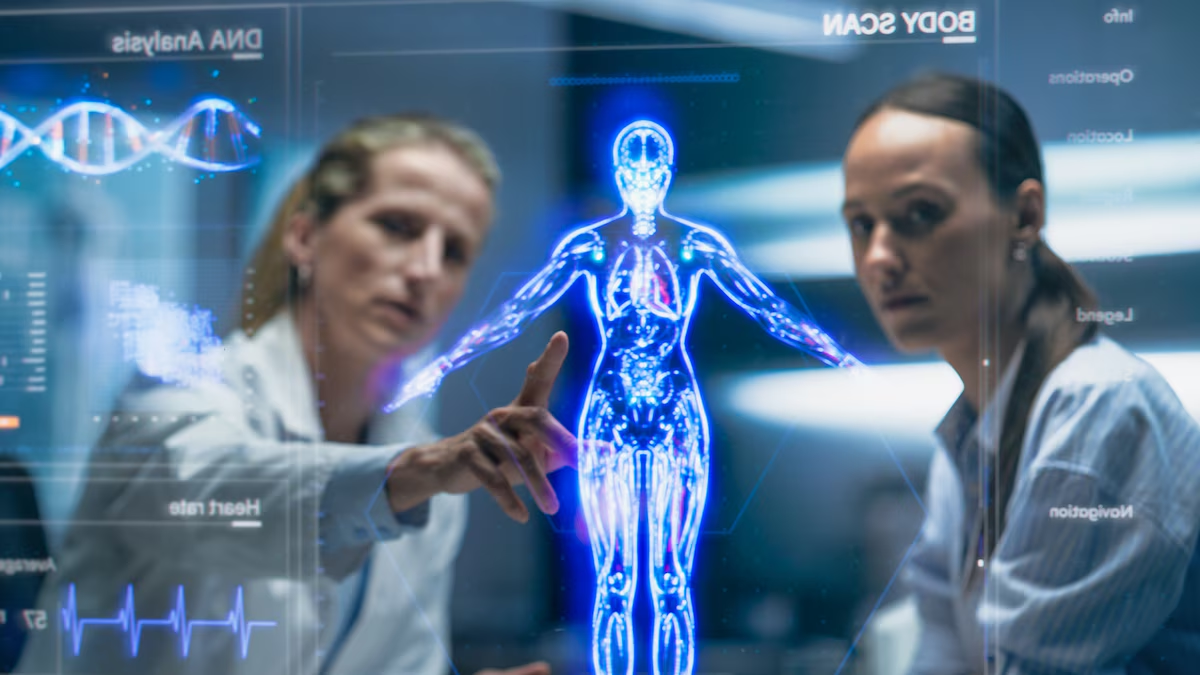
But it would seem that a new turning point appears in this area, since, when this technology intersects with artificial intelligence, it begins to play in another league within health. “Digital twins that incorporate artificial intelligence make it possible not only to plan a treatment, but, with the support of AI, possible findings can be automatically identified. that are found in the anatomical region, such as a lung nodule or a lesion in the prostate, which could be an indication of cancer,” explains Mario Amadio, director of Siemens Healthineers Argentina.
The firm where Amadio works – a global provider of equipment, solutions and services for the health sector, with a presence in more than 180 countries and with more than 120 years of experience – proposes a new solution, combined with AI. The bet is to create a digital clone capable of predicting the behavior of a real organism by testing oncological treatments before applying them to the patient. AI would intervene by allowing the modeling of a digital clone, also called a mathematical and biological “avatar”, of the person, which functions as a secure testing environment.
In a context in which oncological treatments are usually aggressive and highly invasive, having the possibility of subjecting a clone to hundreds of computer simulations, analyzing which path has the greatest probability of success, before advancing with the treatment, represents an important step in medicine. In addition, the initiative seeks to reduce operational costs, optimizing the resources available to clinics and hospitals.
It is also an alternative with greater diagnostic and treatment precision and, therefore, with shorter times. “For prostate cancer patients, for example, AI-guided diagnoses can be made in seconds and validated by an expert,” explains Amadio. And he adds another case: Artificial intelligence algorithms make it possible to find lung nodules with a precision similar to that of an expert radiologist, approaching 93% sensitivity, but significantly reducing interpretation times by 30%.
Digital twins already exist in Argentina and are applied in different areas of health, such as cancers that are more difficult to treat and also those that have a greater prevalence in the population, such as breast cancer, lung cancer, prostate cancer, brain and bone cancer, lymph nodes, among others.
The technological solution that the company proposes today integrates several axes: on the one hand, includes automatic image interpretation with AI. In other words, before the radiologist analyzes the image, an artificial intelligence assistant analyzes the scans, highlighting nodules or millimeter lesions that could go unnoticed, saving critical diagnostic hours.
Second, the solution includes “breathing” radiation therapy. In other words, it is a technology that seeks ensure that radiation hits only cancer cells and does not damage surrounding organs. Amadio explains that, to achieve this, a complete CT scan of the body is performed and the contours of all the organs that may be at risk at the time of radiotherapy are segmented. “Normally this process is done manually, however, With the advancement of AI, times are reduced to seconds, increasing the precision of the result”, explains the expert.
Finally, they propose the use of operating rooms with augmented reality, where surgeons interact with the digital twin superimposed on the patient. How does this benefit them? “It speeds up the surgery because reduces the “shift of focus” between the operating field and the monitors, improves spatial orientationl to locate structures and follow more precise trajectories, helps avoid risk areas and optimizes the use of intraoperative imaging. In addition, it facilitates team coordination by sharing a common visual reference, and can support remote training and collaboration when the environment allows it,” says Amadio.
Currently, Siemens explains that the cost of artificial intelligence still has a very high barrier to entry, like any technology that is being implemented recently. “In the future we hope that AI and digital twins will be a standard solution in the industry, so the cost should not be higher than the current operating prices in clinics and hospitals, added to the reduction in time that the use of these technologies allows,” concludes Amadio.
On the other hand, there are already digital twin solutions that seek to lower the costs of energy provision. The Schneider Electric company works with digital twins that help them make better energy, operational and business decisions in real time. “Digital twins mark a game-changer in how organizations manage their energy and operations. In a context where artificial intelligence accelerates energy demand, having a digital replica of our infrastructure allows us to design more efficient, resilient and sustainable systems from the first moment. In short, it is transforming energy into actionable intelligence,” indicates Noelia Miranda, director of Secure Power for Argentina, Paraguay and Uruguay at Schneider Electric.
One of the most recent and strategic developments is the digital twin applied to “artificial intelligence factories”, where the company works together with ETAP and NVIDIA. In this case, the digital twin comprehensively replicates the infrastructure of an AI data center, integrating electrical, thermal, network and mechanical systems into a single environment. This allows these centers to be designed before construction, optimize energy consumption – a critical challenge in the face of growing processing demand – and anticipate failures or load peaks. “The impact is direct: it improves the efficiency, reliability and sustainability of infrastructures that today are the heart of the digital economy,” the company explains to LA NACION.
It is worth clarifying that they are not the only ones who have integrated artificial intelligence into health; Sanofi, a pharmaceutical company, is promoting the use of digital twins to transform drug development. By creating virtual models that replicate organs, patients and entire populations, they simulate the behavior of drugs and anticipate the progression of diseases in multiple therapeutic areas, also integrating AI. Additionally, they use advanced data analysis engines to identify therapeutic targets and define which patient populations could benefit most from each treatment, thus optimizing both study design and the likelihood of clinical success.
Emma Venezian, director of the Sanofi Southern Cone Clinical Studies Unit, summarizes the impact of these technologies: “The use of digital twins is already showing concrete results: Sanofi managed to accurately predict clinical outcomes in asthma studies and accelerate developments in oncology, immunology and rare diseasesreducing the need for extensive studies in limited populations.”