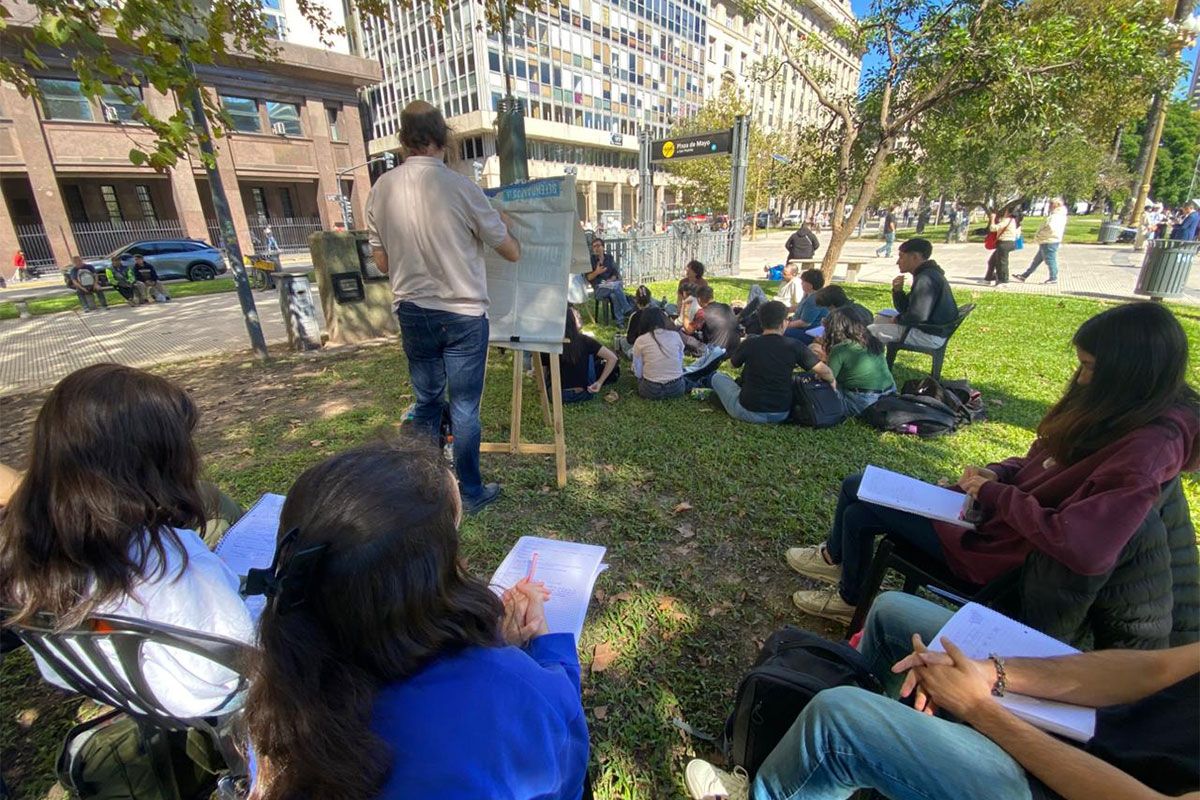
Pilar Fiuza’s eyes light up when she says that she is a daughter of the public university, but that light becomes opaque when she looks at the silent building of the Casa Rosada. Doctor in Social Sciences and professor of the Sociology program at the UBA, Pilar prepares in front of a portable blackboard a few steps from the May Pyramid to teach History of Sociological Knowledge II. He earns a pittance paid by a miserable government: a first-class assistant receives only $228,095 out of pocket, a mockery in a country where prices (like ministers) travel by private jet and salaries go by cart. While arranging her notes on the Protestant ethic and the spirit of capitalism, Pilar summarizes the suffocation of an era: “Just stepping on campus changes your life, but today they push us toward a mercantilist and elitist education. It’s terrifying.”
Under the pearly sky on Friday that seems to ignore the violence of the adjustment, the Plaza de Mayo is transformed into a gigantic open-air study center. It is the university of the street giving lectures; a response of knowledge and books to the systematic non-compliance with educational financing by an obscurantist and denialist Executive. The conflict, which already ran through the judicial spine until the Federal Administrative Litigation Chamber reminded the president that he cannot ignore a law of Congress, exploded in the political agora of Argentina to denounce that the future is dead.
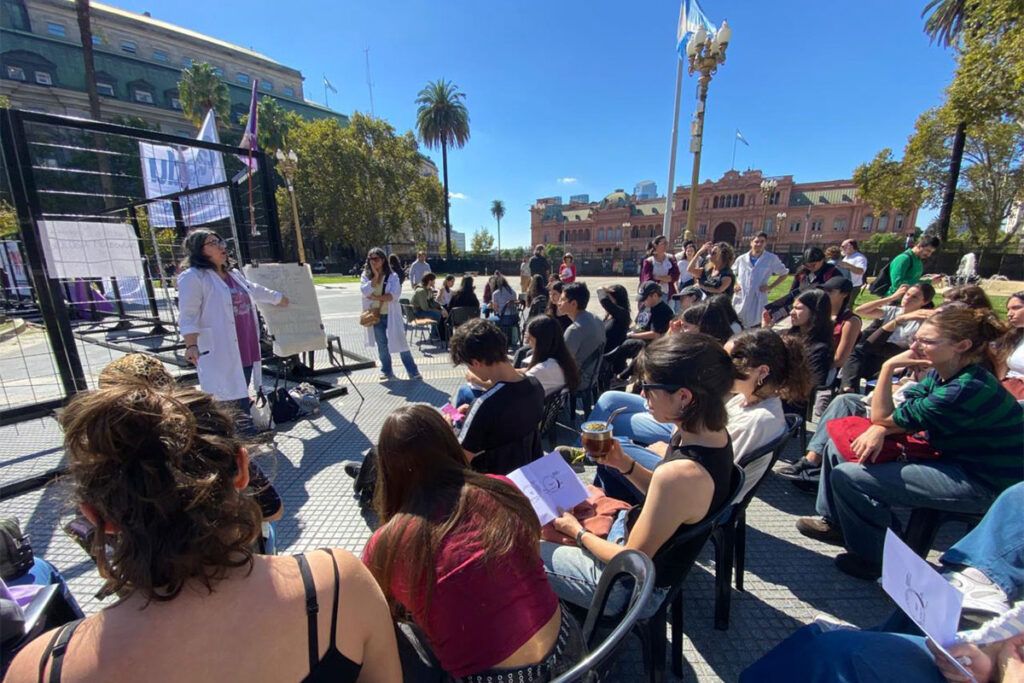
Photo: Nicolás G. Recoaro
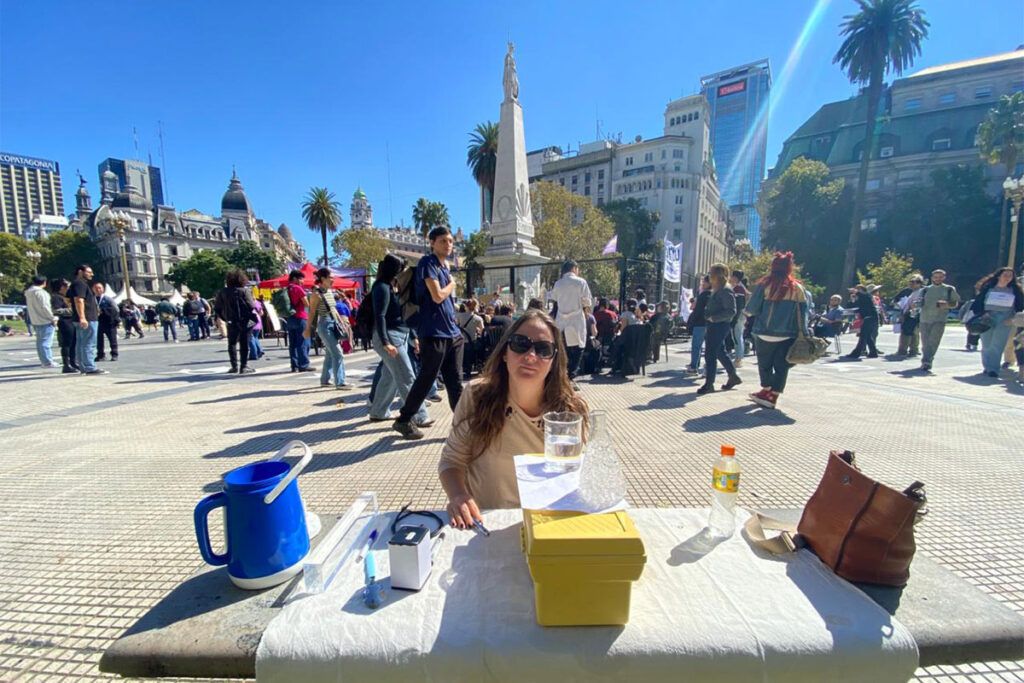
Photo: Nicolás G. Recoaro
A few meters from the sociologist, Laura Estrada unfolds a toolbox. She is a professor at the Physics Department at Exactas and the mother of a student at the Nacional de Buenos Aires. Dictates Electromagnetism and Waves. He brought lenses, lasers and fiber optic cables to talk about the qualities of light, an involuntary metaphor in this present of shadows. She is one of the many scientists who opted for the country: she returned in 2013 from California under the repatriation policies. Roots. “I felt like I had to give back what the public university gave me,” he says in a voice that mixes nostalgia with anger. “Today they expel us again. The scientific career requires investment and long term; the Government wants immediate business.” And he denounces the brain drain that is already felt in the laboratories.
Pablo Perazzi, anthropologist and general secretary of the Feduba union, walks between the blackboards with the air of someone who knows the deep structures of the conflict: “We are out in the open where Milei pushes us.” For Perazzi, the geography of the protest is not random: it is the political heart challenging a government that talks about “complying with the law” but ignores the University Financing rule in force 171 days ago: “Civic Education and Ethics should appeal.” Before the Plaza de Mayo, a group of teachers and students had tried to give classes in front of the apartment (surrounded by security) of the weak Chief of Staff Manuel Adorni, to whom properties and trips appear as a divine gift. But faith does not enter the university, reason and data enter. Perazzi points out that the salary gap is already equivalent to 50% of income in the last semester. It is an anthropology of lack, where knowledge workers are pushed below the poverty line.
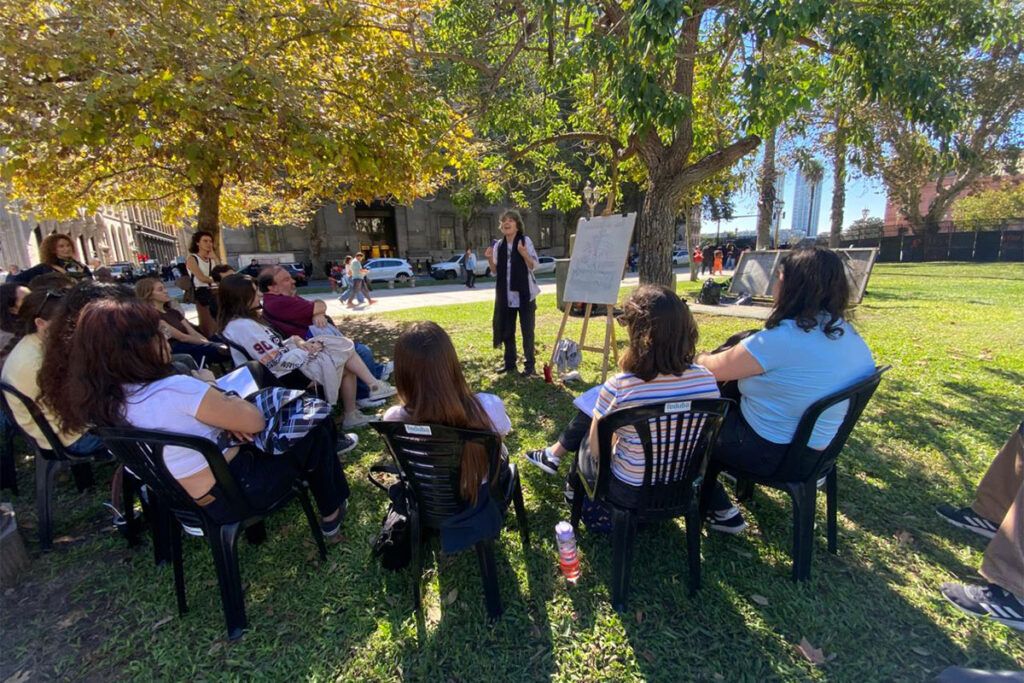
Photo: Nicolás G. Recoaro
Elián Zamora studies Philosophy in Puan: “I would tell the Minister of Economy to read Machiavelli better – the kid says -. They talk about The Prince as if it were a social media post, an empty ‘the end justifies the means’.” Elián wonders what Kant or Rousseau would say about this bastardization of the concept of freedom. But his anguish is more material than metaphysical: he receives a Progresar scholarship of just $35,000. “I can’t even afford the notes. I had to buy Hobbes’ Leviathan and it cost me 40 lucas. It doesn’t even cover a book.”
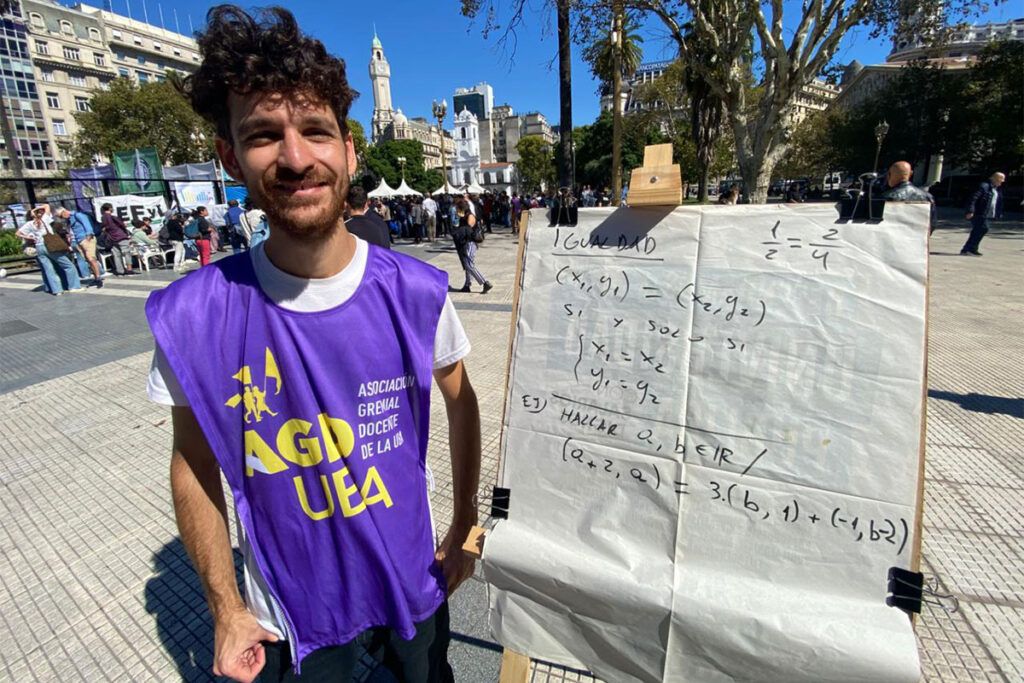
In front of the fence that guards the Casa Rosada, Florencia Fernández writes on her blackboard: “Advanced analysis.” She is an Exactas mathematician and head of practical work. On his chest hangs a sign that is a desperate cry: “De remate.” Below, he details his salary: 235 thousand pesos. “Since last year I had to add a thousand hours in private. I work 12 hours a day and I get home after dinner. I don’t see my children,” he laments. And he notes about the numbers: “Milei forgets that the graphs he shows are people.” Florencia begins her class on set theory. A few meters away, the fire trucks and the blue uniform of the Federals create a violent frame. The policemen look at the mathematical diagrams and functions strangely.
There is also a master class by Alberto Kornblihtt. The molecular biologist remembers Sarmiento and the Mothers of Plaza de Mayo. 60 years after The night of the long sticksthe asphalt is once again the refuge of intelligence against the budgetary sword. A student holds up a hand-painted sign: “The public university teaches, resists and dreams.”
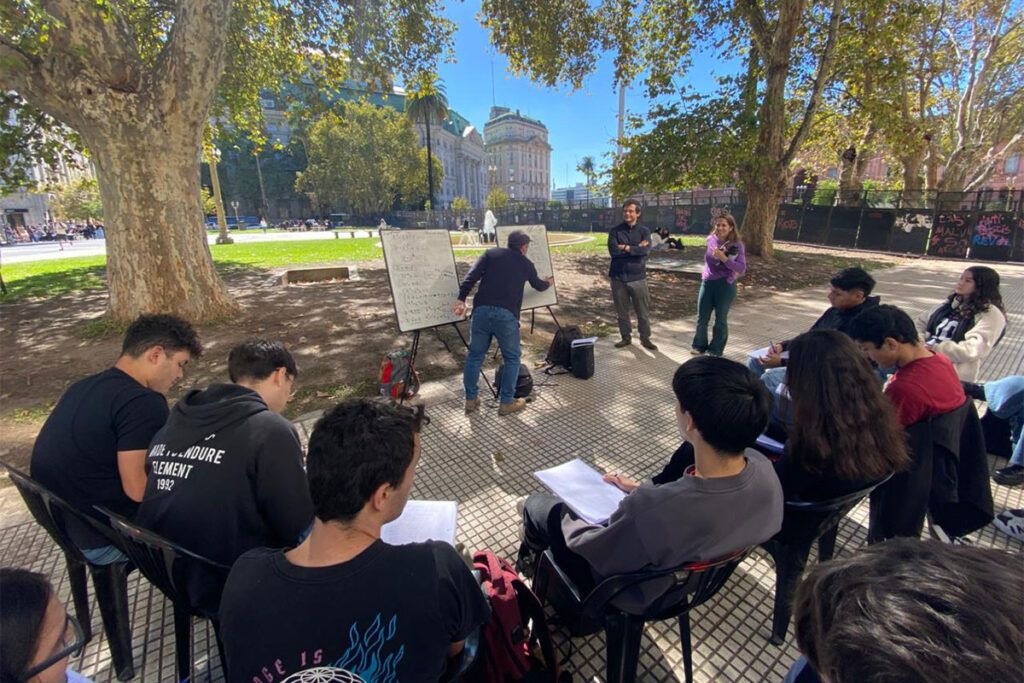
Photo: Nicolás G. Recoaro