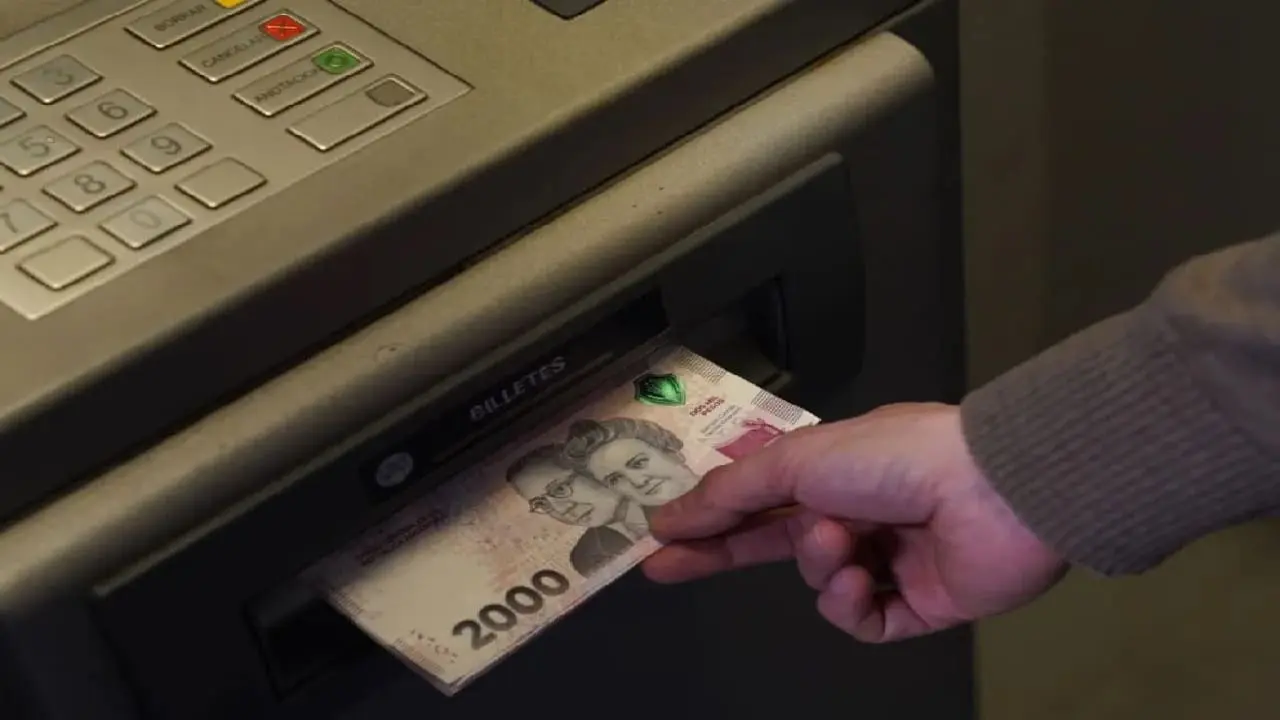
ATMs remain a key tool for millions of Argentines who need cash. Despite the advance of virtual wallets, banking terminals maintain their prominence.
Financial institutions established new daily withdrawal limits. The limits vary according to each bankaccount type and customer history.
These ATMs operate 24 hours a day, every day of the year. They operate even during national holidays and bank strike days.
The advantage is clear: they allow you to withdraw money without waiting in lines at branches. And with complete security, as guaranteed by the entities.
How much cash can be withdrawn from an ATM according to each bank
Each financial institution sets its own maximum daily withdrawal limits, which can be increased depending on the user’s credit profile and the type of account they have. The updated limits are:
He Nation Bank allows you to withdraw up to $1,000,000 daily at its own ATMs.
In it Province Bankthose who use a DNI Account have a daily limit of $400,000. With a debit card, the limit is $170,000 per operation and can reach a maximum of $800,000 per day, depending on the client’s configuration.
He City Bank sets a maximum of $800,000 per day, expandable up to $1,200,000 through home banking. However, this limit applies only to our own ATMs; In other entities or in the Banelco network, the limit drops to $60,000 per day.
In it Galicia Bankcustomers can withdraw up to $4,400,000 per day combining ATMs and self-service terminals. With a debit card, the maximum is $4,000,000 in self-service and $400,000 in own ATMs. It also allows cardless withdrawals of up to $1,000,000 via QR, and up to $250,000 with a code from the app or home banking. At ATMs in other networks, the limit is $60,000 per day.
He ICBC establishes a limit of between $600,000 and $800,000 per day at ATMs in the Banelco network, depending on the type of card. At ATMs of other entities or in the Link network, the maximum is $60,000 per day. In participating businesses, you can withdraw up to $170,000.
He Macro Bank allows you to withdraw up to $1,000,000 daily. In operations without a card, the limit is $300,000 at its own ATMs, with orders of up to $60,000 each. At ATMs of other entities, the limit is $60,000. It also enables withdrawals of up to $170,000 in stores.
In it BBVA, The daily limit is $2,000,000, combining $800,000 at ATMs and up to $1,200,000 without a card through biometric validation. These amounts can be modified from the app or online banking.
Lastly, the Santander Bank sets a maximum of $900,000 per day for standard accounts, which rises to $1,700,000 in Platinum or Black accounts and up to $3,600,000 for SME clients. Cardless withdrawals have a limit of $300,000, which can be temporarily expanded from digital channels.
In all cases, the limits can be adjusted according to the client’s profile and the configurations that each bank allows from its digital platforms.
These limits seek to balance user convenience with banking security measures and cash availability at the terminals.
What about virtual wallets and ARCA controls
Virtual wallets have established themselves as a digital alternative to cash. According to the National Fintech Monitor, more than 96% of those over 18 years of age use them.
In the case of Payment Marketcan be removed up to $170,000 by operation in participating businesses. At ATMs in the Link network, the limit is $50,000 per withdrawal, while in the Banelco network it amounts to $60,000 per operation.
The national government implemented new measures within the framework of the “Historical Savings Reparation Plan” and the “Fiscal Innocence Law.” ARCA now receives information about movements that exceed certain amounts.
When the established limits are exceeded, the tax agency may request justification of funds to validate the origin of the money.
Valid documents to justify before ARCA include:
- Pay stubs or salary vouchers
- Tax Affidavits
- Billing in the case of self-employed or monotributistas
- Purchase and sale contracts
- Income certificates signed by accountants
- Bank statements
The measure aims at greater transparency in digital operations. Users must be prepared to present documentation if the treasury requires it.