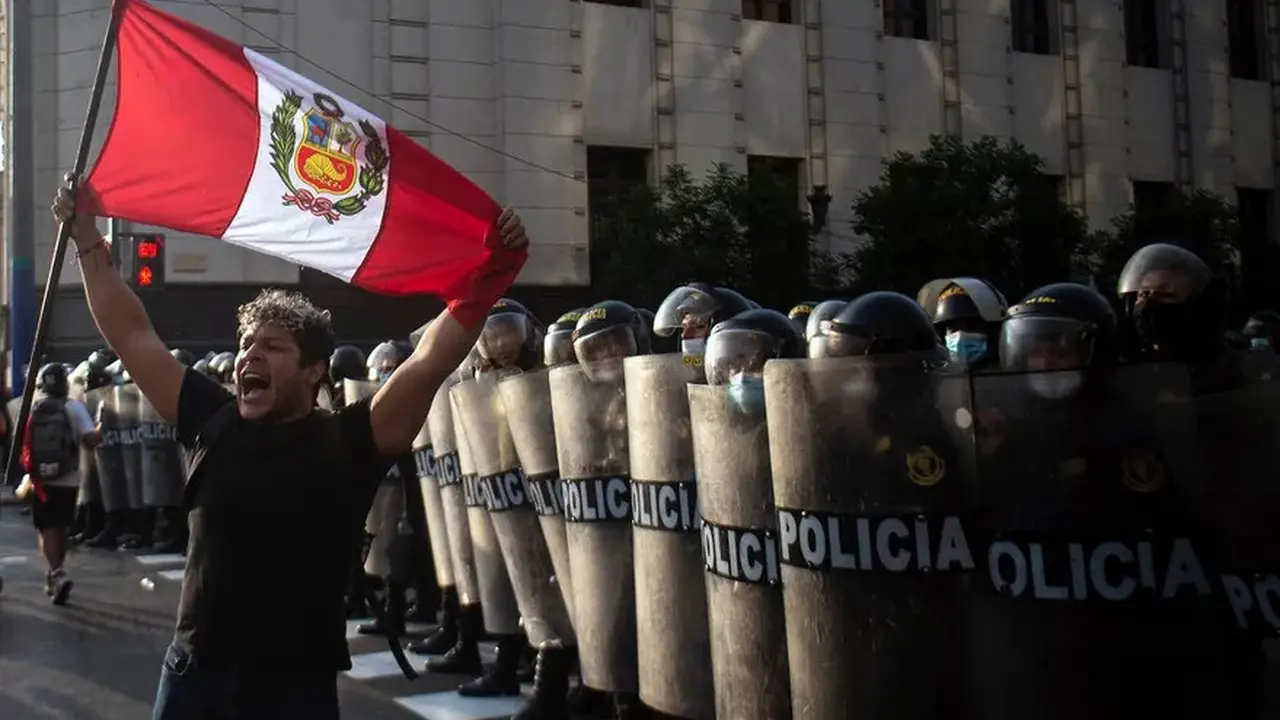
Few jobs have proven to be as unstable as that of the presidency of Peru: eight in the last decade, which gives an average of one year and three months for each president. Even so, the position seems to remain attractive, given that in the elections taking place this Sunday The record number of 35 candidates was reached.
If, furthermore, one takes into account that many former presidents were not only dismissed but also prisonersit does not seem that the Peruvian political system was the best to take as a model. And yet, it is one of the countries that is watched with the most interest from Argentina. The reason is simple: despite the political turbulence, the national currency – the Sol – shows striking stability.
And many attribute this fact to the fact that, In contrast to the high rotation of presidents, the Peruvian Central Bank has had the same person in charge for 19 years, the economist Julio Velarde. For this reason, when two months ago there was a new change of president without the slightest hint of a bank run or turbulence with the dollar, the debate was reinstated in Argentina: should Peruvian economic stability be considered the result of its institutional design or should all the credit be given to Velarde’s capabilities?
It is an important debate at a time when many economists, including some who hold positions in the government, speak with admiration of the “Peruvian model.” Following that path would imply, among other things, moving to a total autonomy on the part of the Central Bank, something that not everyone sees as viable in the Argentine political context.
The truth is that, just as in the 2023 electoral campaign, all those interested in the economy were studying the case of Ecuador, as it was the only country in the region that had completely dollarized its economynow the fashionable country is Peruwhich has not eliminated its currency or closed the Central Bank, and maintains a “bimonetary” system with the dollar.
Velarde, Argentine idol
“Be careful. A man is not an institution. It is the opposite.” That was the former minister’s warning Hernan Lacunza before the wave of praise that was poured on Velarde after the umpteenth Peruvian political crisis. His point is that it cannot be taken as a model for Argentina a system that works more because of the expertise of an official that by the strength of his institutional design.
In fact, Velarde announced that he will not continue in office next year, and they are already emerging in the Andean countryor expressions of concern in the sense that monetary discipline may be threatened. “We really cannot risk that these favorable winds that are strongly boosting the economy may dissipate”said the official himself, at a business meeting held to honor him. And although Velarde did not want to be alarmist, the audience decoded the allusion to a series of reforms approved by Congress, that increase public spending and could put fiscal accounts at risk.
Velarde, whom he knew as an official the hyperinflationary times of the late 80s, strict monetary discipline was established, with inflation targetsand a total independence of the treasury. By the charter, it cannot go into debt or financially assist the government in case of fiscal problems.
As a result of this situation, Peru closed 2025 with an annual inflation of 1.5%, the lowest in eight years. The worst year of his management was 2022, when the CPI was 8.4%. Regarding the exchange rate, the currency has strengthened against the dollarfrom a parity of 4.11 soles per dollar in 2021 to a current level of 3.40 soles.
Flexibility recommendation
In the Peruvian Central Bank there are reserves of US$98,000 million, equivalent to 36% of GDP, a notable difference with the BCRA, whose gross reserves They do not reach 7% of GDP.
These figures have made Velarde frequently mentioned in Argentina as a reference figure. Invited to the financial conferences of the Central Bank during the previous Peronist government, interviewed by local media, praised by economists of various tendencies, the Peruvian official has become a kind of “guru” regarding how a country that suffered the trauma of hyperinflation can successfully move to stability that is proof of government falls.
And it is, above all, the example that both officials of Javier Milei like the opposition economists when thinking about a “bimonetary policy” in which the peso can coexist with the dollar without bank runs or speculative attacks.
His most recent participation in Argentina was in an event of the Mediterranean Foundation, in which he expressed confidence about the direction of Milei’s plan. ““Argentina is aimed at lowering inflation, technical aspects may be discussed, but the path is clear.”said the Peruvian, before an expectant audience, who asked him for his opinion on the management of the local economy. Velarde refused to give advice, although he did express his conviction about the need to accumulate reserves, just at a time when Toto Caputo and Santiago Bausili They seemed convinced of the opposite.
Besides, highlighted the need for flexibility to better absorb the impact of external shocks. On the specific issue of exchange rate policy, he was in favor of free floating, although with freedom of discretionary intervention by the Central Bank.
In any case, the point on which Velarde did appear inflexible is that of the independence that the central banker must maintain, to prevent the government of the day from pressuring it to achieve a certain exchange rate or to finance a treasury with cash problems.
Skepticism of dollarizers
Surprisingly, one of the economists who has shown more skeptical on the application of the Peruvian model to the Argentine economy is Emilio Ocampothe main promoter of total dollarization, who during the electoral campaign prepared to take over as head of the BCRA, until he stepped aside when he realized that his plan would be curtailed by the interference of Toto Caputo from the Ministry of Economy.
“Peru is not a realistic option” was the lapidary title of an article written by Ocampo two months ago. And his argument is that the achievements of the Peruvian economy are not replicable in Argentina due to a difference in institutional framework.
“As long as the root causes of the divergence between both countries are not eliminated, attempting to emulate Peru is naive and dangerous voluntarism,” maintains Ocampo. And remember that those who propose the Peruvian path omit a crucial fact: the self-coup d’état carried out in the 1990s by Alberto Fujimori, who dissolved parliament and implemented a new constitution.
From Ocampo’s point of view, it was that new constitution, and not the “bimonetary regime,” that allowed the Peruvian economy to achieve the stability that today produces admiration. This institutional framework strengthened the independence of the Central Bank, and eliminated the possibility of inflationary financing.
On the other hand, in Argentina, Ocampo sees a “chronic institutional anomie” that makes economic policy is always subordinated to political needs of the government.
And one of his most controversial observations is that the strength of the Peruvian Central Bank does not occur “despite” the weakness of governments but, to a large extent, thanks to the fact that presidents do not have power that allows them to interfere in the monetary and exchange areas.
“Peruvian monetary stability rests, to a large extent, on the skill, prestige and technical strength of an exceptional official. The weakness of the Executive Branch acted as a natural antidote to institutional anomie. But this introduces a structural fragility. There is no guarantee that the next president of the BCRP will preserve the same degree of independence and professionalism as the current one. When the results They depend more on people that of institutions, are not necessarily extrapolated,” he says.
Is it not possible in Argentina?
Actually, There are many Argentine economists who advocate the independence of the BCRA as a desirable objective. The difference is between those who, like Ocampothey believe it is a utopian goal -and that is why he sticks to his proposal of total dollarization- and those who believe it is feasible erect a wall that completely separates the powers of the economy minister and the head of the Central Office.
In a recent interview, the economist Javier Timermanwho resides in New York and is often taken as a reference for “Wall Street humor,” stated that one of the factors that prevent the country risk index from lowering It is the lack of real autonomy of the BCRA.
It is a criticism that does not know about ideologies: it has been made to all governments since the breakdown of convertibility. One of those who suffered firsthand from this lack of independence was Martin Redradowho in 2010, during the government of Cristina Kirchnerbarricaded himself in his offices, refusing to leave his position in the face of political pressure to sell the BCRA reserves.
“It is important not to depend on people, but to generate institutions,” said Redrado, in line with the concern expressed by many of his colleagues. AND was skeptical about which Argentine savers formalize “mattress dollars” as long as that point is not resolved.
For those most critical of the Milei management, it was evident that the independence of the BCRA has little appeal for the political class. For case, Diego Giacominiformer ally of the president, the point of least monetary autonomy in Argentine history was reached. And, with sarcasm, he said in the streaming “Serrucho Economía” that the economy is “in the hands of a consulting firm, where one of the partners occupies the ministry of economy and the other partner the Central Bank”.
Cavallo’s proposal
Not everyone, however, maintains that skeptical view. Among those who believe that it is possible to generate stability safe from political interference is none other than Sunday Cavallowho in one of his last articles proposed a new management criterion for the BCRA.
For the influential former minister, there is no need to get too enthusiastic about the “carry trade”, which can have a side effect of cooling the economy. AND He affirms that the Central Bank must issue pesos to accumulate reserves, but warned that these dollars should not end up in the payment of debts of the Treasury or the provincial governments – which, in fact, is what is happening now.
“In order for the only monetary issue to be the one destined to accumulate reserves in the Central Bank, it is necessary that theinterest and principal maturities of the debt in pesos too are financed with fiscal surplus primary or with new debt, but never with monetary issue of the Central Bank,” says Cavallo.
But he warns that it is not enough to accumulate reserves, but that we must avoid doing it “Sturzenegger style.” He affirms that the experience of the Macri administration is that taking advantage of the inflow of short-term capital and manipulate the interest rate to keep the dollar anesthetized leads to a currency crisis. For this reason, it suggests that, in addition to eliminating the residual exchange rate, the Treasury and provincial governments should be prohibited from borrowing at a fixed rate.
“They may only do so in pesos adjustable by inflation or exchange rate and for terms greater than six months”he proposes, as a way to prevent the cyclical return of the financial bicycleAt the moment, his advice does not seem to generate enthusiasm on the part of Javier Milei.