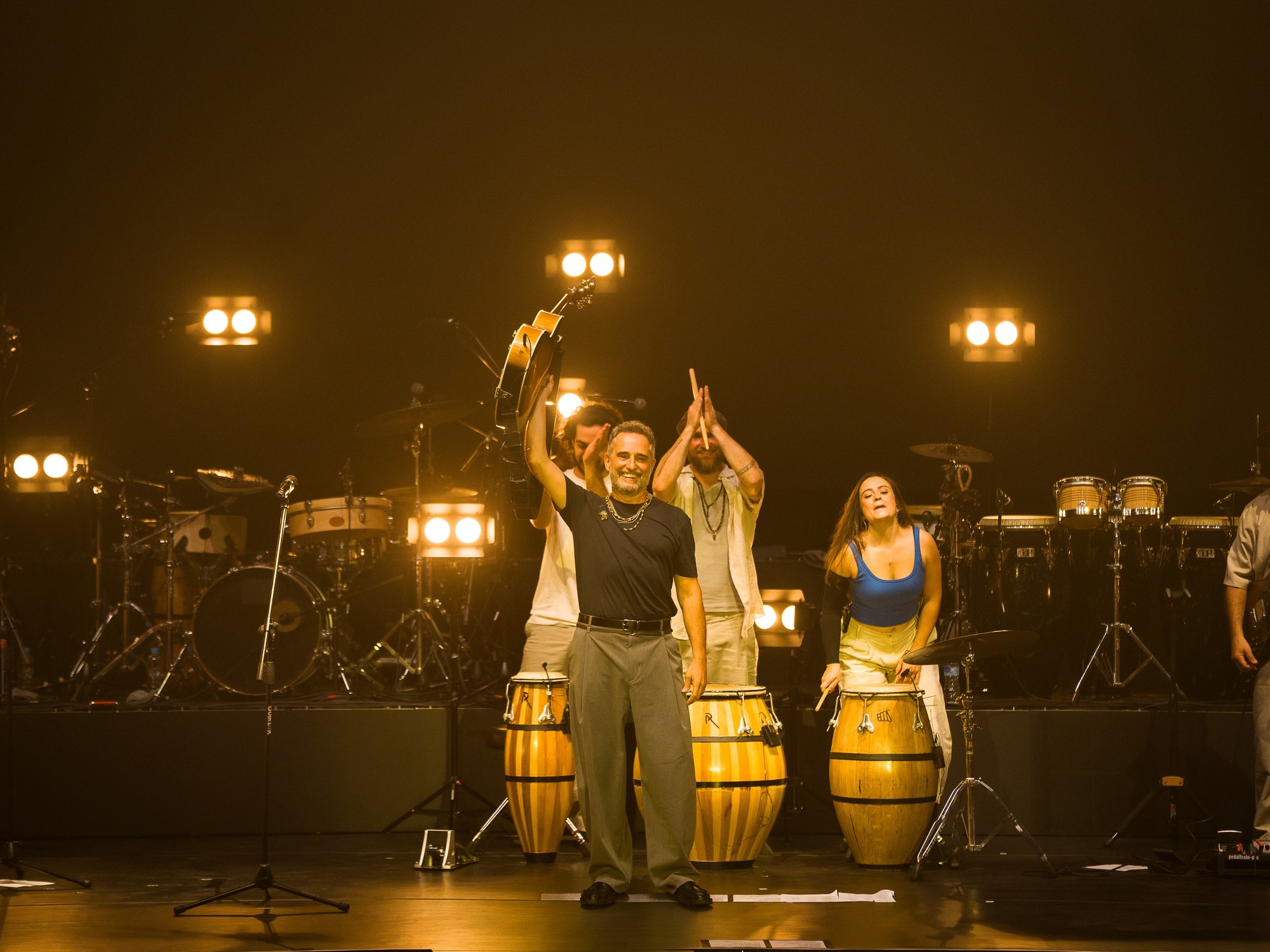
Jorge Drexler Play like a boy with a new ball on stage. He spins around hugging his acoustic guitar, dances among the drums and surprises when he goes down to the audience to climb onto a small stage and remain in the middle of the audience.
The Taracá show is an immersive experience of candombe, murga, folklore and flamenco pop, a bridge of sounds between Madrid and Uruguay.
It took the Uruguayan musician and composer, who has lived in Madrid since 1992, two years to produce this album, which is a return to his roots.
“When I went from being a son to just a father (because his parents died), I returned to record Uruguay “This is how Drexler tells how Taracá emerged.
The name of the album evokes the onomatopoeia of the rhythmic sound of the small drum, the basic instrument of Afro-Uruguayan candombe. It represents an accented hand stroke (TA) and two stick strokes (RA-CA), and connects it with the return to payment, “being here.”
The tour started on Friday, April 10 in Mendoza, at the Arena Maipú stadium, which was packed. It was a double celebration: new album and new band to tour in more than 30 cities in Latin America and Europe, for 11 months.
Throughout the two and a half hour show, the Uruguayan repeated his joy at returning to the celebration of the live show. “We are very happy. It is a unique night“Crazy, it’s the first time we played together,” he said.
 Jorge Drexler appeared at the Arena Maipú in Mendoza. Photos: Simón Canedo.
And he apologized because he seemed focused on the band ensemble and, perhaps, less conversational with the audience, as he usually did between songs.
With Taracá, Drexler moves away a little from the word and guitar format to give prominence to his young musicians and the virtuosity of their instruments. The solos of Alejandra López (on double bass) and Julio Sánchez Rizzio (percussion) stand out.
“They all have personal careers, they compose their own songs,” he said about the band that accompanies him with musicians and singers from Uruguay, Catalonia, and Madrid, which is completed by the Valencian Vicente “Huma” Miñana (guitar), Marc Pinyol Curto (percussion), and Eva Catalá (percussion). And the outstanding voices of Miriam Sánchez (backing vocals) and Flor Gamba (backing vocals, guitar and keyboards), both shine with duets with the Uruguayan singer-songwriter.
 Jorge Drexler on a night of pure candombe in Mendoza. Photos: Simón Canedo.
Wearing gray pleated gaucho pants, a black T-shirt and a white shirt, the singer appeared dancing on the scene. The public vibrated with the festive spirit of a carnival quermés, a night that promised to be long and was unforgettable.
Knock on Wood and How do you love?, were the songs chosen at the start of the setlist of the Uruguayan’s recital. His mention of the recent Artemis II mission: “Did you see how small the planet Earth looks from the Moon? Something so precious and that men want to destroy with more wars,” he reflects and gives rise to his song There is Someone AI.
The classics have arrived Telephony, Parallel Universe, Touch You and I’ll Take You Tattooedin chorus with the public. In Stardust He made an ironic mention of the Gulf War: “Oil goes up and the value of life goes down,” he will say with emphasis on the phrase “All life is sacred.”
From the audience they threw a flag at him with the slogan in Defense of Mendoza’s Water and against mega-mining. To those who protest with chants, Drexler invited them to approach someone on his team to learn about the claim and be able to collaborate: “I don’t like to give my opinion on issues that I don’t know about,” he warned.
Halfway through the show, he walked down the stairs from the stage, singing and dancing among the audience to climb onto a small platform and remain surrounded by his audience, who tried to touch him and slap him.
 Jorge Drexler appeared at the Arena Maipú in Mendoza. Photos: Simón Canedo.
My guitar and you and an acoustic solo On the other side of the river They were one of the most intimate moments of the night. Drexler dropped to the floor of the small stage, knelt and sat down, as if he were in a mateada in front of the Río de la Plata.
The drum string gained prominence, with a small one (high-pitched that kept the pulse, with one hand and a stick), chime (tenor, improvises) and piano (bass, marks the rhythmic base). A series dedicated to candombe with the song Bienvenida (which he wrote for his first album on cassette and which, as he joked, sold only 33 units, most of which were given away),Tamborera, Quimera, Tambor chico
There were several encores and a repertoire of 26 songs, surely many were left out. “It all started in Mendoza,” proclaimed the Uruguayan musician.
 Jorge Drexler and the entire band at the end of their presentation at the Arena Maipú in Mendoza. Photos: Simón Canedo.
The memory and tribute of those who made her career greatest emerged, Mercedes Sosa with her version of Sea, Martínez, dedicated to Joaquín Sabina, who advised her to leave medicine and move to Madrid to dedicate herself completely to music, which “changed her entire life.”
Almost at the end of the Candombera party, he returned to the endless and unique night in February 1992, in which he met Enrique Morente, a fundamental flamenco singer, in a cave in the emblematic Albayzín neighborhood in Granada. There dancing and singing became belief, heritage and game. He invited the audience to feel the dance, like a cloud goes in the wind. Not being in, but being the movement.