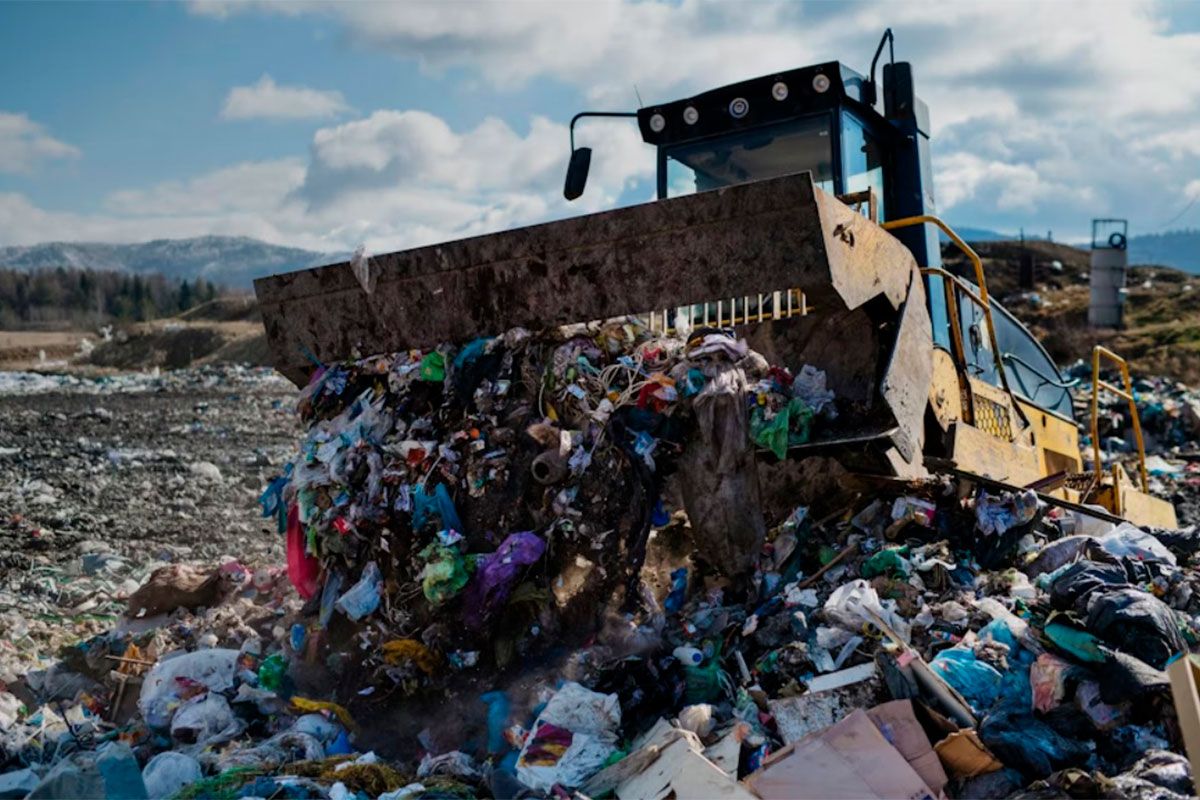
In a country where there are no official systematized statistics on the generation and treatment of waste, a survey promoted by the Hazardous Waste Observatory of the UBA-UNR universities put numbers on this large-scale environmental problem. According to the latest annual report (which runs from July 2024 to June 2025), only a small fraction of the almost 20 million tons generated receives adequate treatment. Specifically, only 5.57% of the waste was managed correctly, which is equivalent to 1.08 million tons treated per year.
Although there are more than 252,000 waste generating companies, only about 31,500 contract treatment services: 12.48 percent. This highlights the need to strengthen control mechanisms, advance the regulation of current standards and generate public policies based on evidence that allow reversing a trend that, year after year, leaves thousands of tons of hazardous waste without adequate management.
The Observatory was created in May 2021, as a joint initiative of the National University of Rosario (UNR), the Faculty of Economic Sciences of the University of Buenos Aires (UBA) and the business chambers Catries (of Treaters and Transporters of Industrial and Special Waste) and Caitpa (of Treatment Industries for Environmental Protection).
Both Matías De Bueno, today Secretary of the Environment of the UNR, and the executive director of the Geo Sustainable Development Center of the UBA, Marcelo Corti, participated in the formation of the Observatory, who contributed his strategic perspective and environmental experience. The objective was to have at hand a tool that would allow us to dimension, with concrete data and scientific rigor, a problem that until then had been invisible. For this, its own methodology was designed that systematizes information periodically. For its reports, the Observatory carries out a monthly survey of processing companies associated with the chambers, which include 47 plants throughout the country. Through anonymous surveys, data is collected on volumes of waste treated, customer characteristics and generation trends.
The results are integrated and analyzed using a statistical model that allows the information to be extrapolated to the national level, generating reliable indicators on the amount treated and especially those that remain outside the formal management circuit, building an essential panorama to guide policies, controls and sustainable management projects.
According to De Bueno, the value of this data lies in the fact that it comes from public organizations and universities, which gives it scientific and methodological support: “They are prepared by specialized technical teams and have the same evidentiary force as that of official experts, according to the General Environmental Law. This is information that is unique in its kind in the country.” The big question raised by this panorama is where the approximate 95% of waste that is not treated correctly ends up: “It is in the rivers, in the air, on the land, in the digs and garbage dumps. Unfortunately, much waste is disposed of improperly; They are poisonous, polluting and seriously affect health, the environment, flora, fauna and people. The problem is that these environmental costs are not paid by who should, but rather are absorbed by society as a whole.”
The latest report from the Observatory indicates that the situation worsened during 2025, especially among small and medium-sized companies. During the first semester, an abrupt drop was observed in the treatment rate, which fell to levels close to 6%, when in previous periods it had been 8%. This phenomenon is mainly explained by the exit of small companies from the system: the number of contracting SMEs fell by around 30% in the first six months. Corti considered that, although when the Observatory was started the public policy of control and oversight was deficient, when those policies by the State disappeared the situation worsened significantly: “The lack of an environmental agenda on the part of the national government exposes the current situation, which has repercussions on the health of the population and on other socioeconomic and environmental indicators. That is why it is essential, first to have information that allows making better decisions and from there to implement public policies at the three levels of government: national, provincial and municipal; according to their competencies and needs.
The necessary actions to take
“The work of the Observatory is fundamental because it gives us an overview and numbers that indicate where it is necessary to invest, what technologies to use to treat different types of waste and what is being generated; it even allows us to prepare maps and basic tools for the management of the sector,” explained Gustavo Solari, head of the Argentine Chamber of Treatment Industries for Environmental Protection (Caitpa).
For the referents, having updated information marks the path of the necessary actions to take. These range from increasing controls and traceability, to generating more indices and analyzing province by province what waste is produced and what portion receives adequate management. For his part, De Bueno stressed the urgency of advancing the regulation of existing standards, such as Law 25,612 on minimum environmental protection budgets and Law 13,959, which until now was not regulated, so that public policies can be transformed into concrete measures that reduce the harmful impact and protect society.
Downwards
The 2026 Budget establishes a decrease in inspections and training for companies that generate hazardous waste: they fall from 320 established in previous years to just 260. Inspections that control industrial effluents are also reduced from 1,020 to 840.