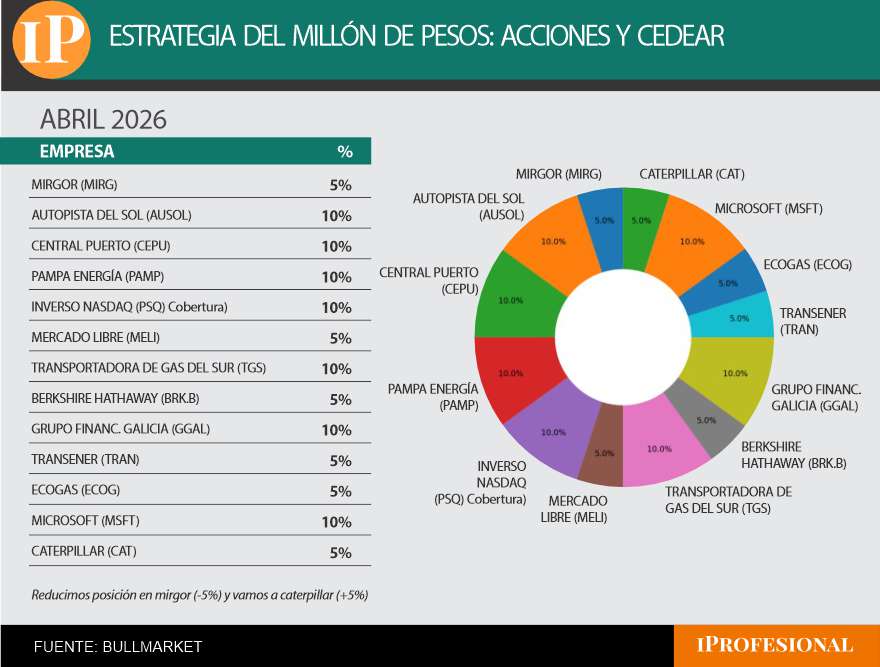
An important broker in the City, Bull Market, came out to show how he rearranged his recommended stock portfolio for April and left a roadmap that combines Argentine papers, CEDEARs and coverage against Nasdaq. The most visible change was the reduction of Mirgor by 5 percentage points to give way to Caterpillar with 5%, while the heart of the portfolio remains concentrated in a handful of well-defined local bets.
The overall picture is built around sectors and names where the broker understands there is still room to go, with a clear bias towards energy, gas and banks, and with explicit protection for an international context that can continue to be full of noise.
According to the report, the composition was distributed like this: Highways of the Sun (AUSOL), Central Puerto, Pampa Energía, TGS, Galicia and Microsoft with 10% each one; Mirgor, Mercado Libre, Berkshire Hathaway, Transener, Ecogas and Caterpillar with 5% each one; and a coverage of 10% in PSQ, he inverse of the Nasdaq.
The core of the portfolio
Bull Market maintains that the priority should be placed on Central Puerto, Pampa Energía, TGS and Grupo Financiero Galicia, to the point that among these four names they should explain between 60% and 70% of the portfolio. The document defines CEPU and PAMP as the heart of the energy block, GGAL as the main financial commitment and TGS as a medium-term position associated with the growth of the gas and export business.
And, in the broker’s view, Argentina is going through a stage in which the local market could partially decouple from external bad mood if risk appetite returns. In fact, in the macro assumptions of the work, Bull Market proposes that the Argentine equity “cut beta” against Wall Street in times of geopolitical tension and that, if the US benchmark recovers the upward trend, an additional rally could appear due to external impulse.
This idea explains why the portfolio is not put together with a purely defensive logic. There is coverage, yes, but the bulk of the capital continues to be invested in local companies that depend on rates, infrastructure, energy, production and financial deepening. In other words, it is not a portfolio designed to hide, but to capture a scenario in which the Argentine market still has room to rebuild valuations.
1
Why are you leaning toward Central Puerto, Pampa, TGS and Galicia?
In the case of Pampa Energía, the report highlights that the international context helped with a sharp rise in oil, but it does not stop at that. He also emphasizes that the company showed a solid balance sheet and a top increase to the 30% in its total production. Added to this is its participation in projects linked to export and infrastructure, such as VMOS and Southern Energy, and the announcement to enter the RIGI with a project of US$4.5 billion for the upstream in Rincón de Aranda.
In TGS, Bull Market highlights that the company presented a project of US$3,000 million, with estimated completion in 45 months, that could generate US$1.2 billion annually in exports. The report also highlights that at the end of March, new tariff schedules were approved with effect from April 1, something that could improve price captures both regulated and unregulated and end up impacting the next balance sheets.
Although the document does not develop to the same extent Central Puerto and Galicia within the pages that detail the monthly drivers, it does make clear the place they occupy within the general scheme. Central Port is part of the central energy block and Galicia appears as the tab to capture an eventual credit improvement and greater depth of the financial system. They are not two accessory positions: they are part of the heart of the bet of the month.
AUSOL, Ecogas and Transener
Within the platoon of 5% and 10% positions, there are other cases that help understand the sectoral reading of the Bull Market.
In AUSOL, The report highlights that since March 7, new toll rates approved by National Highways have been in force, with increases of more than 30% in Telepass and more than 40% average between classes and payment methods.
Added to this is a balance that showed a right for almost US$100 million above fiscal year 2024. Although the company continues without distributing dividends due to its open judicial front, the report indicates that the optional reserve to distribute in the future continues to grow.
In Transener and Ecogas, Although the main sheet does not explain it with the same level of detail, its inclusion maintains the logic of Strengthen exposure to utilities, transportation and energy distribution in a context where the market is once again looking closely at rate normalization and regulated businesses.
The change of the month happens through Caterpillar
April’s news for the stockbroking company involves Caterpillar. The broker opened a 5% spot for him with a thesis that is based on a structural change and not in a short rebound of traditional cyclical business.
Bull Market maintains that the company is being pushed by the demand for energy and electricity required by data centers linked to artificial intelligence. In this view, Caterpillar should no longer be read only as a firm dependent on construction, mining or taxes, but as a supplier that can capture a portion of the gigantic energy expenditure associated with the AI boom.
The report highlights that its energy division was the largest and fastest growing, with a year-on-year increase of 23% In the last quarter of 2025, a jump of 44% in power generation sales and segment margins 19.6%.
The thesis becomes even more aggressive when looking at the order book, here, Bull Market notes that Caterpillar has a backlog of US$51 billionequivalent to two years of insured income, after a growth of 71%. It also suggests that if on-site power for data centers ends up representing just a portion of global AI infrastructure spending, the addressable market could add up to between US$150,000 million and US$200,000 million in five years.
Now, the report itself also exposes the risks since the brokerage company mentions additional tariff costs by US$2.6 billion in 2026equivalent to about 3.8% of the projected revenue base, and warns about a eventual slowdown in CAPEX in AI infrastructure if the cycle loses steam or if the macro context deteriorates.
Microsoft, Mercado Libre and Berkshire
Microsoft appears with 10% as a long-term technological representation while, Free market, add another 5% and Berkshire Hathaway other 5% as a more moderate and diversifying component. This trio fulfills an important function.
- Prevents the wallet from being completely tied to the Argentine humor
- Contributes companies of international scale with consolidated businesses
- Balances aggressiveness of the local block with assets that can function as an anchor when the volatility of the domestic market skyrockets.
In fact, the same report explains that Berkshire should be thought of as a more conservative exposure within the stock universe, while Microsoft retains a strategic place although the document admits that ““It’s a more long-term bet.”
The need for coverage
Another central data of the portfolio is the 10% in PSQ, he Nasdaq Inverse ETF. That position fills a role that many retail investors often overlook when looking at recommended portfolios since not all the armed forces seek to rise at any price; part is designed to protect capital if the international market worsens again.
This point dialogues with the external framework described in the report: geopolitical tensions, oil risk, noise in international rates and a scenario where volatility has not yet disappeared.
How is the million dollar portfolio?
So, the million dollar portfolio is armed with greater concentration on energy, gas and banks through names like Central Puerto, Pampa, TGS and Galiciaa complementary portion in stocks and CEDEARs to diversify, and a coverage with PSQ to cushion eventual shocks on Wall Street.
- Mirgor (MIRG): 5% = $50,000
- Sun Highway (AUSOL): 10% = $100,000
- Central Port (CEPU): 10% = $100,000
- Pampa Energy (PAMP): 10% = $100,000
- Nasdaq Inverse (PSQ): 10% = $100,000
- Free market (MELI): 5% = $50,000
- Transportadora Gas del Sur (TGS): 10% = $100,000
- Berkshire Hathaway (BRK.B): 5% = $50,000
- Galicia Financial Group (GGAL): 10% = $100,000
- Transener (TRAN): 5% = $50,000
- Ecogas (ECOG): 5% = $50,000
- Microsoft (MSFT): 10% = $100,000
- Caterpillar (CAT): 5% = $50,000