There are products that do not need big speeches to explain where they are going. Bluetooth headphones Samsung Galaxy Buds4 Pro fall into that category: as soon as you open the case, you understand that these are not just headphones, but one more piece within an ecosystem that Samsung It is building with each release.
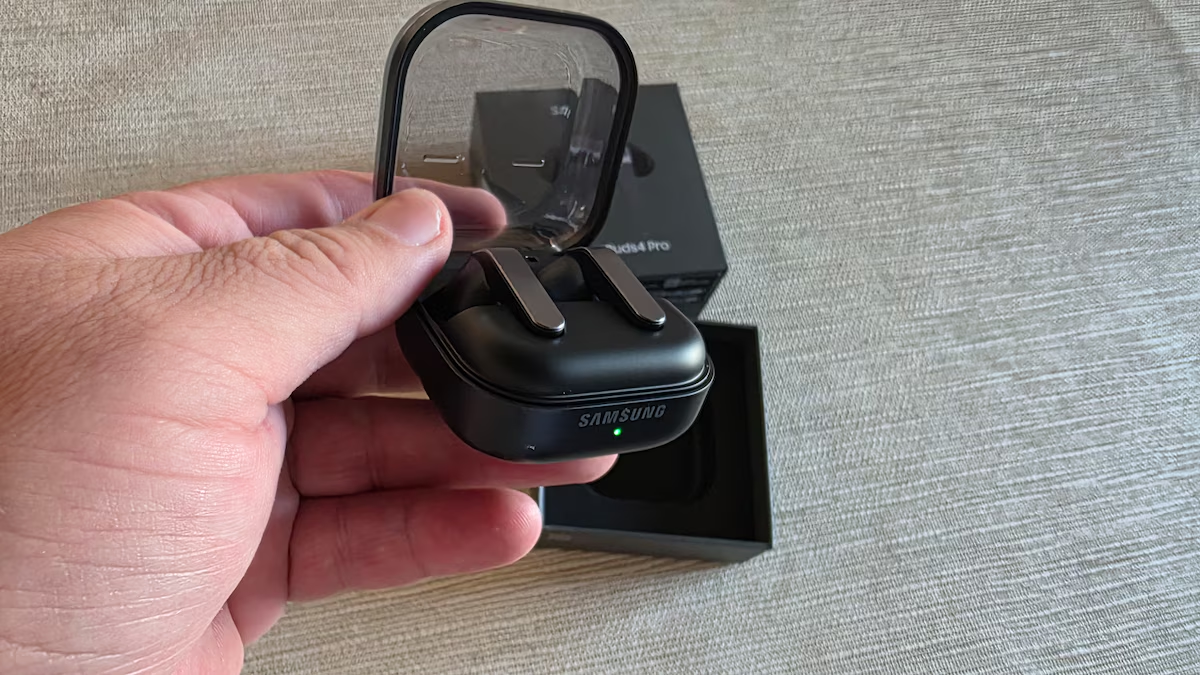
The experience begins even before listening to music. By simply opening the cover of the case, Buds4 Pro were detected automatically for my Samsung Galaxy S25 Ultra. No setup, no Bluetooth searching, no intermediate steps. A logic that inevitably reminds us of what Apple achieved with its devices, but that Samsung has been replicating (and consolidating) within its own universe.
The design accompanies that maturity. Clean lines, format with a more stylized stem and a finish that conveys quality. The case is compact, robust and comfortable to carry.
In hand, the feeling is clear: Samsung is not improvising. You’re pivoting on a formula you already understand.
After the first contact, what is important comes: the real experience. And that is where the Buds4 Pro finish justifying their evolution.
In my case, the immediate point of comparison was the Samsung Galaxy Buds3 FE that I had used for several weeks. They were reliable, balanced headphones with very good audio quality.
The Buds4 Pro, on the other hand, take a step forward. The first thing that appears is the bass: more powerful, with greater presence, but well controlled. They do not saturate or invade, but rather accompany. Added to that is a improvement in overall sound definition. The voices sound clearer, the instruments better separated, and the experience gains clarity.
It is a richer, more elaborate audio than It is enjoyed both in music and multimedia content. Every once in a while I would take them off in disbelief, thinking how something so small could sound like that. I recalculated: “It’s not magic, it’s technology,” and I put them back on.
The noise cancellation also improves. It does not seek to compete with the most extreme models on the market, but achieves more effective insulation than in previous generations. In everyday use (street, office and home) it performs very well and allows you to concentrate effortlessly. The litmus test, the airplane, did not suffer due to lack of travel.
Construction is another point where the jump is noticeable. The Buds4 Pro feel more solid, better put togetherwith materials that transmit greater durability. It is a silent detail, but important.
On calls, performance is consistent. Voice stays clear even in noisy environmentssomething key for those who use headphones for much of the day.
But where these headphones really start to stand out is in the integrated experience. Switching between Galaxy devices is practically automatic. Smart features begin to anticipate use: detect when someone is talking to youadapt the sound to the environment, simplify interaction.
Adding to this leap in the general experience is a key aspect: the Hi-Fi approach that Samsung is beginning to consolidate in the Buds4 Pro. The system incorporates a Advanced two-way speaker accompanied by a dedicated dual amplifiera combination that aims directly at a clear objective: to offer a sound more faithful to the original recording.
All this is enhanced with software integration. The evolution of One UI allows interaction with the headphones to be even more direct: There is no longer a need to rely on external applications to manage key functions. From the Galaxy phone quick panel, you can adjust settings, manage sound modes, and save specific preferences depending on the app being used. This depth of integration reinforces the idea of the ecosystem that Samsung has been building, where the Buds are not just another accessory, but a natural extension of the smartphone.
The battery accompanies that proposal. Easily enough for a full 7-hour day (using them with noise cancellation active) and 26 if recharged using the case.
Artificial intelligence is also beginning to take a central place in the experience of the Samsung Galaxy Buds4 Pro. The possibility of interact directly with attendees How Bixby without having to take out the phone marks a clear change in everyday use: ask for information, manage tasks or solve simple actions It becomes something immediate, almost natural, simply using your voice.
Added to this is one of the most interesting functions: the real-time translation powered by Galaxy AI. The headphones function as a kind of personal in-ear interpreter, allowing you to hear conversations in another language while the content is also reflected on the phone. Is a tool that, beyond the technological impact, has specific applications in travelwork or everyday situations where language can be a barrier.
The interaction is completed with basic gestures, such as nod or shake your head to respond to calls or commandseven when it is not possible to speak. This combination of voice, artificial intelligence and gesture control reinforces the idea of an increasingly invisible technology, which adapts to the user and not the other way around.
The Galaxy Buds4 are probably one of the clearest examples of where Samsung is going: Less isolated products, more connected experiences.
The jump compared to the Buds3 FE is evident. There’s better bass, higher definition, better noise cancellation, and a more solid build. It all adds up to a product that feels more complete, designed for more demanding users.
But the real differential is in the ecosystem. That feeling that everything works effortlessly, that the devices recognize each other and simplify the user’s life Samsung is achieving something that for years was almost exclusive territory of Apple: an integrated experience that is truly perceived.
In Argentina, the reference price is around $620,000, although in Mercado Libre they can be obtained for 100,000 pesos less. On Amazon they are available for $306 (shipping to the country included). Are they worth it? Yes, especially for those already within the Galaxy ecosystem.
Because beyond the sound, the Buds4 Pro propose something more interesting: that technology stops feeling like such and becomes simply part of the routine. And when that happens, the product meets its objective.