
The traditional logic of the financial system regarding default is reactive. This is, The client stops paying, accumulates arrears and surcharges, and only then does the entity offer a restructuring. The thing is, by then, the damage has already been done.
From the fintech sector they explain that this model has a central defect: when action is taken it is already too late, the client is already more deteriorated and stressed, and with less real capacity to organize their finances.
Sector sources confirmed exclusively to iProUP that, In addition to rescuing defaulting users, work is being done on a conceptually different response.
The signs that turn on early warnings
An entrepreneur in the fintech sector defines what a preventive refinancing: “It consists of not waiting until the client has already fallen into formal default and only then offering him a way out“but to detect signs of financial fragility before default and intervene at that moment,” reveals a fintech executive to iProUP.
In operational terms, the change is very strong. Instead of managing completed damage, it is about preserving portfolio before the default. The promoters of this novelty believe that, well executed, this tool is not only more effective for the entity, but also protects the client from consequences that may be difficult to reverse: loss of credit capacity, accumulation of penalties and exclusion from the formal financial system.
The most relevant technical point of preventive refinancing is knowing who to offer it to. Industry sources warn that It is not about opening massive campaigns of refinancing for the entire portfolio, because it generates an undesirable effect, such as accustoming the client to thinking that there will always be a more flexible exit, even if they are still up to date.
The ‘anti-fall’ strategy of wallets
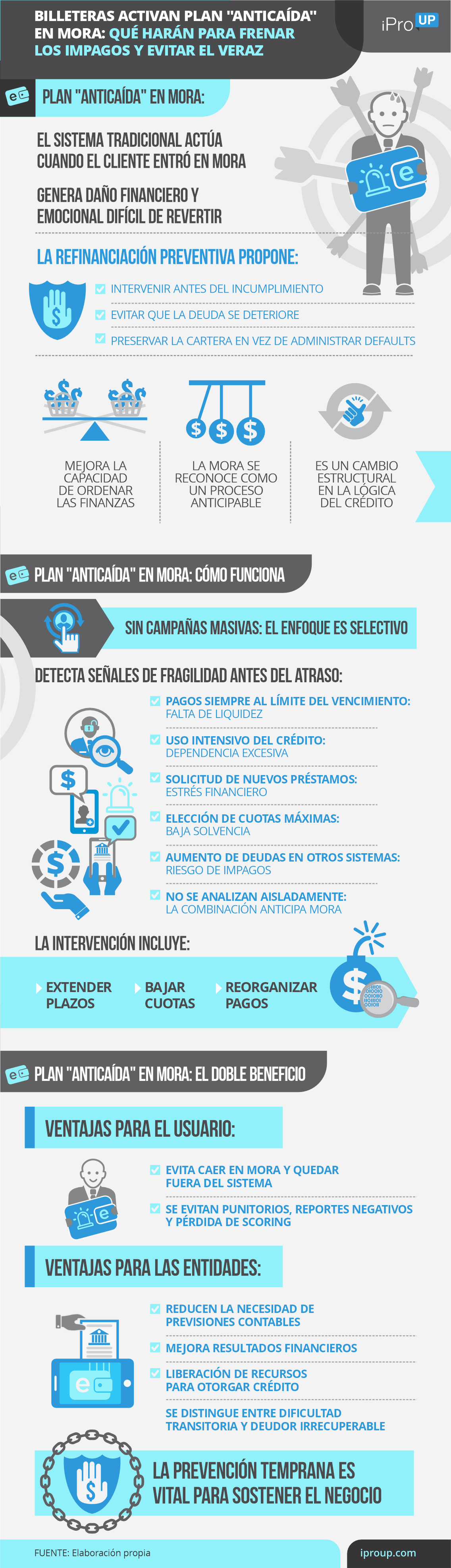
Therefore, they explain to iProUP, the approach is selective and based on concrete signals. That is, a series of behaviors that may go unnoticed on the user’s side, but not for those who lend money:
- Payments always made at the due datewhich may indicate that the client no longer has liquidity margin
- Intensive or almost total use of the available linewhich suggests increasing dependence on credit
- Applying for a second loan too soon compared to the previous oneas an indirect way of seeking financial oxygen
- Choosing the maximum possible quotawhich reveals that the policyholder is at the edge of his payment capacity and not comfortably
- A visible increase in debts incurred in the rest of the financial system.
Those who reveal this strategy to iProUP clarify that none of these variables, taken in isolation, necessarily prove a problem. But when combined, they form a pattern that anticipates a default in the making. And that is where they intervene by extending the term, lowering the fee, reorganizing the payment flow or reformulating the obligation so that the client can sustain it.
For consumer expert Gabriel Meloni, it is “a logical path that seeks to not always have to go after bigger problems.” For the specialist, “The end client almost never has any idea of tools that can even cause mental relief. That the lender proposes them is healthy for everyone“.
Early default vs. late default
In the fintech universe they establish a distinction that does not always appear in public debate, but is key to understanding the logic of the model. A client with signs of fragility who has not yet defaulted is not the same as one who accumulates more than 270 days in arrears.
- Early blackberry: There are signs of fragility, but without non-compliance. There is still room for intervention and the user retains a greater capacity for normalization. Preventive refinancing aims exactly at that stage
- Late default: debt of 270 days or more. The situation is already much more deteriorated, with less recoverability, and the logic is closer to intensive management and even judicial action.
“What is being seen in recent months is that Several banks began to offer refinancing to those who were having difficulty paying their loans.especially in cards and personal loans,” says one of the banking sources consulted.
In his view, “the logic is clear: Instead of letting the credit go into default, we seek to restructure the debt by lowering the monthly payment so that the client can continue paying.” From the fintech sector they go one step further: the idea is not only to restructure when there are already visible signs, but anticipate the decline before it becomes a statistic.
The double rationality: what the client gains and what the entity gains
Preventive refinancing has a double logic that distinguishes it from other portfolio management tools. It is not only a business decision, it is also a tool for preventing credit deterioration with effects on both sides of the equation.
On the one hand, the client can prevent a temporary difficulty from becoming a formal breach with reputational, financial and emotional consequences. A delay registered in the Central Bank of Debtors of the BCRA can close access to formal credit for years. An early restructuring, on the other hand, allows you to keep your history in good standing and remain within the system.
On the other hand, When a loan goes into default, the entity has to make accounting provisions to cover potential losses, which directly impacts results. If the refinancing ensures that the client returns to pay with some regularity, the credit can remain in a lower risk category and the entity needs to provide less capital.
In practical terms, this avoids tying up resources and allows credit to continue being channeled. Among the fintechs they are explicit: It is not about giving more credit to those who are complicated, but about an intelligent and anticipated restructuring in the face of objective signs of tension.
The sector rejects the narrative of usurious rates
Preventive refinancing appears in a context in which the fintech sector faces mixed criticism. From Congress they are accused of abusive rates and from some sectors they are pointed out as directly responsible for the default boom. They reject both readings.
“Fintech companies do not have the capacity to set the price of money, neither by themselves nor all together. They are not price makers,” they defend themselves. They argue that A high rate is the result of adding funding cost, expected default, operating expenses and minimum profitability. If the default goes up, the rate goes up. It is not an arbitrary decision, it is the market transferring the risk to the price.
Regarding the default, fintech sources warn that Behind an agile digital experience there is a sophisticated architecture for risk assessment, prevention and managementbased on decision engines that analyze multiple variables before approving, rejecting or reformulating a credit offer.
“The current default is not the fault of non-financial credit providers. If you really want to solve the problem, the discussion has to run in another direction,” they demand.
With delinquencies at record levels with 11% irregularity in family loans (the highest value since the 2001 crisis) and up to 27% in the non-banking sector, Distinguishing the client in temporary difficulty from the irrecoverable debtor is not only a good risk practice. It is the difference between sustaining the digital credit business or seeing it close before the economy finishes stabilizing.