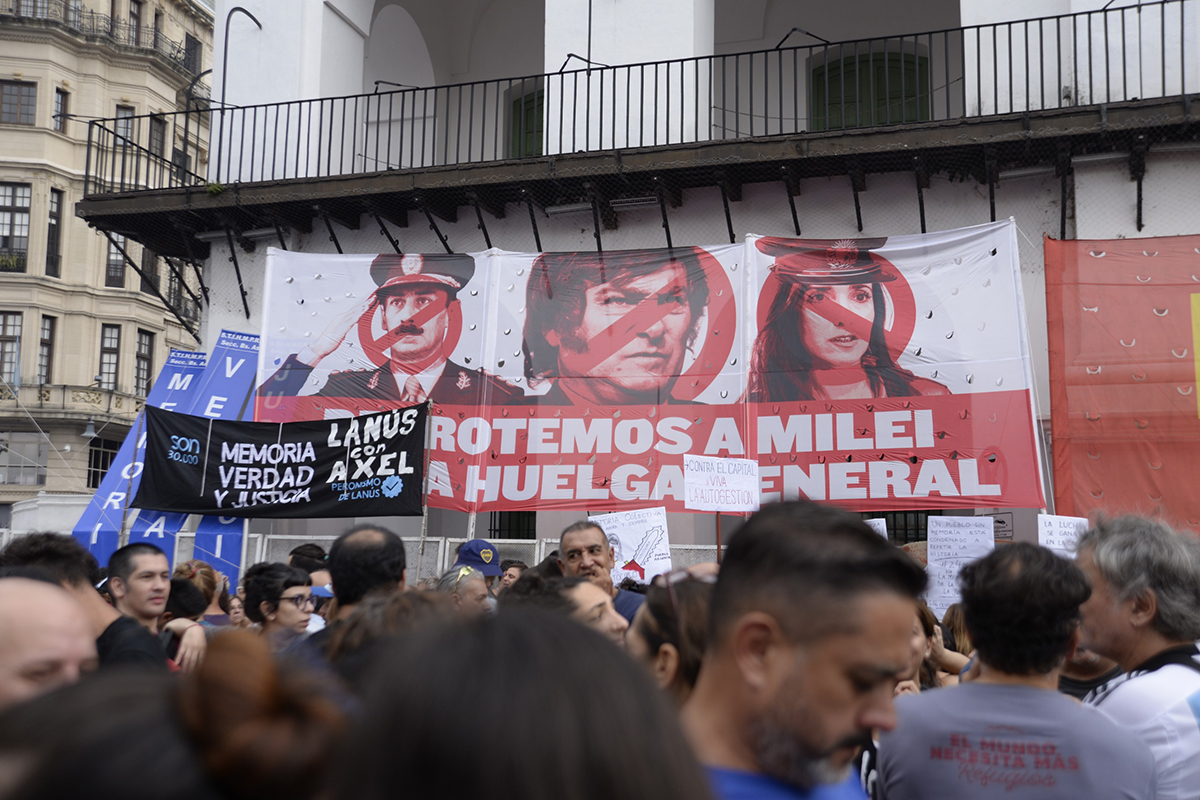
Thirty thousand missing was not the cost of order: it was the price of the transfer. The National Reorganization Plan did not just reorganize the State: it reorganized property, relative prices, the entire class structure. José Alfredo Martínez de Hoz, the minister who executed him, was a lawyer for multinationals and a personal friend of Rockefeller. Under his management, the external debt went from 7,800 to 45,000 million dollars in seven years. That money did not evaporate: it was systematically transferred from Argentine salaries to New York creditors.
Terror and the economy were the same politics with two arms. The missing person was the militant who opposed the adjustment. The torturer, the arm of the creditor. The cattle prod, the argument with which the strike was responded to. Naming that is not a metaphor, it is a precise description of a chain of causality that the trials documented with names, dates and orders.
Fifty years later, the tanks no longer take to the streets. The algorithms come out. And the chain of causality, although longer and more diffuse, still has the same owners at the far end.
BlackRock, the largest investment fund on the planet, has significant stakes in Alphabet -Google-, Meta, Microsoft, Amazon, Apple and OpenAI. Together with Vanguard, it simultaneously constitutes the largest or second largest shareholder of the four large technology corporations and the most influential media groups in the West. The same financial surnames that appear in the history of Argentine debt – Rockefeller, Goldman Sachs, JP Morgan – today have dominant positions in the infrastructure that determines what information each person sees, what news circulates, which candidates go viral and what movements are silenced.
The School of the Americas, where more than 60,000 Latin American soldiers trained in counterinsurgency techniques, closed in 2000. But its doctrine did not die: it mutated. Today it is called the Atlas Network, a network of more than five hundred libertarian think tanks in ninety countries, financed by Koch Industries, ExxonMobil and the same large investment funds. Its graduates do not wear uniforms: they give TED conferences, advise presidents, and write economic policy documents that multilateral organizations translate into loan conditions. The doctrine did not change in essence either: the State is the enemy, the market is the solution, and any attempt at redistribution is a step towards totalitarianism.
But there is a qualitative leap in this new instrument that should be named precisely. The algorithm not only fragments society: it individualizes defeat. Where before there was a factory taken over, a union standing, a neighborhood assembly, today there are millions of screens that return to each subject their own anxiety wrapped in the role of a personal choice. The algorithm doesn’t tell you that your salary lost to inflation; It tells you that you are missing a financial education course. It does not explain to you that the health system collapses due to a political decision; It suggests that you didn’t exercise enough. Therapy becomes, in this context, a substitute for militancy. It is not random: it is the result of a platform architecture that rewards dehistoricized introspection and penalizes structural understanding, because that is the first step towards organization and organization is the only threat that capital has never stopped fearing.
What was previously called counterinsurgency and limited to specific territories – factories, universities, towns – became a permanent cognitive war waged in the terrain of subjectivity. The objective is no longer just to defeat a political organization: it is to make any form of political organization impossible, dissolve trust in the collective, naturalize inequality, privatize hope. It is a war that is not declared, but whose casualties are counted in cut salaries, in loneliness induced by the precariousness of ties and in depressions that are the psychological expression of an objective defeat.
The victim no longer disappears: he is discredited, ridiculed, canceled. Silencing no longer requires a detention center, ten thousand coordinated messages and an algorithm that amplifies hate is enough because hate keeps users on the platform longer. The method changed. The impunity is the same.
When Milei took office there was no general in the box of honor. There were representatives of the Atlas Network: the Freedom and Progress Foundation, the Pensar Foundation, the Cato Institute. All members or partners of that network, all active for years in the ideological formation of the president who came to power promising to destroy the State with a chainsaw.
As in 1976, what followed can be read in two simultaneous registers. In the case of bodies: real wages fell, poverty grew, retirees lost purchasing power, soup kitchens served more families than in 2001. The other record is that of balance sheets: country risk fell, bonds rose, funds with Argentine debt improved, the IMF celebrated the adjustment, the media framed all this as historical audacity. The circle is the same. It just spins faster and looks less.
The last scene is not in any office. It’s on any screen at midnight. Someone scrolls. Forty minutes of short videos: an economist explaining that the deficit is the cause of all evil, an influencer mocking those protesting in the street, a notification about the exchange rate, a meme with the face of a union leader. He didn’t read anything longer than two hundred words. He found no explanation connecting what’s happening in his pocket with the balance of an investment fund in Delaware. He is angry – yes – but he doesn’t really know with whom. The algorithm did it.
50 years after the coup, that person is not missing. She is sitting, with the phone in her hand, completely free.
That is the perfection of the new instrument: it does not need to restrict freedom. You just need to empty it of content until it is indistinguishable from helplessness. The tanks no longer take to the streets. It’s not necessary anymore.