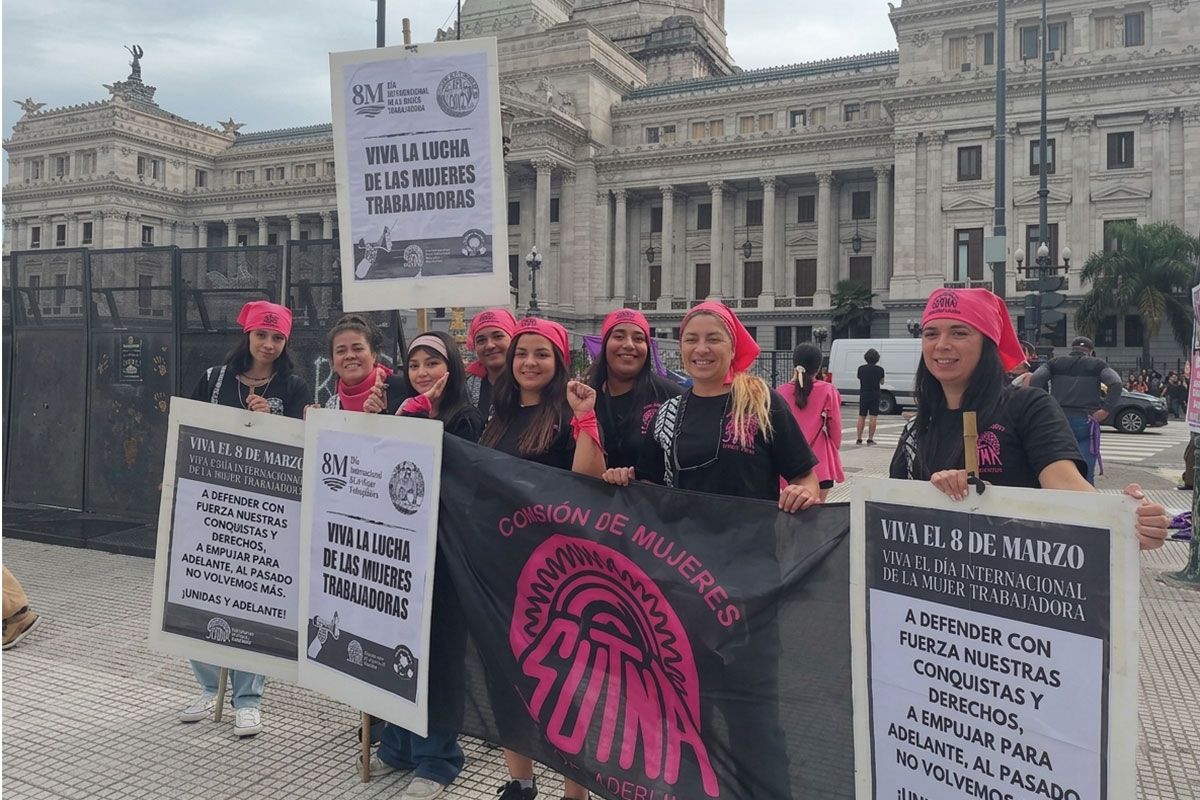
“Last weekend from Friday to Monday I almost didn’t exist in my house. I came and brought food, I looked for someone to take care of the little ones and I left again,” says Maqui Beitía Rocha, member of the Sutna Women’s Commission, life partner of one of the Fate workers. “We know that if we win this fight it is very important for many people, not just for us,” he adds in a telephone conversation with Argentine Weather.
In 2019, when during Mauricio Macri’s government the wheel factory presented a preventive measure, the workers’ wives were in the actions, they wore the same shirts as their husbands but needed another instance to accompany them. Thus, on March 7 of that year, the commission was born. Maqui remembers that the first action was for Working Women’s Day and that since then they have been working to help their colleagues with whatever they need to maintain this fight.
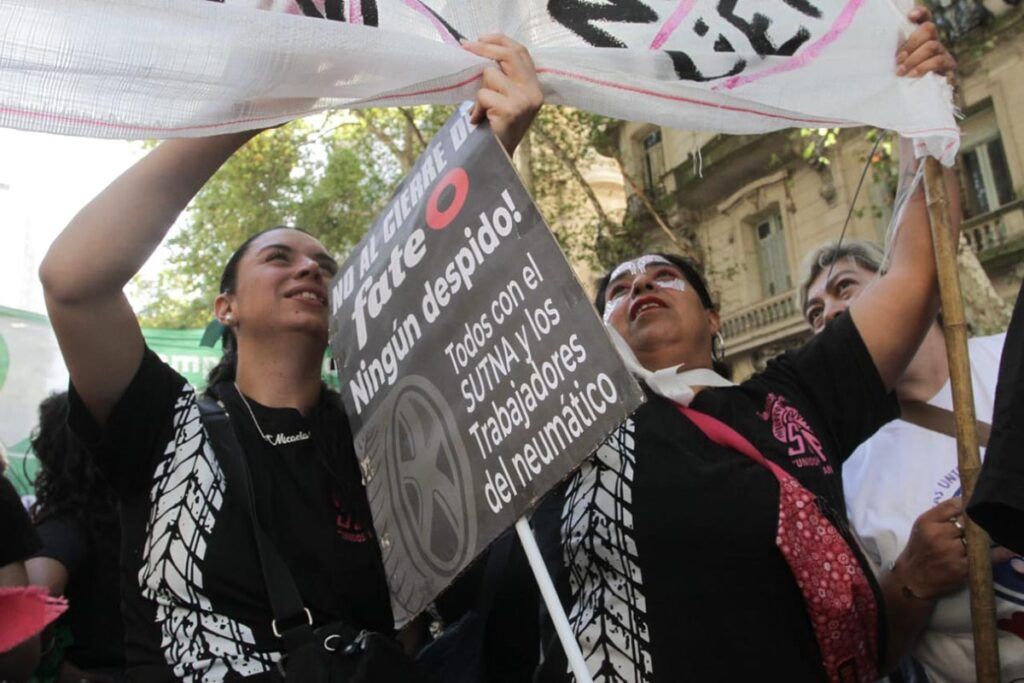
On February 18, the company fired the 920 workers who were part of the factory. That morning they came to work and found the factory closed. Maqui says that the workers’ reaction was immediate: they entered the factory to defend their jobs. From that date to today there have been various instances from both the government and the justice system, but specifically, there is still no solution for the situation they are experiencing.
The Women’s Commission is dedicated to accompanying their husbands but they also carry out other activities. On Sunday, March 8, they organized a large meeting for Working Women’s Day where Cecilia Basaldúa’s parents came and talked about gender violence and the situation with the gender public policy agenda in San Fernando. Maqui remembers that during the festival they organized a childhood space, and since 2019 they have been carrying out Family Day at the factory.
Caring and accompanying
The majority of the women who make up the commission have young children and also have more or less stable jobs. Maqui has five children and is a teacher. She got, she says, a few scattered hours in the schools but the greatest income is that of her husband. This is the case in almost all the homes of Fate workers.
“Work in Fate is not with fixed shifts. Now it was regularized due to the union’s struggle, but for a long time it was sometimes the night shift and sometimes the morning shift. You had to adapt your life to those schedules. We couldn’t have a more or less stable job in those conditions, that’s why for most families the livelihood in Fate,” describes Maqui.
During the talk, the woman says with anguish that she hears that many of the workers have to return to live in their parents’ house, although now with their own family; or the worry because they took out loans to fix or build the house and now they don’t know how to pay.
“The majority have Fate as their main income. Some were only able to start studying now, when the children are older, and those things are what have an impact. We have colleagues with children with disabilities, who need social work. We all have part-time work, jobs that you can do at home, like making cakes for example. But we are all worried because not having this income.”
The Fate Family
Maqui defines relationships in the factory as a “big family.” “It’s not just that they go, wheel and go. There are many generations, there is a neighborhood called Fate,” he adds.
Remember that in that first stage when the factory was in the hands of the grandparents of Javier Madanes Quintanilla, the owner who today left them on the street, the Fate neighborhood was created given that “Mrs. Quintanilla took great care of the workers and they built their houses.”
“This is an emblematic factory. It is a factory where, for example, my husband works in the ‘nozzle’ sector, where at the same time my father-in-law worked for 30 years and retired doing that work. And it happens a lot that the son, the father, the grandfather worked. Then you get to know each other, you generate a more or less family bond,” Maqui describes and adds that his mother’s family also worked there.
The women’s space serves, she says, to “channel what happens to us. We get together and when one falls for something, the other picks her up. The good thing is that we are not alone. There are workers who had the door closed and had to leave. And we have a union that fights, that is in there. That’s why, when someone comes to ask, especially to women, I tell them to organize, to get together is the only way to get ahead.”
The fundamental accompaniment to your companions is struggle and resistance. “We always have our hearts with the women’s movement. We know what women go through. All this labor reform puts all the girls who are alone in the wrong. There are many women raising alone in very complicated conditions. We do not look the other way, we defend our family but we also defend our colleagues. As a mother, as part of this commission I always say that we should not be selfish and look the other way. We should always get involved.” «