The Buenos Aires government managed to close a new salary agreement with the state workers included in Law 10,430 and is now awaiting the response of the teaching unions to the proposed 9% increase in three installments corresponding to February, March and April.
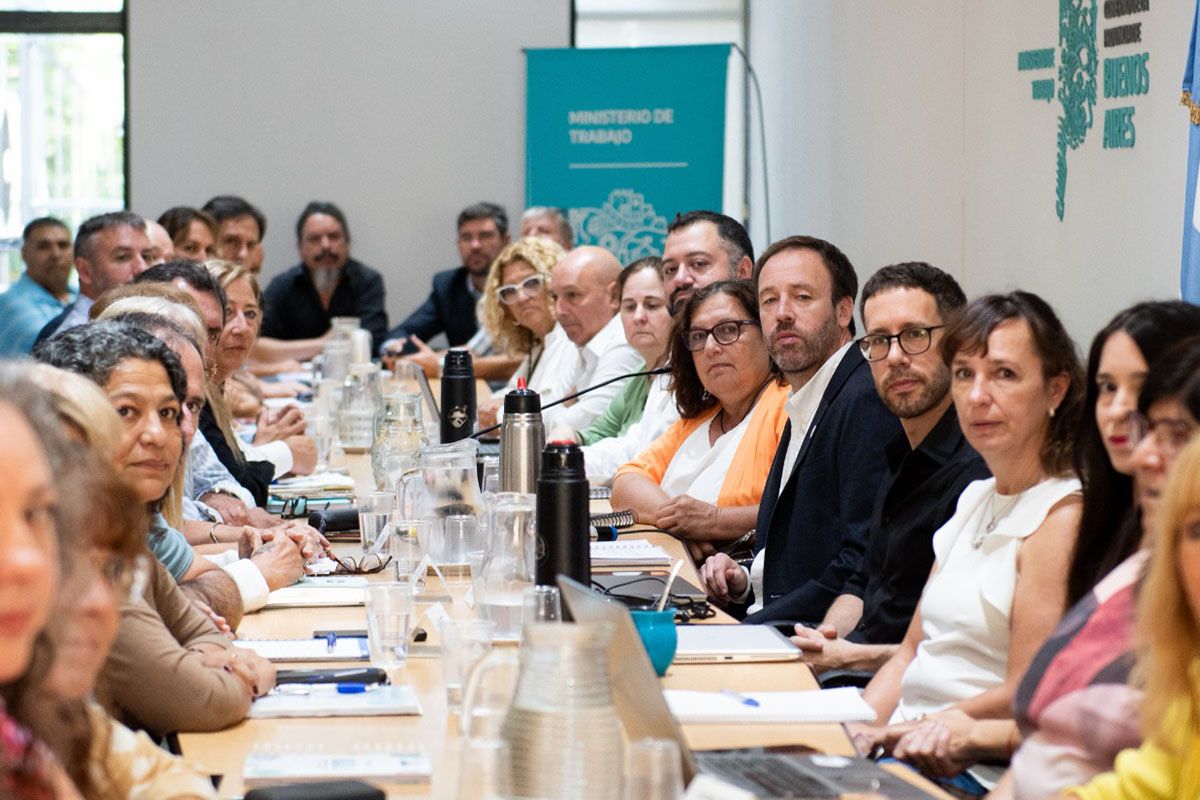
The offer was presented during the last joint meeting held on Wednesday at the headquarters of the Ministry of Labor, in The Silverand consists of an increase of 5% for March and another of 2.5% for April, both calculated on January earnings. Added to this is the 1.5% that the Executive had already granted in February on account of future increases, which totals 9%.
The proposal was received by the Buenos Aires Teaching Unit Front (FUDB), which integrate FEB, SUTEBA, SADOP, AMET and UDOCBAwho will analyze the proposal with their respective affiliates and will communicate this Friday whether they accept or reject it.
The negotiation takes place in a context of conflict, after last Monday teachers carried out a national and provincial strike that prevented the normal start of the school year in Buenos Aires public schools.
The proposal submitted by the province’s economic team to the unions also includes the payment of a non-remunerative and non-rewardable bonus of 28,700 pesos called «FONID/Connectivity Compensation»intended to compensate for the loss generated by the cut of the National Teacher Incentive Fund and the additional one for connectivity that the national government stopped transferring from 2024. There will also be a special bonus for education assistants.
According to the unions’ calculations, if the proposal is accepted, a graduate teacher who is just starting out in the activity will receive a salary of $800,084 in March and $850,053 in April. In the case of a full-time undergraduate teacher, the salary would reach $1,600,168 in March and $1,700,106 in April.
For teachers who complete the so-called “fifth hour”, the income would be $1,005,638 in March and $1,060,424 in April. While a teacher with 20 modules in charge would receive $1,032,198 in March and $1,113,838 in April.
The salary agreement also provides for a monitoring clause to evaluate the evolution of salaries in relation to inflation during the first half of May and the reopening of negotiations in June, with the aim of reviewing whether they lost purchasing power in relation to the official cost of living.
While awaiting the response from the teaching sector, the Buenos Aires Ministry of Economy highlighted in a statement the agreement reached with state workers enrolled in UPCN, ATE, FEGEPPBA and CICOP, and reiterated that the Province faces a complex economic scenario as a consequence of the national economic plan.
The provincial Minister of Economy, Pablo Lopezmaintained that “we are experiencing an extremely worrying economic situation, a product of the economic policies of the national government, which threaten production, employment and Argentine companies.”
In that sense, he specified that “the Province of Buenos Aires has lost $22 billion due to national government debts and the constant drop in revenue due to the economic situation.”
“Despite this, from the administration of Governor Axel Kicillof we recognize the effort that provincial workers are making and we are committed to maintaining the best working conditions possible,” he added.
The Minister of Labor, Walter Correafor its part, highlighted the joint venture as a key area of negotiation with the unions in contrast to what happens in the Nation. “Faced with a national government that synthesizes its actions in a labor pseudo-modernization reform to exclude rights, the Province of Buenos Aires chooses another path: including, respecting and sustaining collective bargaining, guaranteeing free and homeless joint ventures,” he stated.
«In an adverse context and economic suffocation, this agreement with the workers, through their union organizations, takes on even more value. We appreciate the responsibility and commitment of each party, and we reaffirm that the Province respects labor rights and defends purchasing power as a priority,” he concluded.