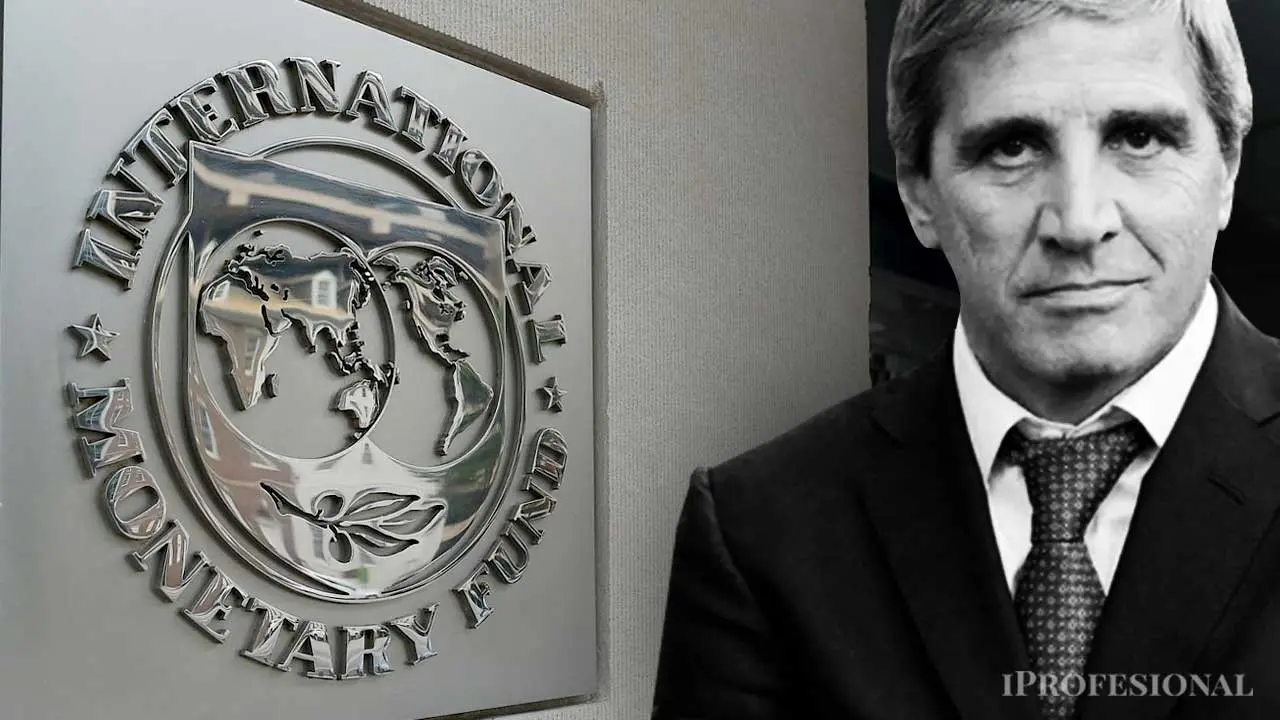
In the next few hours, the Minister of Economy, Luis Caputo, together with the head of the BCRA, Santiago Bausilli, and other members of the economic team will travel to the United States to participate in the spring meetings of the International Monetary Fund (IMF) and the World Bankwhich will take place starting next Monday in Washington.
Local market operators and Wall Street have certain expectations about whether in the coming days there could be news from the IMF regarding the second review of the agreement, the publication of the staff report and the pending disbursement of US$1,000 millionbut everything suggests that it will be after that international event.
The IMF-World Bank Spring event will run from Monday, April 13 until Saturday, April 18although there is still no confirmation of when the Argentine delegation would arrive and if they will do so together. Apparently, Caputo will be in Buenos Aires as he is scheduled to be part of the United States Chamber of Commerce in Argentina (AmCham) event.
Regarding what may happen in these meetings, it should be noted that last Thursday, in a kind of preview, the managing director of the IMF, Kristalina Georgieva, warned in Washington that central banks must be prepared to raise interest rates if the war between Iran and other countries in the Middle East generates new inflationary pressures. The warning came at the opening of the spring meetings of the organization itself and the World Bank Group, in a context of uncertainty derived from the conflict.
Georgieva raised a warning about the global economic impact of the war in the Middle East and pointed out that, even in the best-case scenario, the conflict will leave a weaker world economy, with more inflation and greater financial risks. And he warned that it could bring down 45 million people in food insecurity.
In addition, he gave a speech that marks the main theme of the organization’s spring meetings, which begin next week in Washington and bring together the world’s economy ministers and heads of Central Banks. Georgieva described the conflict, which is now undergoing a fragile truce, as “a supply shock” of great magnitude that once again shook a global economy that had been showing signs of resilience. “A resilient global economy is being tested again,” he said. The impact is already being felt “all over the world,” he said.
He also stressed that Monetary policymakers cannot afford inflation to get out of control if war causes prices to rise, especially in the energy sector..
The impact on the global economy will depend on the strength of the ceasefire reached this week between Washington and Tehran, although he warned that “growth will be slower, even if the new peace is lasting.” The IMF director detailed that the IMF will lower its global growth forecasts next week when publishing the new Global Outlook Report.
The organization identifies three channels of contagion:
- The direct impact on oil and gas prices and shortages, which fuels inflation
- The risk that inflation expectations become unanchored
- The tightening of financial conditions, with the rise of the dollar and widening of spreads in emerging markets and interest rate rise
What do you expect from the IMF staff report and the new reserve goals?
The expectations of the local and international market are focused on knowing the details of the staff report, which is the document prepared by the technical teams of the organization after conversations with officials of the Ministry of Economy, in which the new goals are set, projections are made known and possible questions about the evolution of the program are raised.
It should be noted that before the first review, the BCRA had to end the fourth quarter of 2025 with positive net reserves of about US$2.4 billionbut then the goal was changed to negative $2.6 billion. Despite this, the economic team was unable to comply, largely due to the exchange policy it imposed on itself of not buying reserves until it reached the band’s floor, but also – to a lesser extent – due to those it sold to contain the dollar in the run-up to the legislative elections.
For this year, after the completion of the first review, it was established that at the end of the first quarter of 2026, the BCRA’s net international reserves must be at US$3.1 billion (previously US$900 million). By the end of the second quarter, at US$1.6 billion (previously US$5.1 billion) and in December at US$8.4 billion (previously US$10.4 billion).
In this regard, it should be noted that on Friday the BCRA carried out 64 consecutive days with currency purchases inside and outside the exchange market and, with yesterday’s purchase of US$457 million this Friday, the second highest in Milei’s management, it has already purchased about US$5.4 billion so far this year and has already reached practically half of the US$10 billion that had been set as a goal for the entire year.
With this purchase, the entity’s gross reserves reach US$45.5 billionwhile net reserves already reach US$500 million and, for the first time so far in Javier Milei’s Government, the BCRA has positive net reserves.
The acquisition of the latest wheel is the second highest behind April 4, 2024, when the monetary authority bought US$468 million. To observe a figure of similar magnitude, it is necessary to go back to December 29, 2022, when the BCRA purchased US$540 million during the validity of the Export Increase Program known as the “soy dollar” exchange scheme.
But despite having reached 54% of the annual foreign currency purchase goal, this accumulation of international reserves was limited by the Treasury’s demand for dollars to meet maturities in foreign currency.
A significant part of the foreign exchange obtained was used to pay financial commitments, which is why it was not completely reflected in the increase in these international reserves.
How the BCRA maintained the record pace of purchases without triggering inflation
It should also be noted that to maintain the pace of purchases, the monetary entity issued pesos without carrying out sterilization operations, while the Treasury issued debt in local currency as a liquidity absorption mechanism with the purpose of moderate the growth of the monetary base and contain inflation and exchange rate pressure.
The gross reserves include the Central Bank’s own dollars, gold, bank reserves, the Chinese swap and loans from multilateral organizations.
In the net items, the last three items are discounted. At the start of this year, the BCRA made a change in its policy and began to buy foreign currency in the market, something it had stopped doing almost a year ago, when a good part of the exchange rate was lifted. When announcing the new strategy, the BCRA detailed that the plan for 2026 was buy US$10,000 million throughout the year.
This was the minimum objective, although the economic team still considers it feasible to reach US$17 billion. Three and a half months after the start of purchases, the Central Bank is already close to half of the US$10 billion planned. And it reached that amount before the dollars from the thick harvest of the second quarter of the year began to flow.
Since the implementation of the new monetary scheme that began operating in January, the Central Bank added US$5,424 millionwhich is equivalent to more than half of the established annual objective.
At the end of February, the stock of reserves amounted to US$46,905 millionthe highest level since 2018 and the maximum of the current administration.
Between December 31, 2025 and March 31, 2026, the Central Bank added US$4,382 million from purchases in the exchange market, subscribed to a REPO for US$3,000 million and recorded net income of US$575 million due to price variations.
However, the BCRA’s one-year liabilities increased by US$4,206 millionproduct of a repo with maturity in January 2027 and an additional installment of a previous repo with the same maturity. Added to this are the Treasury purchases for US$3,659 million to meet debt payments, which left the accumulation of reserves practically unchanged in the first quarter of the year.
Meanwhile, for the second quarter, the economic team foresees a more favorable context, since financial obligations will be reduced and the Treasury and the BCRA will have to face maturities close to about US$3.2 billionapproximately half of what was disbursed in the previous quarter and an increase in foreign exchange income is also expected due to the liquidation of the coarse harvest.
Why the official dollar continues to fall while the BCRA accumulates reserves
Furthermore, while the Central Bank accumulates reserves, the value of the official retail dollar has been falling. So far this year, the price has fallen 5% against an inflation that is close to 9% in the first quarter. Yesterday, the retailer fell again and closed at $1,395.
The concrete thing is that the supply in the cash market increased more than US$200 million, which represents an increase of 60.1% compared to Thursday, and reached US$565.2 million.
This increase led to a drop of $11, equivalent to 0.8%, in the price of the wholesale dollar, which closed at $1,370. So far in 2026, the wholesale dollar has accumulated a drop of $85, which is equivalent to a decline of 5.8%.
In the week that just ended, the wholesale exchange rate fell $24 (-1.7%), against an increase of $11 recorded in the previous week and, with this week’s drop, the wholesale dollar returned to levels recorded at the close of last February 23.
In this regard, it should be noted that the BCRA established a maximum value for the day in its exchange rate band scheme. $1,671.07leaving the official exchange rate at $301.07 or 22% below that free floating limit, marking a difference that has not been recorded since June 24, 2025, when the gap reached 22.5%.