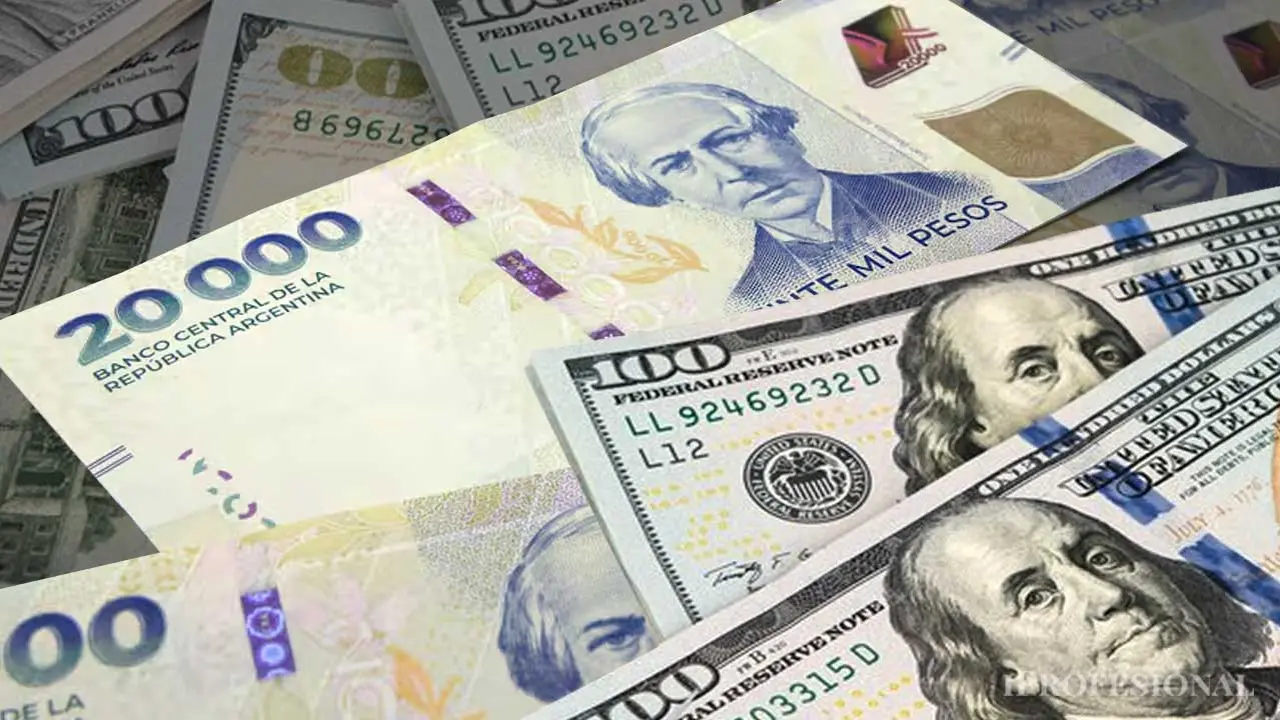
The Delinquency in Argentina escalated to alarming levels during 2025. Mercado Pago tripled its irregularity ratio in just 12 months, according to official data from the Central Bank of Debtors (CENDEU).
The largest virtual wallet in the country went from registering a default of 5.5% in January 2025 to reach 14.7% in January 2026. A jump that set off alarms in the financial sector.
The fintech of Marcos Galperin You are not alone in this crisis. The deterioration of payment capacity hit the entire system hard. The latest Report on Banks from the BCRA revealed that arrears on loans to households went from 2.67% to 10.6% in one year, the highest level in almost two decades.
The numbers reflect a vicious circle. Argentines ask for loans because their income is not enough to cover basic expenses. But later, they can’t pay those fees either.
Where is Mercado Pago located on the financial map
Non-banking entities face the worst situation. The delinquency in that segment approached 25% in early 2026.
Payment Market He remained in an intermediate step. With 14.7% irregularitywas located closer to traditional private banks than to non-banking financial companies, although without getting rid of the generalized problem of the system.
Company spokespersons consulted by Infobae maintained that the ratio is “in line with that of the main private banks” when looking at the segment of individuals. But there are important nuances.
The majority of Mercado Pago’s portfolio is aimed at individual consumers and families. That is, the segment hardest hit by the crisis. That is the public that suffers the most the deterioration of purchasing power.
A private survey with data as of December 2025 allows us to measure the differences. Orange Card recorded the highest default in the sector: 35.7%. A level that doubles that of Mercado Pago.
Mercado Libre, the unicorn that owns Mercado Pago, closed 2025 with 17.5% irregularity. Cencosud reached 25.5% and Consumption Credits reached 25.4%.
How digital banks compare
Digital banks show more controlled default levels. Bank of the Sun closed the year with 6.2% irregularityAlau Tecnología with 8.7% and Banco Columbia with 7.4%.
The average of the non-bank credit and digital banking segment closed 2025 in 21.7%. Almost 7 points above Mercado Pago.
This comparison places Galperin’s wallet in an intermediate zone. Closer to traditional banking than to higher risk entities. But with a jump in default that almost tripled its level in 12 months.
What types of credits register the highest delinquencies?
The personal loans They lead the ranking of delays. Delinquency in this segment reached 13.2% nationally.
The credit cards are not far behind. The delays in summaries climbed to 11% in January 2026a fact that especially worries banks and financial companies.
The collateral credits show an irregularity level of 6.3%. Mortgages, on the other hand, maintain the lowest arrears in the system: barely 1.3% arrears.
The deterioration is widespread. The general delinquency of financing to the private sector reached 6.4%according to the BCRA. Companies register 2.8%, with marked differences between sectors and sizes.
Why Argentines can’t pay their debts
The explanation lies in the deterioration of purchasing power. Salaries do not rise at the rate of services and rates. When a person cannot pay rent, bills or basic services, they turn to credit. But later, You can’t pay those fees either.and the circle closes.
The phenomenon is widespread throughout the country. It is not a problem of Mercado Pago or a specific entity. It is a crisis that affects all Argentine families..
On social networks, Marcos Galperin shared data that places Argentina with one of the lowest debt/GDP ratios in the region. An indicator that reflects the severe financial backwardness of the country.
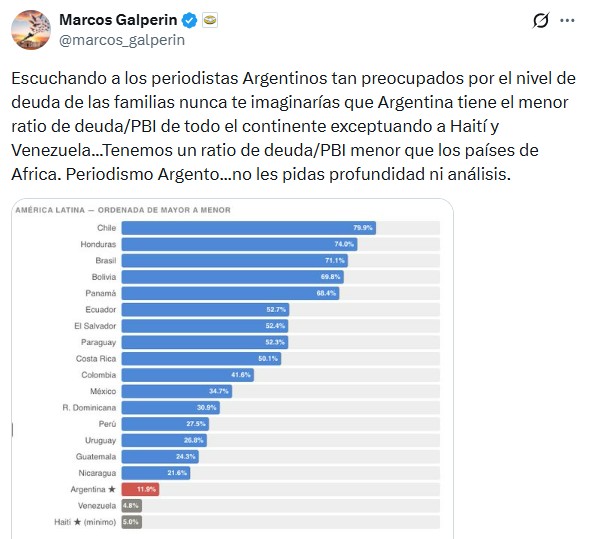
Marcos Galperin’s message on the debt/GDP ratio
“Listening to Argentine journalists so concerned about the level of family debt, you would never imagine that Argentina has the lowest debt/GDP ratio of the entire continent except Haiti and Venezuela.We have a lower debt/GDP ratio than African countries. Argento Journalism…don’t ask them for depth or analysis,” he wrote.
The Argentine financial system experienced a sustained deterioration in payment levels during 2025. Especially in the segment of loans to individuals. And the outlook for 2026 shows no clear signs of improvement.