In the Golden Hall of the House of Culture, music once again put into circulation a work that for years remained on the margins. The tribute concert to Hipólito Felipe Gutiérrez (1931–2009) was not only an instance of listening: it was, above all, an act of recovery and projection of a musical memory.
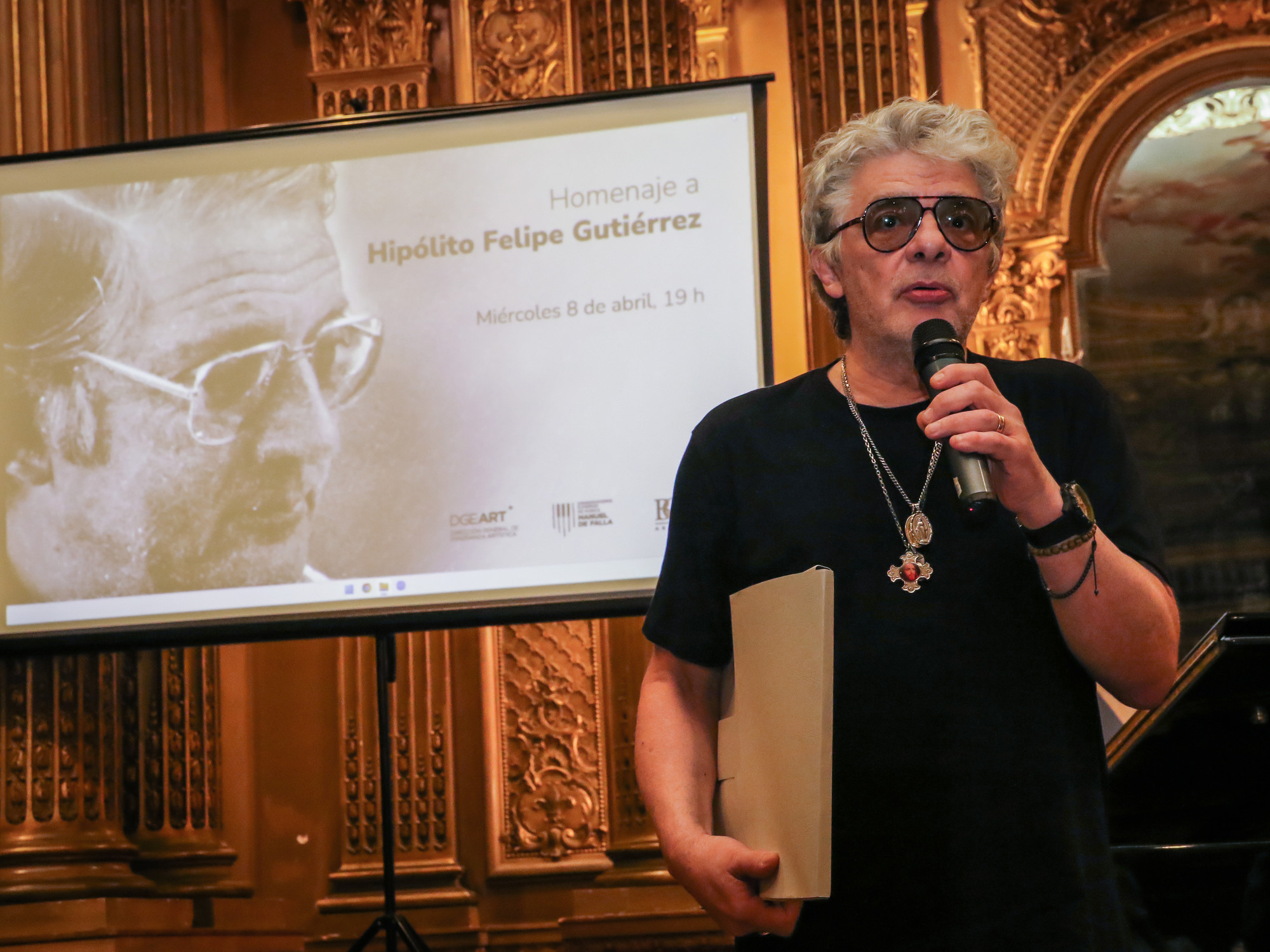
“We are very grateful for the opportunity to put my dad’s work back on display, which was always selfless,” he said. Juanseleader of Paranoid Micein tribute to his father, the composer Hipólito Gutiérrez. “We have waited a long time, not for recognition but for the dissemination that this stage of contemporary music deserves in our country.”
At 90 years old, Winny – Juanse’s mother – was present at the tribute. The musician highlighted her as a key figure in the composer’s life: “In very adverse circumstances she was a fundamental company. She understood the moments of concentration necessary to create and sustained that process.”
The event brought together cultural authorities, teachers, students and family members around a little-known figure in contemporary Argentine music. Within this framework, an agreement was formalized for the donation, digitization and preservation of its archive, with the aim of guaranteeing not only the conservation of the material, but also its public access.
 Juanse, along with his mother, Winny, young 90 years old.
The project involves the Library of Congress of the Nation and the Manuel de Falla Superior Conservatory of Music, which work on the organization of scores, manuscripts and sound documents.
“Conserving is not only preserving the material, but also guaranteeing access,” stated the technical team, headed by Antonio Pérez Botta. Digitization will allow expanding the circulation of the work among students, researchers and the general public.
The concert – performed by teachers and students – It was a first instance of that process: music once again sounded like a living experience. So far, a first section of the archive has been digitized (op. 1 to 9), used for pedagogical work at the conservatory.
 “The process does not end in the archive: the music needs to be played again, to be interpreted,” said Marcos Puente Olivera, director of the Manuel de Falla Conservatory.
Alejandro Santa, director of the Library of Congress, highlighted the value of institutional commitment and the role of libraries as spaces for meeting, cultural circulation and community building, underlining the importance of making these works visible to new generations.
A composer in context
Trained at the Manuel de Falla Conservatory and a disciple of Jacobo Ficher, Gutiérrez developed writing within the contemporary currents of the second half of the 20th century.
Its catalog includes works such as Prelude, Intermezzo and Fugue for woodwind quartet, Music for bows, the overture Unamunianaquartets, solo pieces such as the Piano Sonata and orchestral works such as Ode II. Some works achieved international projection: their Ode on texts by Raúl Aguirre He integrated tours in the Soviet Union.
 The tribute was in the Golden Hall of the House of Culture.
Among its milestones stands out the premiere of three eternities in 1971 at the Teatro Colón, with the Philharmonic Orchestra. Based on texts by Juan Ramón Jiménez, the work was awarded in the First National Tribune of Composers.
In addition to his production, he had an active institutional participation: he was a member of composers’ associations, the Argentine Music Council (UNESCO) and was a jury in national and international bodies.
More than an archive: a work in circulation
“The process does not end in the archive: music needs to be played again, interpreted, discussed, appropriated by new generations,” said Marcos Puente Olivera, director of the Manuel de Falla Conservatory.
 The faith concert performed by students and teachers.
Along these lines, recovery includes not only digitalization but its progressive incorporation into study programs, concerts and academic activities. Recovery thus implies a double dimension: patrimonial and pedagogical, highlighted Inés Sabattini, vice director of the Conservatory.
The pianist Mirian Conti contributed an emotional memory and evoked her bond with the composer: she met him as a child and remembered him as a close and generous presence, who listened to her progress carefully and encouraged her in her training. “He was my first artistic support,” he noted, highlighting his sustained influence over time.
Music as present
There is something especially attractive – and also challenging – in facing the work of a composer without biography, without explicit aesthetic genealogy, without the interpretive scaffolding that history usually offers us. What remains, then, is naked listening. And in this case, that listening reveals a voice that, although still in the process of decantation, already has a recognizable physiognomy.
The concert offered a first approach to that sound universe. The selected works outline a writing in search, with a voice that avoids conventional solutions.
 Gutiérrez was a composer of contemporary and classical music.
The Two Lyrics for Edithwith the participation of the pianist Laura Daian and the singer Marina García, opened the concert and are part of an aesthetic close to free atonalism, assumed with flexibility. The piano writing is dense, built from harmonic aggregates that privilege fourths, generating opaque sound surfaces. The voice neither dominates nor accompanies: it dialogues in a tense and expressive relationship. The vocal line avoids conventional lyricism, but finds moments of intense expressiveness in its most austere inflections. There is a personal appropriation of language: a syntax that seems to arise from intuition rather than from a method.
The contrast, the piano marchperformed by Diego Ortiz, the composer moves towards a playful, even pedagogical register, inscribing himself in the tradition of children’s pieces of the 20th century.
The last work of the program, To read in an interrogative form -A- “Wise skin”based on a text by Julio Cortázar, suggests another stage of the composer. The piece exhibits a different language, more open in its timbral and formal conception. The organic – soprano (Marina García), flute (Ana Ligia Mastruzzo), clarinet (Griselda Giannini), violin (Irene Barrantes), cello (Juan Ignacio Zubiaurre), bandoneon (Aron Mathias Coronel) and piano (Inés Sabatini), under the direction of Nicolás Kapustiansky – is in itself an aesthetic statement. The texture is more open, the lines sinuous, and the speech progresses with a sense of exploration.
The bandoneon avoids direct evocations of tango, although its shadow is always present, like a distant memory. It is a stripped-down, almost abstract use of the instrument, it integrates it into the general texture without turning it into an emblem. The melodic lines, often sinuous, intertwine in a plot where each instrument seems to find its place in real time. There’s a sense of exploration, so you build as you go. Harmonious management, again, is personal: it does not respond to an identifiable system, but it is not arbitrary either. There is an internal logic, still in formation, that sustains the discourse. The work does not close on itself; rather it leaves questions open, as the title suggests.
Beyond the formal instance, the meeting made something central evident: Gutiérrez’s music does not belong only to the past. Its reappearance on stage opens questions about the construction of the canon, the circulation of works and the mechanisms of forgetting within musical history.
In that sense, the tribute was not only a retrospective gesture, but an intervention on the present: an invitation to listen again, to replace what was left out and to reconstruct, from musical practice, a broader and more diverse memory.
This event invites us to reflect on other legacies that remain, in practice, inert. Such is the case of the legacy of Juan Carlos Paz, a central figure for understanding the history of Argentine music of the 20th century. However, access to his work in the National Library, even without digitization, remains extremely restricted – the scores cannot even be photographed – which seriously hinders its dissemination. It is, in short, a petrified legacy, waiting to be reactivated.
Tribute to the composer Hipólito Gutiérrez
Preservation, donation and digitization of your work
Program: Two Lyrics for Edith- Poem by Edith F. de Conti; I. El Pinar (Escobar’s House); II. Life; Marina García, soprano; Laura Daian, piano; Children’s pieces March; Diego Ortiz, piano
To read interrogatively -A- “Wise skin”, Poem by Julio Cortázar
Director: Mtro. Nicholas Kapustiansky; Marina García, soprano; Ana Ligia Mastruzzo, flute; Griselda Giannini, clarinet; Irene Barrantes, violin; Juan Ignacio Zubiaurre, cello; Aron Mathias Coronel, bandoneon; Inés Sabatini, piano.
Date Wednesday, April 8: Place Golden Hall – House of Culture Av. de Mayo 575