
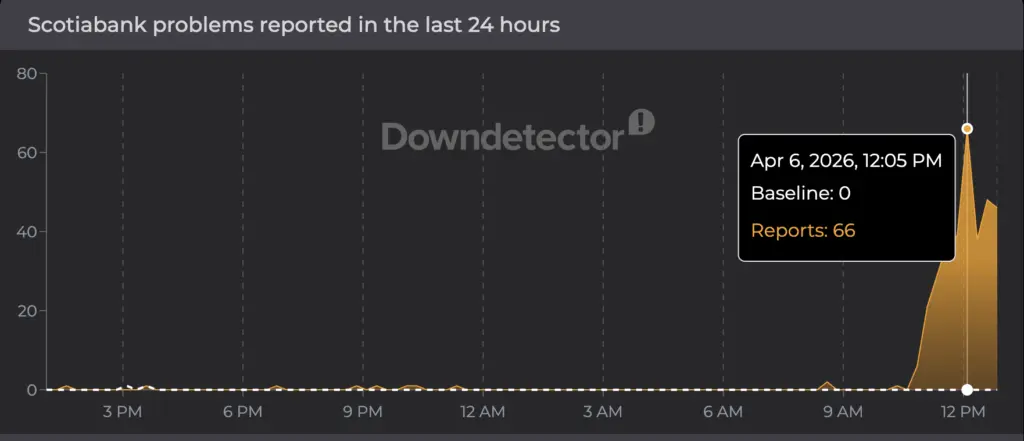
Scotiabank Mexico’s digital infrastructure faces operational interruptions this April 6, 2026, affecting access to mobile applications and the execution of electronic transfers after registering peaks in failure reports in the country’s main urban nodes.
You may also be interested in: Guide to blockades and routes affected by the National Transport Strike this April 6
X-ray of the technical anomaly in the banking ecosystem
Digital services telemetry indicates an operational crisis of a technical nature. The analysis of current data reveals a sudden increase in the incident rate, exceeding 60 simultaneous reports in the moments before noon. This situation directly compromises the availability of mobile banking, preventing users from carrying out basic transactions or consulting their financial balances.
This intermittency is not an isolated event. The behavior of the system shows a pattern of technical regression, since the current failure bears direct similarities to the severe drop experienced on March 6. The recurrence of these events highlights a persistent vulnerability in the responsiveness of application servers to transactional demand.
Determinant vectors in system saturation
The systemic instability of the platform responds to structural factors that converge at critical points of failure:
- Legacy infrastructure saturation: Implementing hybrid cloud architectures creates specific bottlenecks in authentication processes. During demand peaks, the system is unable to process access requests, resulting in service outages.
- Update protocols and incompatibility: Recent maintenance windows and the application of security patches have generated conflicts with various mobile operating systems.
- Log-in flow failure: It is estimated that 63% of affected users fail to get past the login screen due to these software inconsistencies.
Operational volatility during the first quarter of 2026
Scotiabank stability has shown erratic performance so far this year. In March 2026, specifically on Friday the 6th, one of the institution’s deepest falls was documented, with widespread paralysis in the SPEI system and mobile banking.
Despite a brief normalization phase, the current spike in incidents in Mexico City, Monterrey and Guadalajara suggests that the solutions previously applied were temporary or insufficient to contain the current volume of operations.
Recovery horizon and contingency measures
Operational uncertainty will extend for the next 24 to 48 hours. The technical management of the entity has confirmed the execution of protocols to mitigate intermittency, which implies the restart of server clusters.
It is essential to anticipate periods of intermittent total disconnection during these stabilization processes. Monitoring official channels is recommended, since the execution of unscheduled maintenance is likely during low transaction times to correct technical debt.
The structural challenge of traditional banking compared to Fintech
Scotiabank’s current problems are the reflection of a historical challenge in digital transformation. The institution has allocated multimillion-dollar investments to consolidate its “Global Digital Banking” strategy, but the integration of regional systems and the migration of massive databases have accumulated a complex technical burden.
Unlike digitally native entities that operate entirely in the cloud, traditional banks face the friction of modernizing “Core” systems without stopping daily operations. This transition generates a constant tension between the robustness of old systems and the agility demanded by the modern market, leading to reported service outages.
Dynamics of impact on the financial market
The lack of availability of liquid assets generates a displacement of the actors involved:
- Direct impact: End users with immediate payment commitments, such as payroll or supplier settlement, suffer the greatest economic impact.
- Reputational wear and tear: Technical support and public relations teams face constant pressure due to the erosion of brand trust.
- Flow migration: Direct competitors, especially Neo-banks and other traditional financial entities, act as indirect beneficiaries by attracting users who seek greater reliability and availability in their financial services.