In the last few hours, the Justice of the City of Buenos Aires issued a precautionary measure that obliges the Buenos Aires government (GCBA) to guarantee urgent accommodation to the 300 families affected by the recent collapse in the Procrear “Estación Buenos Aires” housing complex in Parque Patricios.
The precautionary resolution was issued by Judge Francisco Javier Ferrer, head of the Court of 1st Instance for Administrative and Tax Litigation No. 23, within the framework of the cause promoted by the Right to the City Observatory together with other neighbors.
The collapse in Patricios Park
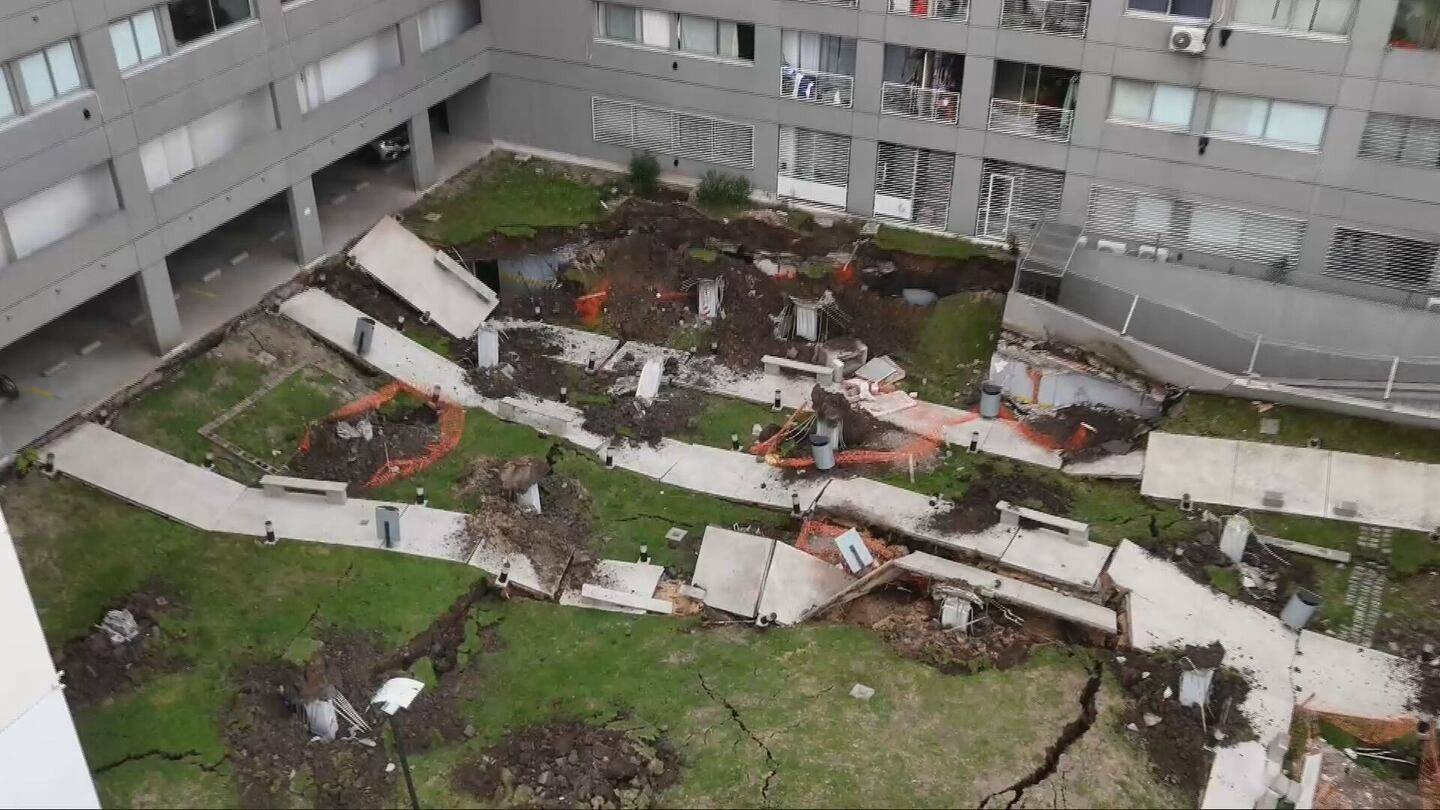
On March 3, between 04:30 and 4:45 in the morning, there was a “sudden, massive and total structural collapse” of the load-bearing slab of the central patio in Sector 2 of the aforementioned complex, located at 907 Mafalda Street. The structure collapsed into the basement: it destroyed about 65 vehicles.
Although there were no fatalities or serious injuries, the GCBA proceeded to cut off supplies and ordered the preventive evacuation of some 300 families, affecting more than 700 people.
Faced with this situation, Jonatan Emanuel Baldiviezo, president of the Civil Association Observatory of the Right to the City, and Dr. Marcos Zelaya presented a collective protection action. The lawsuit requested the issuance of a precautionary and precautionary measure to demand from the GCBA “the immediate provision, logistical allocation and full payment of hotel rooms” or similar accommodations for the evacuated families, arguing that many were “homeless.”
The judicial situation
The GCBA reported having deployed assistance operations through its different areas of action. In this sense, he pointed out that 44 family groups, which would represent a total of 120 people, were transferred and housed in hotel establishments managed within the framework of the assistance operation and 224 people chose to relocate by their own means, either in the homes of relatives, relatives or other housing alternatives.
The Court held that «The accompanying information does not account for the total number of affected subjects, nor does it discriminate how many of them are in a vulnerable situation, so that it can be known what happened to those who did not relocate by their own means or do not belong to the assisted family groups. Likewise, there is no information regarding the stability of the assistance provided to the 44 family groups, in the terms of General Observation 4 cited above. The same deficit in terms of information on the stability of the relocation affects the 224 people who would have temporarily chosen to use their own means.
Basing his decision on the right to decent housing enshrined in article 14 bis of the National Constitution and article 31 of the Constitution of the Autonomous City of Buenos Aires, the magistrate resolved, in the terms of art. 186 of the CCAyT:
- Order to GCBA that “guarantees effective and adequate housing assistance, in accordance with the adequacy parameters established by General Observation 4 of the Committee of the Covenant on Economic, Social and Cultural Rights, to the inhabitants of the buildings located in Sector 2 of the Procrear ‘Estación Buenos Aires’ urban project (…) who, as a result, are currently in effective or imminent homelessness.”
- Request detailed information from the GCBA until the final precautionary measure is resolved. The Buenos Aires Government must:
- Provide a “socio-housing survey” of the evacuees to identify the makeup of the family groups and the accommodation conditions.
- Highlight circumstances of priority vulnerability (families with girls, boys and/or adolescents, people over 60 years of age, victims of gender violence and/or people with disabilities).
- Inform about the assisted families, “detailing what the assistance consisted of and how long it will last.”
- Specify whether you enabled “any special registration protocol or process” for displaced families.
Baldiviezo maintained that “the precautionary measure will remain in force until the court has the required information and the final decision is issued on the admissibility of the precautionary measure. “This resolution marks an immediate precedent regarding state obligations to guarantee international habitability parameters in the face of emergencies and structural disasters that cause sudden housing vulnerability.”
Research on the company
Meanwhile, another judicial branch continues the investigation into those responsible. According to the first inspections, a slab of approximately 50 by 70 meters It gave way abruptly into the subsoil, causing the partial collapse of the parking lot and a large hole in the central patio of the complex.
La Constructora Sudamericana (Cosud), responsible for sectors 1, 2 and 10 of the Buenos Aires Station complex, issued a statement in which he claimed to have immediately activated the emergency protocols and initiated the corresponding investigations to establish the causes of the collapse.
The company, active since 1970 and participating in emblematic projects in the country, stated that it was “at the complete disposal of the competent authorities,” including the City Fire Department and Civil Defense, and expressed its collaboration in all the required technical expertise.
Authorities are working with structural engineers to determine whether the collapse was due to structural failure, water leaks, calculation errors, execution problems or a combination of factors.