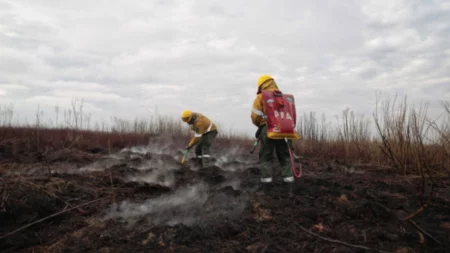
Between December 2023 and so far in 2024, the provinces of Córdoba, Salta, Jujuy, Buenos Aires and Corrientes, among others, suffered strong storms and floods that left thousands of families evacuated and material damage. On January 25, a fire started in the Los Alerces National Park, in Chubut, which affected 8 thousand hectares. During 2023 alone, the fire keen to 500 thousand hectares and caused at least 2,212 fires throughout Argentina, according to data of the Ministry of the Interior obtained by this means through a request for access to public information.
Despite the environmental and climate crisis that Argentina is going through, and which materializes in a greater number and frequency of floods, fires and droughts, The administration of Javier Milei (La Libertad Avanza -LLA-) allocated fewer funds for caring for the environmentthe protection of forests and fire management, according to a analysis from the Environment and Natural Resources Foundation (FARN) published last April.
Furthermore, at the beginning of LLA’s management, the Ministry of Environment and Sustainable Development of the Nation was dehierarchized and was absorbed by the Ministry of the Interior. The portfolio became part of the Ministry of Tourism, Environment and Sports, led by Daniel Scioli.
What happened to the budgets of the National Fire Management Service and the funds for forest conservation in the first months of 2024? What happened during the government of Alberto Fernández (Frente de Todos)? We tell you in this note.
Less environmental budget for 2024
The 2024 Budget Bill was not approved by the national Congress, so the Executive Branch extended the 2023 budget for the current year.
According to a analysis of the FARN published last April, The 2024 budget of the Undersecretary of Environment presents a slight drop in nominal terms, which implies a reduction in real terms (that is, discounting the effect of inflation) of 65.4%. “In other words, a third of the budget is available compared to last year,” the report states.
In general terms, what is allocated to the Environment (that is, considering what is allocated to this area in other state agencies, in addition to the specific undersecretariat) in the national budget had a fall of 28.9% in its participation in the total budget in relation to 2023.
On the other hand, the budget allocated to the National Parks Administration had a nominal increase of 5.7%, which implied a reduction in real terms of 63.4%. These 2 items represent 0.16% of the total national budget.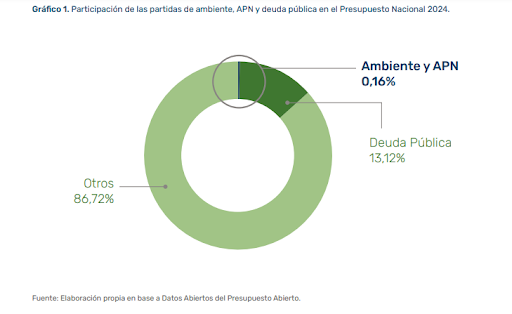
Source: FARN
It is important to clarify that the Executive Branch has the power to reallocate the funds that were originally budgeted, that is, it may happen that the numbers allocated to these items grow, are maintained or reduced for this year.
This medium consulted the Undersecretariat of Environment to find out if some of these items will be increased, but until the time of publication of this note there was no response.
During a meeting with the Argentine Network of Scientific Journalism, Undersecretary Ana Lamas said that she did not yet have a 4-year agenda because “there are many things to still decide,” such as credits and international cooperation, such as those that the former Ministry had with the Inter-American Development Bank (IDB). “All of this is being restructured; today we cannot have those funds as before, because the Ministry of Economy restructures them (sic), so we cannot have a 4-year plan,” Lamas reported.
If you look back, during the government of Alberto Fernández (Frente de Todos) The amounts for the former Ministry of the Environment decreased by 18% in real terms between 2022 and 2023but they grew between 2020 – the first year of his administration – and 2023. These conclusions arise from the budget execution data analyzed by Checked.
A Forest Law that remains unfunded
When looking at the details, one of the key points in relation to the environmental budget usually revolves around the so-called Forest Law. The Law 26,331 of Minimum Budgets for Environmental Protection of Native Forests – sanctioned in 2007, during Kirchnerism – regulates the restoration, protection, use and sustainable management of native forests.
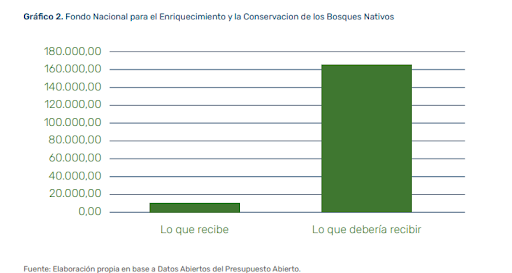
The rule establishes that the amounts for the National Fund for the Enrichment and Conservation of Native Forests “may not be less than 0.3% of the national budget.” These funds serve to compensate the jurisdictions that conserve native forests and are distributed annually among those that have prepared and have their Native Forest Ordinance approved by provincial law to finance compliance with the law.
In any case, that goal would not be met with the current budget numbers. The FARN analyzed that this fund should receive by law, by 2024, $164.2 billion. “However, it is observed that, as of March 2024, “It is only scheduled to receive $9,000 million, 18 times less than what is required by law.”, indicates the analysis of the environmental organization.
This game too remained frozen in nominal terms, which implies a real fall of 65.4% by 2024, according to FARN calculations.
Source: FARN.
According to another analysis of the NGO Fundación Vida Silvestre, what has been allocated – so far – for the fund represents, in 2024, 10% of that 0.3% of the national budget indicated in the law.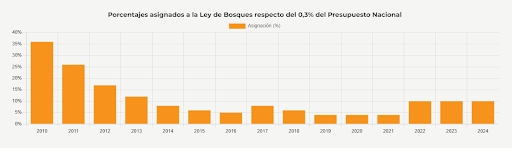
Source: Wildlife Foundation.
In any case, the Forest Law is underfunded for years and, since its sanction in 2007, no government complied with the indicated goal. According to the Wildlife Foundation, in 2022 and 2023, During the Frente de Todos government, 10% of that 0.3% of the entire national budget indicated by law was also allocated. Between 2019 and 2021 that amount had been even lower: 4% of the indicated goal.
During the administration of the Front of All funds they descended during all the years of that administration, with the exception of 2021.
According to the Wildlife Foundation, this affects negatively “both to the control, monitoring and surveillance, and to the promotion of sustainable use and restoration of forests.”
“The lack of financing in the Forest Law is a recurring problem, a bad habit that all pre-existing governments have fallen into. What we need is to improve not only the availability of funds but also the implementation and performance by the jurisdictions, and that this be articulated with a good set of indicators for monitoring the use and efficiency in the use of these resources,” explained Manuel Jaramillo, general director of the Wildlife Foundation, in dialogue with Checked.
For fire management, underexecuted funds
In relation to fires, the most important program is that of the National Fire Management Service (SNMF).
In 2020, through the Law 26,815the National Fire Management Fund was created, a trust that is nourished by contributions from the General Treasury of the Nation and the collection of 3 per thousand of insurance rates (excluding life insurance).
In relation to the Treasury resources, the national Budget includes for this year an item of $10,973 million for current expenses and another of $14.4 million for machinery and equipment to provide the National Fire Management Fund, according to Indian the FARN.
Furthermore, the SNMF has of $12,101 million, which, according to FARNthey have not yet been executed.
In 2023, the executed budget of the SNMF decreased in real terms in relation to 2022 – according to data analyzed by Checked-, but the budget executed for this item increased more than 300% (2020-2023) throughout the Fernández government.
In relation to other items related to fire management, as of March 2024 only were executedAccording to the report, $275 million from the Fire Management activity – within the Conservation and Administration of Protected Natural Areas Program of the National Parks Administration -, which has been allocated $1,626 million.
“In general terms, there is a clear vocation for the elimination of specific funds, going back decades in regulatory matters. The truth is that when the State decides to have a focused policy, that focused policy also needs to have assigned resources. It seems to me that this is a question of enormous ideological importance that is in the background, that goes beyond a budgetary restriction,” he told Checked Juan Carlos Villalonga, former national deputy for Cambiemos (2015-2019) and specialist in sustainability and energy transition.
The funds are necessary to face the devastating fires that occur in the country. During 2023 alone, the fire keen to 500 thousand hectares and caused at least 2,212 fires throughout Argentina, according to data of the Ministry of the Interior obtained by this means through a request for access to public information.
According to data from the SNMF, in 95% of cases fires are caused by human action, and among the first causes is the use of fire to prepare grazing areas.
The alarm of environmental organizations due to the Bases Law
On April 30, the Chamber of Deputies of the Nation gave half a sanction to the new Bill of Bases and Starting Points for the Freedom of Argentines. Approval by the Senate still remains for it to become law, but environmental organizations warned of the risks that this initiative could imply for the environment.
In a letter to the Upper House, various environmental organizations they pointed out that The bill empowers the Executive Branch “to modify, transform, unify, dissolve, liquidate or cancel public trust funds.”such as the Trust Fund for the Environmental Protection of Native Forests and the National Fire Management Fund.
Furthermore, they warned that the dissolution of the Trust Fund for the Environmental Protection of Native Forests would imply the tacit repeal of several articles (from 30 to 39) of the Forest Law: “The fund intended to compensate the jurisdictions that conserve native forests for the environmental benefits that they provide and the holders of lands on whose surface the native forests are conserved would cease to exist, harming the development and maintenance of a monitoring network and information systems of the different jurisdictions.”