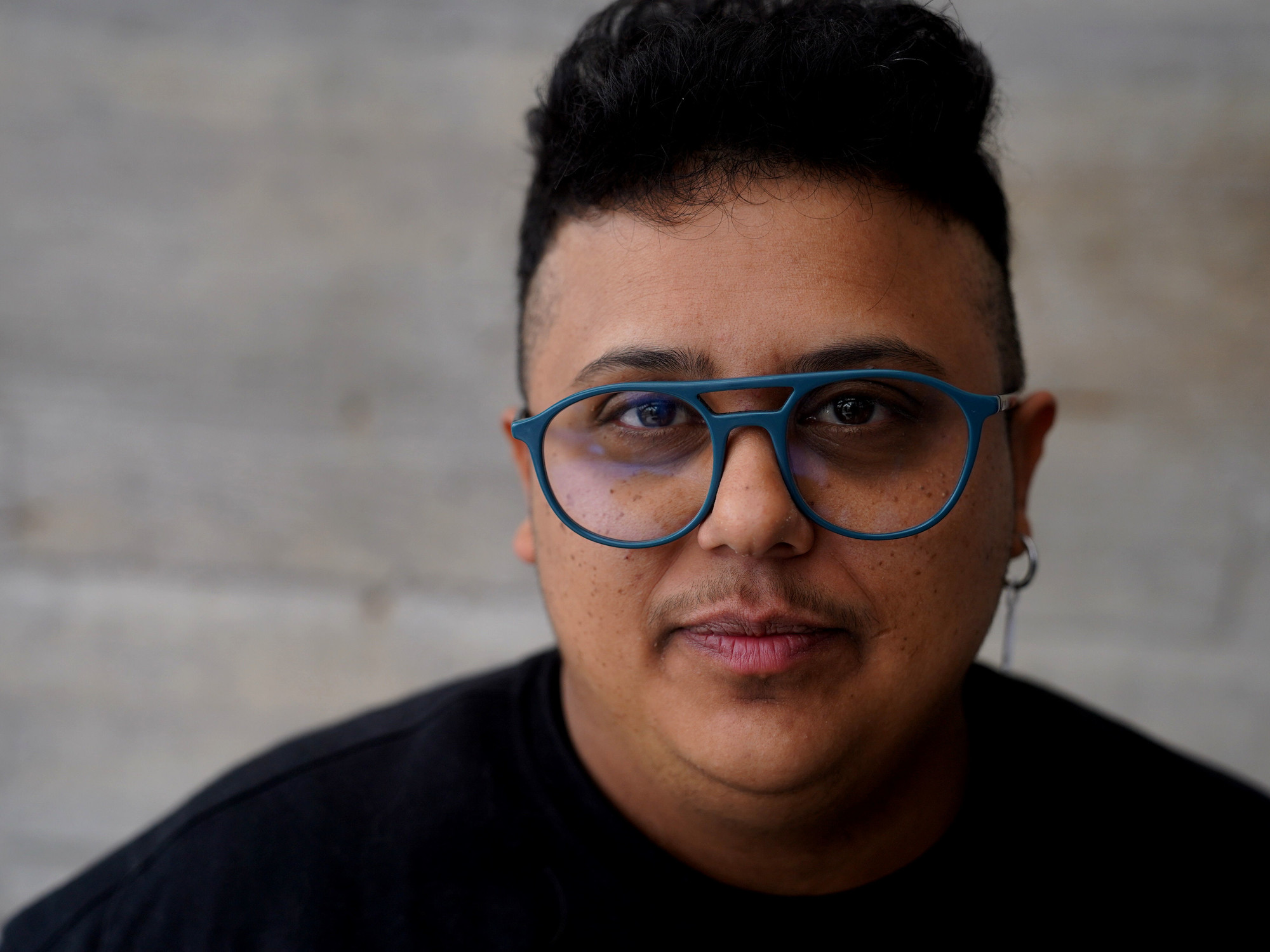
If someone calls him Lu or Luciana on the street, he won’t turn around. But that comes from before even having a male name: he, strictly speaking, was always called by his last name. Mocchi.
A few years ago his ID changed and now it says Lucas Mateo Mocchi. Luke Matthew: biblical. Not because of religion, but because of devotion and writing. Because in their songs there is something of a profane testament, of a pagan gospel, of sacred —and atheistic— songbook of the Río de la Plata.
 Mocchi reviews a story of origin marked by loneliness, the street and chance.
It is not just that it has opened for Paul McCartney —although, well: he opened for Paul McCartney!—. In Mocchi There is something else that matters more: that mix of street, tenderness, intimacy and politics with which his songs seem to speak at the same time to the lost kid, the veteran music lover and anyone who still believes that a voice can break through, (not so) alone against everyone.
If an entry key is needed, it can be “Diaz without you“, one of those songs where heartbreak sounds with the cruelty of the poet Idea Vilariño and with the optimistic duel of the film Before dawn: understand that, as you begin to forget someone, that someone also begins to forget you.
This Saturday April 11th plays in CABAat Quetren Club Cultural, with its cycle Hacernos casa: a good gateway to one of the most unique songbooks of recent Rio de la Plata music.
From loneliness to a miracle-recorded first album
-Where does your relationship with music come from?
-From a very young age. Until I was 12, I spent a lot of time alone, and in that loneliness I listened to music convulsively. I recorded songs from the radio on cassette, waited for them to play and sang along. I lived a lot in my inner world. In my house we listened to a lot of music: I don’t come from a family of musicians, but I do come from a music-loving house.
And before any idea of a career there was already that need: I found a little sheet that I had made as a child that said “Admission 1.50 and if you don’t enter it is the same.” It was for a show in the patio of my house. I was eight or nine years old.
 “My dead name was never alive,” Mocchi says when talking about identity, voice and transition.
-However, from there to imagine yourself a musician…
-Total. I didn’t have that permission. Afterwards I walked a lot on the street, in Montevideo, stopping with people at the INJU (National Youth Institute). We were part of the street ecosystem of that place. And by a very strange coincidence, some guys who were looking for a candombe workshop ended up calling me.
I didn’t give workshops, I didn’t know anything about music, I didn’t have a record, I didn’t have anything. But I tried to help them anyway, because it was what I would have liked them to do with me. From there came the invitation to go see Lila Downs. And there everything changed.
-And when did you first feel that someone from that world really saw you?
—The incredible thing is that they didn’t even hear me sing first: they heard me speak. And they told me: “You have to sing. Look at the strange voice you have”. I was totally ashamed. I told them: “No, I don’t sing, I don’t do this.” But it changed my life.
I felt that someone was believing in me without having heard me sing, seeing me as a peer in something that I loved and that, until that moment, I felt alien to. I was there, with my only pants, looking at the musicians from outside, and one of them told me: I want to listen to you.
 Between intimacy and politics, Mocchi built his own work within the River Plate song.
–Yayo Serka, the drummer of Lila Downs. He told me that if I ever went to New York to call him. I thought: when am I going to go to New York… And a week later an aunt called me to go. There it already seemed like a novel, but the most unusual thing was missing: I didn’t have his phone number or any way to look for it.
I was scared to death on a plane, I stopped in Panama and, in the middle of the airport, I came across it by chance. So, straight ahead. He put me in the VIP room and insisted again that he wanted to hear me sing. I kept saying no. I had a MySpace with five songs recorded with the computer stick and a guitar that sounded terrible. All very stupid.
A stick in hand and a revenge
-And when did it start to become real?
—When I ended up calling him. I landed in Queens, they heard my songs and invited me to play. Later, already in Uruguay, I had the album rehearsed but I didn’t have the money to record it. Yayo moved everything and that’s how the first one came out: with musicians from Lila Downs—among them, a bassist who played with Thalía and Ricky Martin—and total precariousness. I got the battery through Facebook and I made those musicians walk on July 18, in Montevideo, because I didn’t even have a ticket. That mixture of miracle and poverty was my first album.
-As a child you wanted to be a pianist, but your history with the piano was not kind at all. What happened?
 Mocchi built a work where intimacy, politics and song coexist without solemnity.
—I wanted to be a pianist from a very young age. They had given me a scholarship at a conservative conservatory. I once told the teacher that I had a musical idea and he replied: “Don’t say that again. The music is all made up.”
Another day he hit me on the hand with a stick. I left, I took the final exam anyway, preparing alone, I passed and I left the sheet music on the table telling him: “I’m never going to play the piano again.” I was eleven years old. And it was like that until much later, when a piano appeared in a house where I lived and I composed “Days Without a Voice.”
Over the years, to Mocchi music began to be more than just songs. I also find, community, a way to be with others. It talks about recitals, but also about what happens around it: people who buy tickets from each other when someone can’t pay for them, help that appears in the project’s WhatsApp group, links that continue after the show. Once, he counts almost in passing, Even a Uruguayan deputy helped him when he lost his car.
In that network he sees a way of doing politics. It also happened to him in a public school, when he was invited to sing at a sixth-grade graduation ceremony and younger kids said goodbye to those who were leaving with a song of his. He had also left public school and feels that those institutions sustained him. “I try to leave more than songs and take more than a collection”says.
What Paul McCartney left behind
-What did opening for Paul McCartney really leave you?
—It was important, but more as a revelation than as a consecration. I had idealized the idea of playing in a stadium and I found something quite cold: people very far away, full of cell phones, and an almost perfect image of a society, where those in front are usually the most powerful and those who see the worst are the least privileged.
It helped me materially: I was able to buy a guitar and things to record. But it also left an uncomfortable mark on me: For a long time there was more talk about my body, my poverty or my origin than about my music. That made me panic and even took me away from playing for a while.
“My dead name was never alive”
-I also wanted to ask you about your identity. Do you feel that something changed or that, rather, that you could have named it differently?
-In my case I don’t feel that my identity has changed. I was always Mocchi. I was never Luciana, nor Lu. My dead name was never alive, actually. What happened is that, when I recorded the first album, I felt like I needed a stage name and I ended up making someone exist who had never existed in my daily life. Over time I realized that when someone calls me Luciana, they don’t really know me: they know a stage of my work. Because They always called me Mocchi.
—So, more than discovering something, it was managing something that was already there.
 Mocchi, between tenderness, weather and a way of making the song something more than songs.
-Exact. I don’t experience it as “I realized I was trans.”. I experienced it more as realizing that I could manage my identity. And something also happened to my voice: it had been getting deeper naturally since the first albums, and then I did a very slow treatment, with medical control, not so much for identity as to stabilize it and not get so tired when singing.
I thought: why couldn’t I do it this way too? Now I have another document and legally I am Lucas Mateo. But I don’t feel like that name fully represents me either. I am Mocchi. Recently they told me: “How biblical.” And I thought: if you only knew.