The presence of snakes in the mountainous area of our region has always been the cause of fears, assumptions and stories – some more true than others – that have been passed from generation to generation, sometimes fueling a generalized phobia and without much reason.
It is true, if you remember that a viper was the first great universal villain, it is possibly more understandable that over the years there has been an almost natural aversion to this species. Later, literature and television and film screens were responsible for magnifying that feeling even more, often transforming it into terror.
And that, unfortunately, too often ends up becoming false information. They are shown and conceived as demonic, poisonous, aggressive, rutting, gigantic and lurking beings, when in general – in our region especially – fiction is quite far from reality.
To make it clear: there are 15 species of snakes that currently exist in the area of the Serrana de Tornquist region and, of those, only two are poisonous: those known as yararás Grande and Ñata; the bite of the others can practically be described as harmless.
On the other hand, these two can cause complications, especially if they are not treated immediately: health problems could only appear if you do not go to a doctor in the first hours after the bite. Of course, always talking about the species typical of our region.
The point, it is understood, is to have the necessary tools to put aside certain stigmas, fears, myths and even feelings that are generated and crossed when encountering one of these animals. This is explained by Agustina Barrutieta, from the National University of La Plata, who highlights that there are some basic issues to identify species, which can be seen with the naked eye and from a safe distance.
“For example, you can take into account the coloration or spots they have on their body. It is easier to explain which ones are poisonous or have venom of medical importance to, by ruling out, know which ones they do not have. So, when it is known that in the Comarca or Bahía Blanca there are only two species of poisonous yarará, it is known that the rest will be harmless. That already tells us a way to act,” he comments.
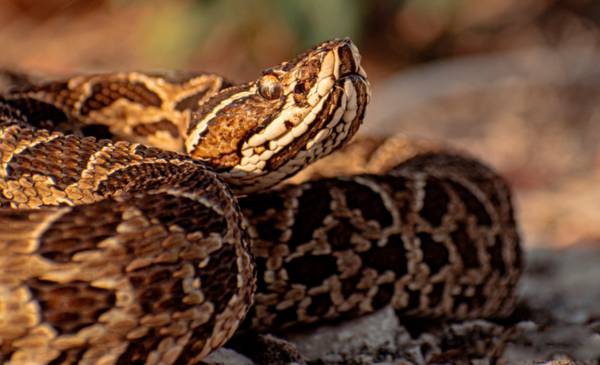
As said, in these parts only the Grande and Ñata yararás imply some type of danger. The first of them is easily recognizable by having brown spots along the body, shaped like kidneys or telephone tubes, with crosses on them, as well as a triangular-shaped head. It is the one that has the most encounters with people, since “it can be in more urbanized places.”
“The other one, the Ñata, is known that way because it has something like a scale on its snout, which simulates having a snub nose. It is normally harder to find, even if you look for it; it is found in places closer to the coast, sandier and not with so much rock,” he points out.
The Ñata does not have a pattern of spots similar to a kidney, but rather they are square and irregular in shape. In addition, it has scales that are not attached to the body – as is the case in other snakes – and give it a “rough appearance, as if they had relief.”
The sizes depend on the stage of life: when they are born, they can be less than 20 centimeters, but they reach 2 meters in length. ”Generally, an adult is between 50 and 70 centimeters, or maybe a meter,” he clarifies.
Encounters with these animals are generally rare, since “they are not so common to find”: they do not look for places to be in contact with people, but rather shelter sites that sometimes coincide with those occupied by man.
“Normally these are places where there is wood or food, and because they approach the houses or we can find them on the roads or under stones. As they do not generate their own heat, when the temperature begins to rise they go out to look for warmth in the sun. That is why it can happen that bite accidents occur in the mountains. But we must also keep in mind that, when faced with an encounter, it is not that they are in danger: if you give them space and do not try to grab them, they will leave and will not try bite,” he says.
The direct attack or the image of the snake jumping to bite a human being, explains Barrutieta, is part of a myth that is often cinematic: “Normally they want to be calm; they are not going to run and attack us when they see us.”
This time of year, when higher temperatures begin to occur, also coincides with their reproductive period: in the face of more benign thermal records they “activate” – after a process called brumation, similar to hibernation in mammals – and look for a partner to reproduce.
“This is also why we find them much more,” he says. “In any case, they are animals that, as soon as they are born, have a life alone, independent of others. But that does not mean that they do not defend themselves if you step on them; and the only way they have to do so is by biting.”
To do this, there are a series of precautions, known and not very complicated, when entering a natural environment where you cannot clearly see where you are going: appropriate footwear and pants, looking for clear paths and carrying an element – such as a long branch – to touch where you are going to step. The latter also warns the animal, so it will escape. Furthermore, since they do not have hearing, snakes feel the vibrations in the floor and usually leave in advance.
“That’s also why it’s rare to see them,” he points out.
Poison and bite
Barrutieta explains that although the issue of snake venom can cause fear or aversion, in Argentina there are normally no cases of deaths for this reason.
“In the event of an accident, whether with a poisonous snake or not, the most important thing is always to go to the doctor, the hospital or the nearest health center. You should not trust yourself thinking that there is time, because then there will be a better chance of reversing the symptoms,” he says.
In the case of the poisonous snakes that exist in our area, the effects are necrotizing and hemotoxic; In other words, they cause cell death and have an anticoagulant and slightly hemorrhagic effect in the wound area. “One is going to feel pain and that part of the body is going to become inflamed; and if several days go by without going to the doctor, it can have consequences on the kidneys.”
Nor can we talk about times in the effect of the poison, because these change depending on whether it is a child or an adult, or has some type of pre-existing or underlying disease, for example. The important thing, and this is also emphasized by Health Region 1, is not to wait and go immediately to a doctor.
“There are factors that can worsen the symptoms and symptoms that appear more quickly. But you have to understand that they are not deadly or immediate poisons, nor believe that because someone was bitten by a yarará they are going to die in an hour,” he said.
However, this does not mean that the rest of the species found in our area, mostly snakes, do not bite.
“There are some species that have a kind of poison that is not of medical importance, because they use it to better digest other animals; the teeth with which they inject it are at the end of the mouth, so it is difficult for them to bite with those teeth in the event of an attack on a human being,” he explains.