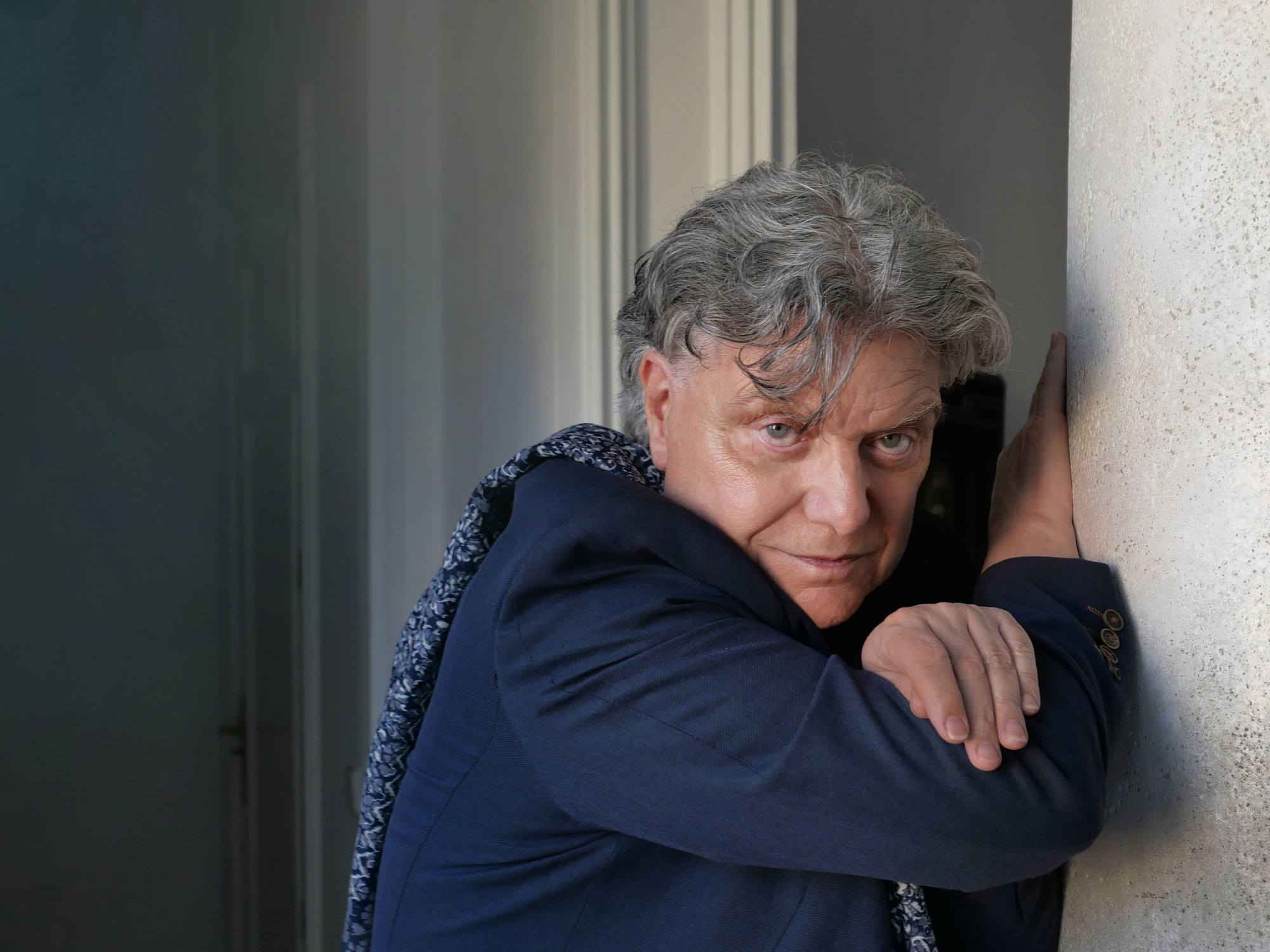
There is no premiere without an adrenaline rush, not even for someone like Hugo Anawhich has made vertigo a form of permanence. In the hallways of the Teatro Colón, while time is compressed in the pre-general rehearsal room, the regisseur moves with the exact mix of urgency and memory that defines men of theater: those for whom each production is, still, a first time. This time, the challenge is a diptych of high emotional voltage Pagliacci and Cavalleria rusticana– in a new production by Colón that seeks to detach itself from the wear and tear of the familiar.
Hugo de Ana does not return to the theater: he returns to his ghosts. “It’s getting more difficult,” he says, almost in passing, as if he were talking about a technical detail and not an intimate transformation. The last time had been in 2021, with The garden feint. Since then, something – or a lot – has changed. Not only the theater, but also the world.
He remembers his beginnings, when, at the age of 16, he hid in the boxes to watch Birgit Nilsson sing Tristan and Isolde. That scene – almost initiatory – condenses a way of living opera that today is perceived to be in retreat: a shared intensity, a humanism that is no longer fully recognized in the contemporary public, more dispersed, more crossed by other urgencies.
However, there is no easy nostalgia in his diagnosis. Ana distrusts the commonplace – “every time in the past was better” – and forces himself to inhabit the present, even when that present is elusive.
He works, he insists, for the public. Not for himself. And that statement, far from sounding concessive, takes on a particular density in his mouth: today putting together two titles as popular as Pagliacci and Cavalleria rusticana It involves facing a repertoire saturated with uses – from cinema to advertising, from The Sopranos series to mass culture – and, even so, trying to restore its original power.
“You have to come to the theater a virgin”says. The phrase, provocative in its candor, summarizes an ethic of reception that seems to go against the grain of the time: suspend over-information, let yourself go. In that gesture – as simple as it is demanding – De Ana places her bet. And perhaps also its resistance.
 Hugo de Ana took on the challenge of uploading two operas at the same time, with the same scenery.
A major challenge
-It is a great challenge to do two operas in the same night. Why do you think this tradition of uniting Cavalleria rusticana and Pagliaccibeing works of such different natures?
-It’s very complicated. It occurred to the Americans to make these two operas together for the first time. Now, in many places, they do only Cavalry… or alone Pagliaccibecause theaters are not prepared for a production of this magnitude. Sometimes it is preferred to do the satanic rhapsody of Mascagni, instead of Cavalry; and Pagliacci with something else, or with fragments of the circusof Charlie Chaplin. People began to understand that they are very different. And you have to play it that way.
-What way did you find to unite them?
-It is not easy to join them. I’m playing it like in the movies, matinee session and night session.
-Can a point of connection between the two be non-love?
-For me there are many points in connection and none. That is, they are two stories that I try to unite in some way. I try to unite them through, for example, the rotating disk where you see an action that takes place in a close-up and another action that takes place in larger spaces. But, in truth, I try to unite the works through a scenography or an atmosphere, even light-pictorial, where they can be assembled. I’m looking for an axis to try to make the show global.
-Where do you guide the search for that axis?
-I start with Pagliacci instead of, as is traditionally done, Cavalry and then Pagliacci. In Argentina it was released first Pagliacci and then Cavalleriaand they were always given separately. Then, in the ’40s, they started making them together. Pagliacci It premieres in our country with a traveling company, which was coming from Italy in those days. Then it premieres Cavalleria. That on the one hand, and on the other, Pagliacci It gives me the essence of what is called verismo, of the philosophy supposedly of verismo – from the moment people sing, verismo does not exist – for me it is “new Italian school”.
 Hugo de Ana, in charge of the rehearsals of “Pagliacci” and “Cavalleria rusticana”. Photo: Juanjo Bruzza
A cinema within the theater
-What is the concept that guides your creation?
-Start with the concept that we are in a metatheater, like there is a theater performance within the theater, where there is a game -in quotes- of masks, as told at the beginning, Tonio says it in the prologue. And at the same time, fiction says: “Everything is false, but everything can be true.” It is interesting to contrast two atmospheres, which in some way are totally different. I play a lot with that concept that I like: theater can be both cinema and theater at the same time. I take a lot of cinema’s point of view as well. The setting is a cinematographic set.
-Any particular cinematographic reference?
I rely a lot on using a much more concept, in quotes, fellinian for Pagliacciand a much more concept Viscontian for Cavalleriaalthough I never allow myself to take the name of Visconti or Fellini because it would be a shame. One of Fellini’s first films was The StradaI take many points from those miserable theater companies. Furthermore, another reason, when it was done Cavalleriain prose theater, it was done for the people, it was not done for the elite, it is not like The Lady of the Camellias.
-As for the setting, Cavalleria rusticana It takes place in Sicily at the end of the 19th century. Did you decide to maintain that historical framework in your performance or did you choose a more contemporary reinterpretation?
-Yes, I kept that framework, but in the setting I also took into account the ’50s in Sicily, when people didn’t wear shoes because they didn’t have money to buy them. The staging of the two operas is handled with a practically unique set design, as if everything happened on a film set: there are elements, projections worked very well by my video assistant, made with filmed fragments of artificial intelligence. You have to put the tools at the service of the show.
-That is, there is a stylistic continuity between the two works.
-Yes, there is a stylistic continuity in the atmosphere, but not in the acting.
 “Pagliacci” and “Cavalleria rusticana” will have a great display, with the Stable Orchestra, the Stable Choir and the Children’s Choir of the Teatro Colón. Photo: Juanjo Bruzza
-Of course, what one work proposes and another is very different. How did you work on this aspect?
-At the level of action or performance, they are two totally different works. In the performance of Pagliacci Everything is more visceral, everything is much more violent. In Cavalrythe violence is more contained. We have to offer two shows with different characteristics. In the case of Pagliaccithe spectacle leads to misery, and at the same time, to the destruction or machismo typical of the Novecento, where the subjugated woman is mistreated. Nedda is a poor abused woman and I make it very obvious.
With Pagliacci I put something much more violent into play because there are no positive characters. Even Nedda, in the end, is not a positive character, because she lets herself be fooled by everyone, even Silvio is not the ideal lover. Silvio wants to take her to bed and that’s it, then he’s going to leave her there along the way. It is a Gelsomina as in The Stradawhich is the starting point I’m playing with.
-Where does the validity of both works pass?
-Music is very important. They have broken, both one work and the other, a way of seeing things. It was called verismo. These are two works that were born through two contests, in the end people did not pay much interest in them. The incredible thing that makes this a very important work in the history, also of music, is that, from a really simple subject, Mascagni introduces into the music – I always say that it is a symphony with sung parts – a kind of atmosphere where a lot of religion is present, a lot of the sense of guilt, a lot of the sense of revenge, a lot of the sense of a people oppressed by religion. The character of Santuzza, for example, is oppressed within his own society.
-How do you evaluate the contributions of Pietro Mascagni and Ruggero Leoncavallo?
-Leoncavallo wanted to tie himself to the car of CavalryLet’s not fool ourselves. He was a character who followed fashion trends, something that Mascagni was absolutely different in that sense, he always tried to do things Avant Garde. Let’s not forget that Iris inaugurates exoticism in Italian opera practically almost 8 years before Madame Butterfly. There is talk of Zandonai and Francesca da Rimini, but Mascagni had made works of decadence such as Isabeau practically 5 or 6 years before, he directed it and premiered it at the Teatro Colón in Buenos Aires. I always insist that must be done Isabeautoday putting a naked lady on stage on top of a horse would be wonderful.
 Hugo de Ana, with a mask, attentive to the rehearsals of “Pagliacci” and “Cavalleria rusticana”, at the Teatro Colón. Photo: Juanjo Bruzza
-What is your vision of the world of opera today, in such a changing cultural context?
-The opera audience has changed. Before he was what was called a music lover, he was interested in knowing what was going to be sung. And before going to the opera I listened to the records three or four times at home. Which was horrible, but the singers had that problem. Now there is so much visual information, we are absolutely in a world of images, and now the problem lies with us, the stage directors.. There are those who want the most innovative and transgressive, like making everyone naked doing their business on stage. And, on the other hand, those who want everything to be traditional, see the little tree and the lagoon or the duck passing by. They don’t have a concept and everything gets mixed up. The spectator has to come to the theater and let himself go.
File
Teatro Colón 2026 lyrical season opening, new production
Program: Pagliacci/Cavalleria Rusticana Interpreters: Stable Orchestra of the Teatro Colón, Stable Choir of the Teatro Colón (Miguel Martínez, director) and Children’s Choir of the Teatro Colón (Mariana Rewerski, director) musical direction: Beatrice Venezi and Marcelo Ayub Stage direction, set design, costumes and lighting: Hugo de Ana
Pagliacci (Opera in a prologue and two acts)
Music and libretto: Ruggero Leoncavallo (1857-1919) Distribution: Denis Pivnitsky and Alejandro Roy (Canio); María Belén Rivarola and Marina Silva (Nedda); Fabián Veloz and Youngjun Park (Tonio); Ramiro Maturana and Samson McCrady (Silvio); Santiago Martínez and Sergio Spina (Beppe)
Rustic Cavalleria (One act opera)
Music: Pietro Mascagni (1863-1945) Libretto in Italian: Giovanni Targioni-Tozzetti and Guido Menasci, based on a story by Giovanni Verga Distribution: Yonghoon Lee and Diego Bento (Turiddu); Liudmyla Monastyrska and Mónica Ferracani (Santuzza); Fabián Veloz and Youngjun Park (Alfio); Guadalupe Barrientos (Mamma Lucia); Javiera Barrios and Daniela Prado (Lola).
Features: Tuesday 14, Friday 17, Saturday 18 and Tuesday, July 21 at 8 p.m. and Sunday, July 19 at 5 p.m. Place: Teatro Colón.