
The digital security strategy promoted by Ricardo Salinas Pliego proposes the adoption of international telephone plans to avoid the delivery of personal and biometric data to government registries in Mexico.
You may also be interested in: Inapam 2026 Credential: How to reactivate your work life and collect Utilities (PTU) this year
Ricardo Salinas Pliego’s positioning regarding data registration
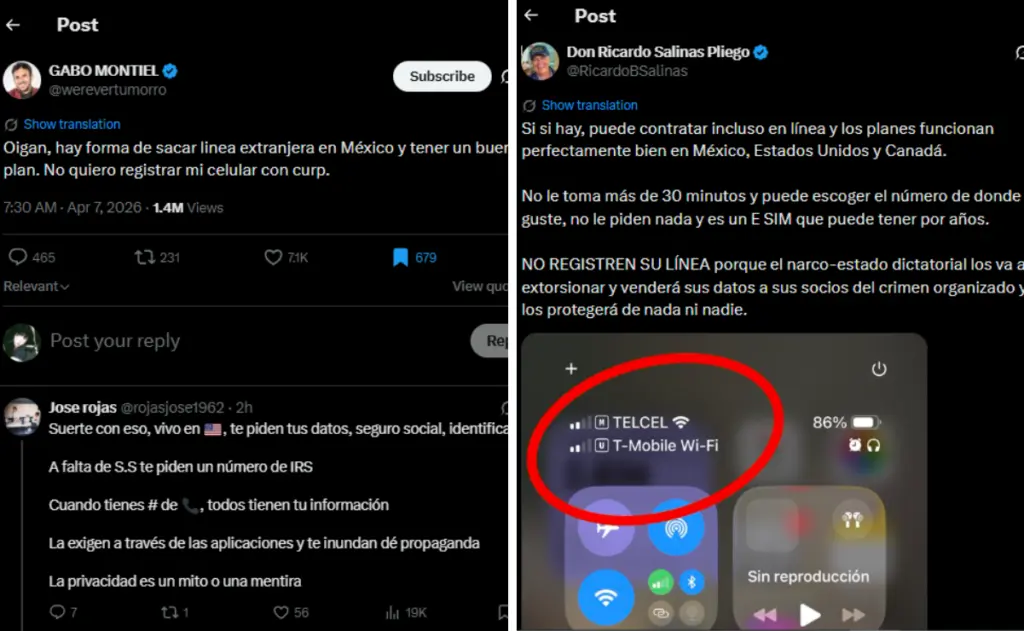
The digital ecosystem in Mexico registers intense activity after the exchange of positions between high-profile figures on the security of personal data. Ricardo Salinas Pliego intervened in the discussion to validate the concern of users who refuse to link their telephone line with the Unique Population Registration Code (CURP), a measure that has generated a wide debate on state surveillance.
It all started when content creator Gabriel Montiel expressed his refusal to register his cell phone with official documents. The businessman’s response not only supported this concern, but outlined a technical route for citizens to maintain their anonymity through providers outside national jurisdiction.
Ricardo Salinas Pliego’s technical guide to digital autonomy
According to the statements of the president of Grupo Salinas, the contracting of foreign services is an accessible reality that offers identical functionality to local operators. Ricardo Salinas Pliego highlights that these services allow users to operate without the restrictions imposed by the Mexican regulatory framework.
- Digital management: Contracts are carried out completely remotely and online.
- Logistics efficiency: Service deployment takes no more than 30 minutes.
- Interconnectivity: The plans work perfectly in Mexico, the United States and Canada.
- Operational anonymity: Local identification documents are not required and it is possible to choose numbers from various geographical regions.
- Sustainability: Through eSIM technology, the service can remain valid for years.
Implementation of eSIM technology according to the vision of the businessman
Ricardo Salinas Pliego’s recommendation is based on the adoption of the eSIM (embedded SIM card), a technology that allows you to activate data plans from global operators without the need for a physical chip or residing in the provider’s country of origin.
According to technical reports from the sector, the flexibility of eSIMs allows users to overcome local regulatory barriers. By operating under European or United States privacy legal frameworks, these international providers offer a layer of protection superior to that available in the Latin American market, preventing user information from ending up in centralized databases that are easily accessible to third parties.
Institutional risks and the urgency of data protection
Ricardo Salinas Pliego’s central argument to suggest this change lies in a deep distrust of state institutions and their capacity to protect. The businessman issued a strong warning: do not register the telephone line due to the risk that the state will be unable to protect the data from criminal structures or that the information will even be used for extortion purposes.
This position reinforces the trend of users seeking protection in the foreign telecommunications market against possible leaks of sensitive information in national territory. The impact of Ricardo Salinas Pliego’s statements shows a fracture in the relationship of trust between subscribers and current regulations, positioning the global digital economy as the only alternative to guarantee privacy without conditions.