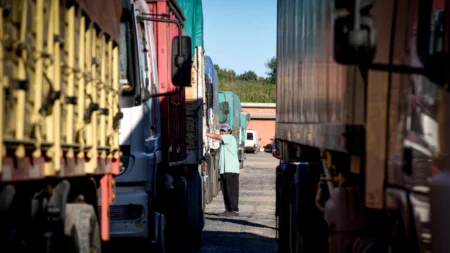
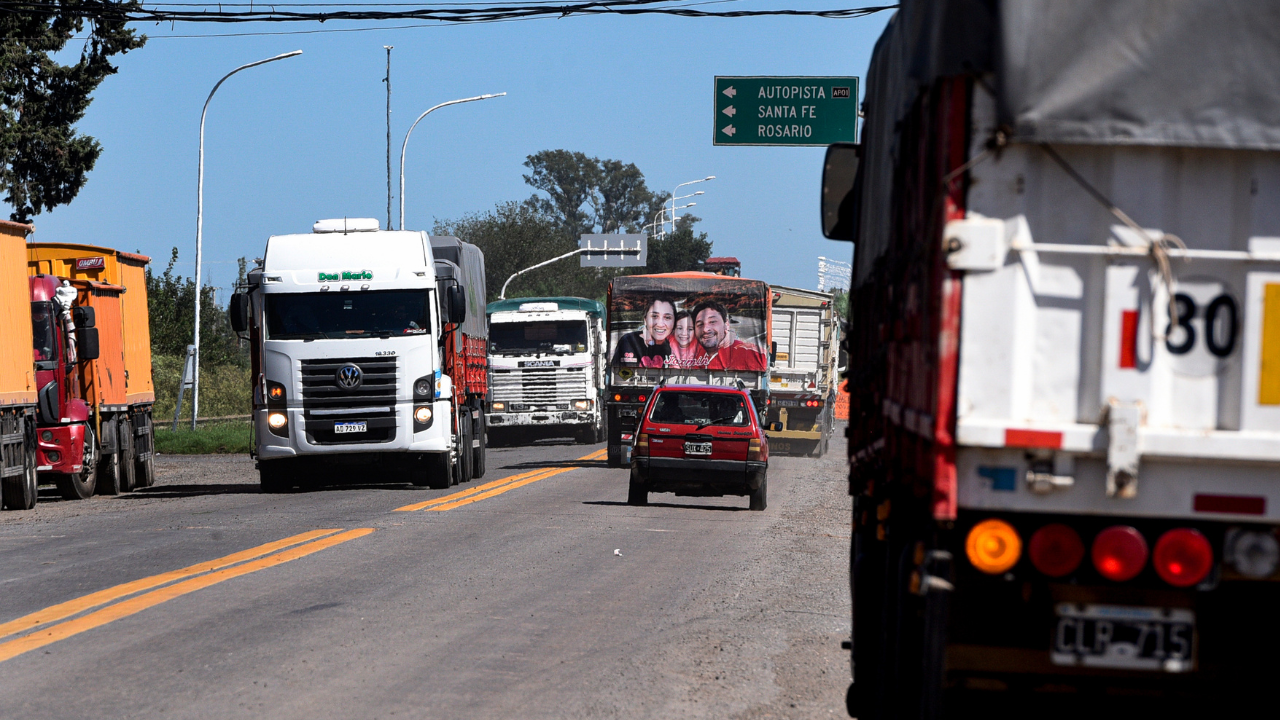
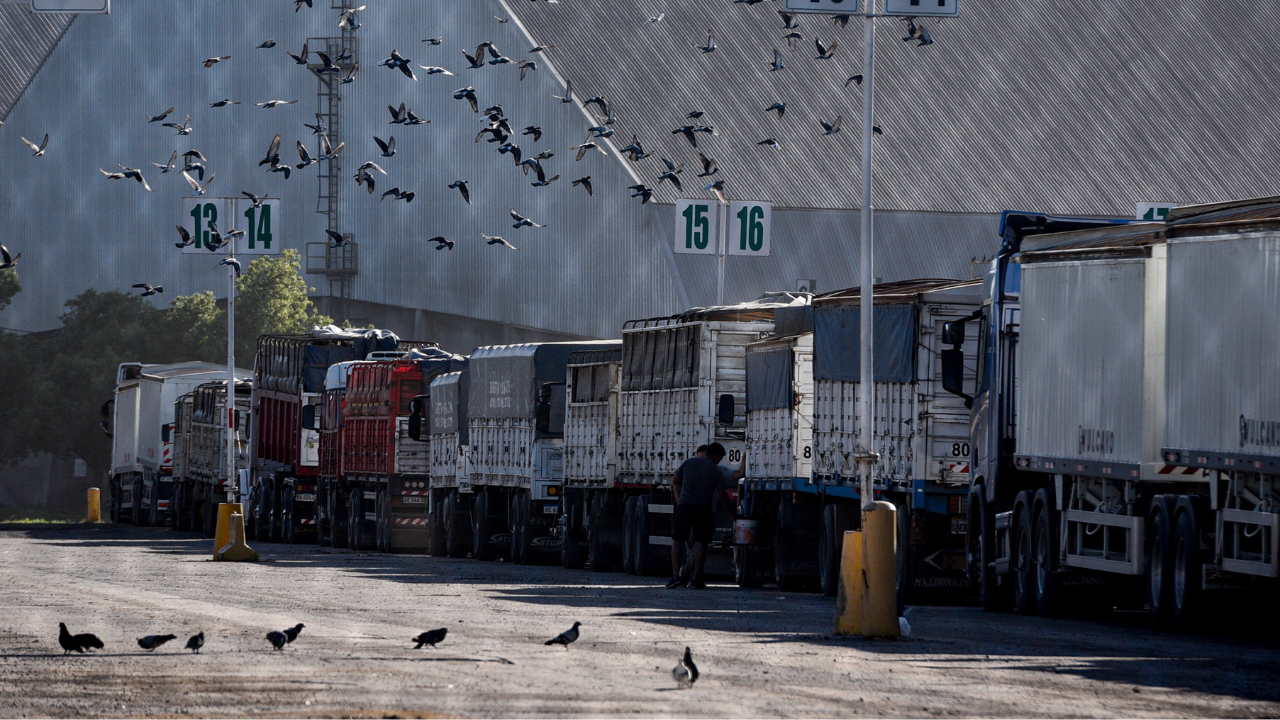
The end of summer is a nightmare for the inhabitants of the port towns of Gran Rosario, in the south of the province of Santa Fe, who for weeks live besieged by a flow of bulk trucks that carry the coarse harvest (that is, corn and soybeans) from a large part of the Argentine agricultural provinces to the terminals built on the banks of the Paraná River. The incessant circulation of these large vehicles can reach 20 thousand units per day, as estimated by Checked Carlos Torres, in charge of the Provincial Road Safety Agency (APSV).
The region concentrates 20 agro-export ports from which approximately 80% of the external sales of the national agricultural sector come from. The port hub can receive a total merchandise load of up to 540 thousand tons per day (each truck loads about 28 tons on average), according to the Rosario Stock Exchange (BCR).
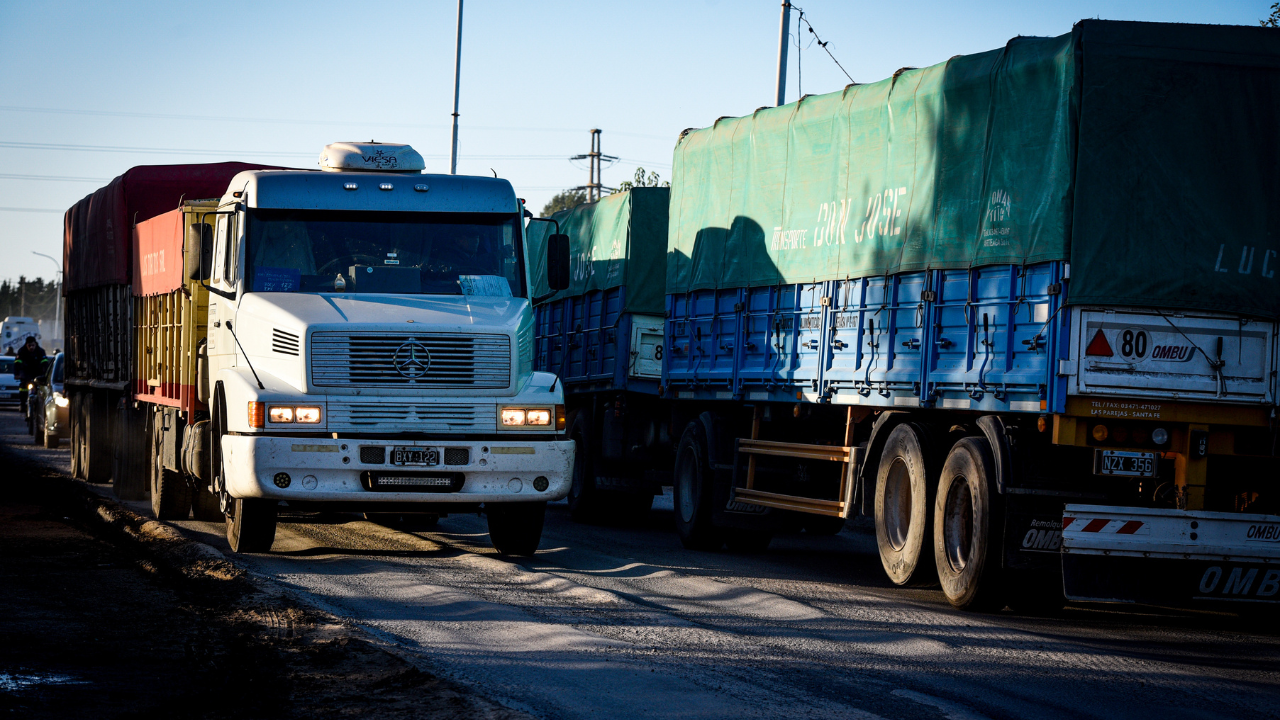
The trucks – which arrive from the NEA, part of the NOA and Paraguay via national route 11; from the south along National Route 33 and from the northwest along National Route 34 – collapse the fragile road infrastructure of the region and alter the daily lives of tens of thousands of inhabitants of port towns – such as San Lorenzo, Puerto General San Martín or Timbúes -, as well as other communes that are crossed by grain routes such as Villa La Rivera.
In addition to the difficulties in being able to go to work or study due to the congestion of the routes and roads, the residents of the area breathe polluted air and suffer for weeks from very high noise and visual pollution, aspects that have been very little studied. “Living here at this time of year is unhealthy, but it seems that no one cares. We breathe smoke and dust; there is noise, sometimes we can’t even cross the road because of the line of trucks,” explains Tania Britos, who lives in Timbúes but works in a small bar in La Rivera, right next to Route 91, through which heavy traffic reaches National Route 11, the access to several of the large ports.
After the drought, a greater entry of trucks
The vast majority of Argentine agroindustrial exports are shipped in the ports of Up River or Gran Rosario, from where 3 of every 4 tons exported leave. Grains and cereals from the country and from neighboring countries such as Paraguay arrive there by truck, rail and barges.
This year it is estimated that there will be a large movement, since the end of the drought means a better thick harvest, which in turn translates into greater truck income. According to the BCR, in 2024 more than double the number of trucks will enter Gran Rosario than the previous year. “Hand in hand with a strong productive recovery in the Central Region of the country, Greater Rosario would receive more than 2,100,000 trucks in the year, compared to just over a million received in 2023,” indicates the report.
 Credit: Celina Mutti Lovera
And he adds: “The ports of Gran Rosario, due to their strategic location, are the natural outlets for exports from the Central Region, as well as for exports from the Northern Region. Furthermore, given that this area is where the vast majority of the country’s oilseed industrialization plants are located, close to 90% of the soybeans that are processed are located in the area.”
The exit of “the thick”, a socio-environmental problem
During the weeks of peak departure of “the gross”, air pollution along with visual and noise pollution are a constant for the inhabitants of the port area of Gran Rosario. Transportation is the second most polluting subsector in the country according to the Greenhouse Gas (GHG) emissions inventory of 2021 (latest data available), with 13.9% of the total GHG, after livestock (22%).
“This is seen as a road problem, when in reality it is a socio-environmental problem. Nobody stops to think about the emissions generated by exhaust pipes, the dust that trucks raise on routes or streets that are often gravel, and the constant noise they generate,” Damián Verzeñassi, doctor and head of the Socio-Environmental Health Institute of the Faculty of Medicine of the National University of Rosario (UNR), explained to this medium. And he added: “They are the externalities of the agroindustrial model that no one questions, nor seems to see.”
 Credit: Celina Mutti Lovera
Air pollution is a huge global public health problem: according to the World Health Organization (WHO), this problem generates 7 million premature deaths and causes the loss of many more million years of healthy life. In adults, ischemic heart disease and stroke are the most common causes of premature death attributable to outdoor air pollution. “Air pollution is one of the biggest environmental threats to human health, along with climate change,” established that organism.
Trucks emit carbon monoxide, make noise and congest the everyday landscape. However, there is little or no systematized information about this in the port terminal area. “Transportation emissions are among the main pollutants in urban and productive areas like this one. But here it is naturalized and is not even taken as an environmental issue. There is a lack of study and information, because it is not even recorded that there is an impact on health,” says Verzeñassi.
For her part, Adriana Ilpiña, Conicet researcher at the Rosario Physics Institute and director of the Air Quality and Satellite Measurements Group of the UNR Environmental Studies Platform, said: “Very little is known because the reality is that this is not even considered a problem.”
Although her team has not carried out work specifically on this problem, the specialist assured that there are studies in other cities on the impact of these particles or volatile material emitted by trucks as they pass by. “The most direct impact occurs where the traffic is, it is almost intuitive that the most affected will be the nearby communities and the people who live or work at the discharge sites. That is for sure,” the researcher reasoned.
In 2022, the UNR Environmental Observatory carried out air quality surveys for a month (between April and May) in 7 locations in the north of Gran Rosario, the results of which were uploaded into a report. Out of a total of 37 samples analyzed, 10 showed values above the air quality regulations of the city of Rosario. “In this first pilot test of measuring sedimentable particulate material we see that in 10 cases the values of the Rosario regulations were exceeded,” says the document, which adds that “more measurement time” is needed to have conclusive results.
The residents, between resignation and complaint
In 2021, residents of Villa La Rivera they submitted a request to the Santa Fe Ombudsman’s Office for the problems caused by the influx of grain cargo transportation. At the end of that year, the Ombudsman’s Office issued a request to provincial legislators to carry out works to minimize the impact of the flow of trucks on the daily lives of those who live in the towns surrounding the large ports.
But nothing much changed in this time: the works demanded by the Ombudsman’s Office were not carried out and the residents are still exposed to the tide of bulk trucks. “Many times you can’t even leave your house or go to work because the routes are blocked. It’s crazy no matter how you look at it, from the road to the environmental,” said Marcelo Muiños, a native of the area and member of Taller Ecologista, a socio-environmental organization based in Rosario.
Added to the pollution is the loss of grain load that falls from the trailers of the trucks (there is a INTA report which says that up to 1% of the annual harvest is lost) and is left on the side of the roads. “These grains generate an odor, attract rats and other animals and become a source of infections,” said the environmentalist. At the same time, he highlighted that – if it rains – all of this ends up in the Carcarañá River bed. “Everyone complains about traffic and no one has closely studied the environment,” Muiños added.
 Credit: Celina Mutti Lovera
Carlos del Frade is a provincial deputy for Patria Grande (left), he is a member of the Environment and Natural Resources Commission of the Santa Fe Legislature and supported the claim of the neighbors and the Ombudsman in 2021. “The impact of the trucks is evident: it is seen in the deterioration of the routes and in the complaints, which have been going on for years.” And he added: “There are no studies of costs and environmental impacts on what this business generates. There is no political decision, because we are talking about side B of the main economic sector of Argentina.”
The weeks of departure from “the thick” are not easy for those who drive the trucks either. “We, in the jargon, say that we are ‘pinned’ when we have to wait for the downloads to be enabled. Sometimes it is fast, but days like this can go by,” says Walter Gamarra, a truck driver from San Guillermo, a city in the northwest of Santa Fe. Added to the complications of bathing or eating are routes “in very poor condition” and a lot of insecurity. “When you are stopped you have to take care that your cargo is not stolen or that they are not stolen from you,” he added.
What do they say from the government of Santa Fe?
Specialists agree that improving the daily lives of tens of thousands of people who are exposed to trucks requires road works and state strategies that help minimize the socio-environmental impact of heavy traffic.
Until now, the Ministry of Environment and Climate Change of Santa Fe has been left out of the discussion and was not even called to the meetings to organize road operations during the thick harvest, nor are they working specifically on that, as they informed Checked from that portfolio, led by Enrique Estévez (Socialist Party).
At the road level, this year the province – governed by Maximiliano Pullaro (Together for Change) – launched an “Operation Harvest”, with which it seeks to reduce traffic problems. This is how Carlos Torres, from the Santa Fe Highway Agency, explained it: “We want traffic to be fluid so that it does not hinder people’s daily lives; we know that they have to walk or take a bike or motorcycle because they cannot circulate. There are children who have had to cross a highway on foot to go to school.”
In relation to the difficulties of living for weeks or months surrounded by tens of thousands of trucks, the official said that trucks “are a blessing, but also a challenge.”
The specialists Verzeñassi and Ilpiña agreed that, to establish a strategy to reduce the socio-environmental impact, the first thing that is needed is to study the problem and generate data.
“Doing surveys is a pending subject. We must take those first steps to investigate, mainly to know how to act and thus be able to minimize the impact on the communities,” said Ilpiña, for whom Argentina is “far behind” in studies on air quality, even with respect to other countries in the region.
For his part, Verzeñassi added: “That there is no information despite the fact that tens of thousands of people live there and that it is something that happens every year, is quite a fact. It seems that what is not recorded does not exist.”