The fountain in Plaza Congreso marks kilometer zero of the national routes, according to the website of the Government of the City of Buenos Aires. That point is the origin, or one could also think, the destination, of all the roads that run through the country from end to end. In addition to being a road measurement element, it is also the only place where we find water, just the natural environment of the Argentine Naval Prefecture.
The fountain was inaugurated 115 years ago, in the celebrations for the first centenary of the May Revolution of 1810, and keeps as its symbol a replica of The Thinker by Rodinperhaps the most famous French sculptor in the world. In that work, Rodin conveys the image of a strong body, worked on in its posture, which according to the historian François Blanchètiere evokes minosthe judge of Dante’s Hell, in charge of assigning souls to the different circles of punishment according to their sins.
On Avenida Comodoro Py al 2002, there is also a figure who fulfills a similar role: Judge María Emilia Romilda Servini, head of the Federal Criminal and Correctional Court No. 1, which judges people for their crimes and earthly sins.
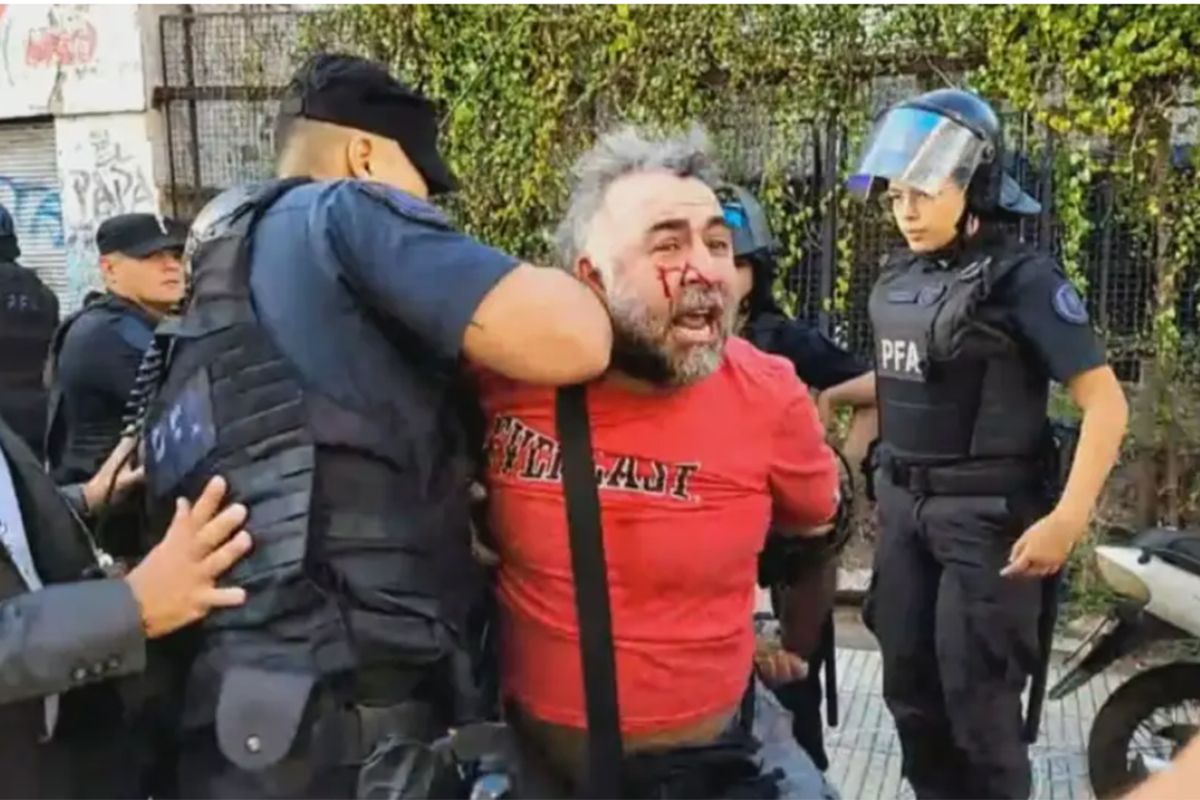
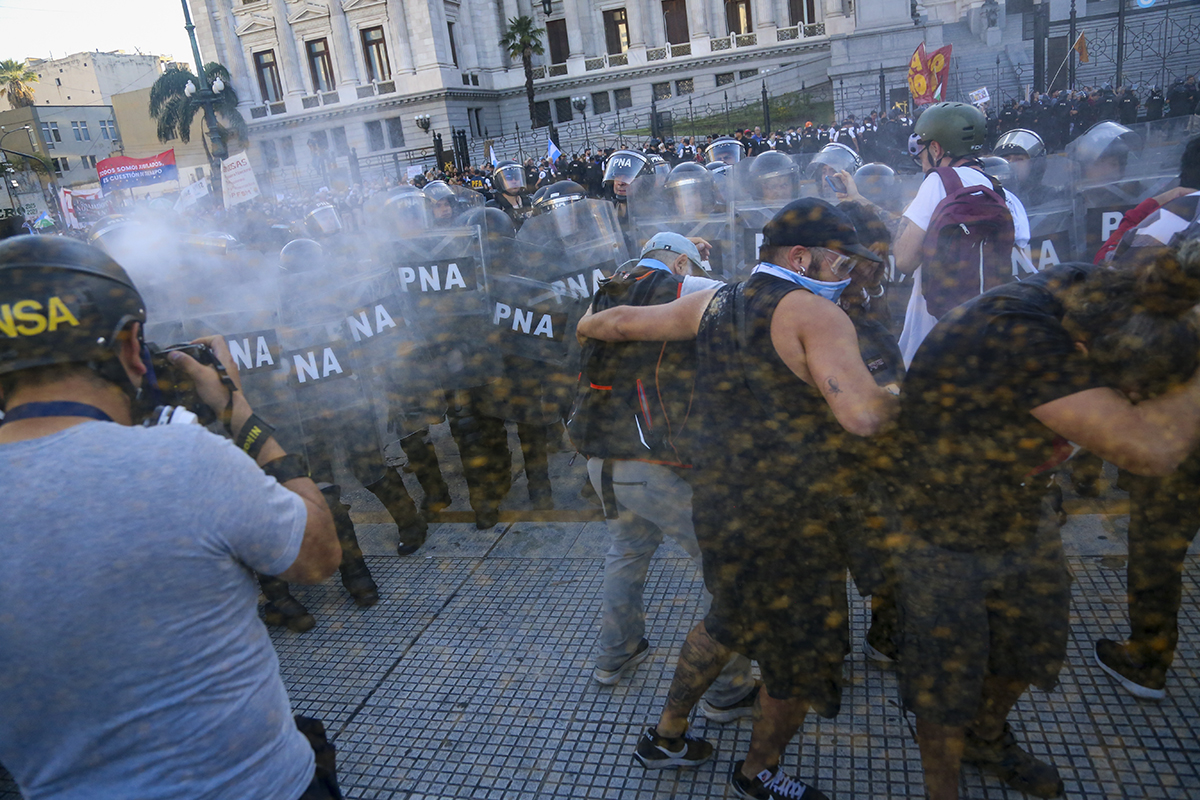
She investigates the behavior of Sebastián Emanuel Martínez, coast guard who on November 24, 2016 decided to complete his registration application to enter the Naval Prefecture and on March 12, 2025, with a Byrna TCR in his hand, he took Jonathan Navarro’s sight away.
What dreams of vocation must have inhabited that young Sebastian at that moment? What led him, almost ten years later, to be the coast guard who shot another Argentine in the face, in a scenario where the only trace of water is that emanating from that fountain that symbolizes both the origin and destination of all roads?
in the book How to build a police officer Mariana Galvani emphasizes the issue of service, in that moral sense and with a higher purpose that drives a person to join a police or security force. Belonging to this monolithic body provides a common identity that, as the organizing arm of the State, has the mission of guaranteeing social order and coexistence. In this logic, the role of the police is to prevent crimes, assist justice and protect both people and society as a whole.
However, trigger-happy events, non-compliance with the duties of a security force, lack of respect for the rules of engagement that regulate the use of lethal force, the corruption of some of its members and the political decisions of the officials on duty, as systematically occurs under the political leadership of Patricia Bullrich (Repression of 2001, Maldonado, Rafael Nahuel, Grillo and Navarro, among many others), distort these functions and these purposes, transforming who should protect us and proudly wear their uniforms, are real criminals.
Jonathan Navarro, victim of Bullrich’s political orders and the actions of a very bad member of the Argentine Naval Prefecture, lives in the Villa Adelina neighborhood, in San Martín. This place is presented by the national government under the label of “Congourbano”, associated with backwardness and marginality. This stigmatization of those who live in the periphery feeds the symbolic justification of trigger-happy cases and the poor functioning of the security forces, which operationalize what criminology calls “criminal selectivity” by turning an entire universe of poor and marginalized people into clients of the police.
The paradox is that the majority of the members of these forces come precisely from those same neighborhoods and peripheries. Their social and economic realities are, in many ways, similar to those of those they end up repressing: low salaries, difficulties in accessing health and social work, housing problems and limitations in education. In short, They share much more with that social group than with the millionaire officials of the libertarian government itself, which systematically insists on stigmatizing the peripheries and the poor.
The cruelest paradox of our time is that the shooter and the victim share, to a large extent, the same social background: Both are part of those popular sectors punished by exclusion. Today a PNA corporal charges $636,545.33two mangoes and fifty…. However, the machinery of power manages to fracture that common belonging, turning one into the armed wing of the State against their own peers. This is how the logic of double violence is revealed: first the economic one, which marginalizes and expels, and then the physical one, which represses and disciplines, like two sides of the same device of social control.. It becomes complex to think of a democratic solution when a disciplinary element, such as repression, is crossed by the same reason that generates it, which is economic exclusion and social illnesses.
It is interesting to draw a historical reflection on violence, politics and the links between the sectors of power in Argentina and justice. There is an evident symmetry between what happens to Jonathan Navarro, a victim of repression within the framework of a mobilization in defense of retirees against the Milei adjustment, and other episodes in our history in which the oligarchy, or the conservative power, sought to domesticate its people through violence. strict. As David Viñas maintains in Argentine literature and politics: “Throughout history there are four ties that express oligarchic violence: the rebellious gaucho, the subversive worker, the dangerous immigrant and the heterodox intellectual.” In this lineage, the aggression against Navarro is not an isolated event, but rather the continuity of a logic of discipline that runs through our political tradition: Every time the popular sectors break out to defend themselves from slave vassalage, economic power and its institutional arms respond with violence, seeking to reinstall the order of inequality.
Perhaps what is truly novel is that, in the Argentine socioeconomic order after the emergence of neoliberalism in the nineties, with the community breakdown of social ties, accelerated exclusion, the lack of access to the most basic needs and the persistent growth of destitution and structural poverty that we have been dragging on for thirty-five years, there has been a fusion of social actors that could previously be clearly distinguished. The gaucho, the immigrant and the worker are, today, the same person: a multiple popular subject, crossed by inequalities that make him a privileged target of repression. And the prefect who pulls the trigger is also part of this relationship of class and exclusion, because he shares with his victim the same social origin, the same shortcomings, and yet he ends up becoming the armed arm of a power that uses him against his own peers.
Martin Kohan in his book “Twice Juneor”, crossed by the discovery of a message from the doctor of the Clandestine Detention Center, Dr. Mesiano who asks: “At what age can you start (sic) to torture a child?”, in the context of the birth in captivity of the child of a kidnapped woman, he relates that when asked by the Sergeant, he responds: “From the moment the Homeland requires it.” This triggers a question regarding the due obedience of the actors who are in charge of applying torture and repression on the bodies of others in institutionalized contexts such as the Armed and Security Forces. In the case of Jonathan, Human Rights organizations maintain that the description of the crime should be taken as torture, according to the American Convention on Human Rights, an instrument incorporated into the National Constitution according to Art. 75 Inc. 22 of the Magna Carta and which understands that a member of a Security Force, such as the case of the Prefecture, who carries out cruel treatment against civilians can be considered torture.
How many times in recent history can the Argentine State commit torture and humiliation against civil society? Our country is traversed by an endless series of injustices and pain, ranging from exclusion and poverty to prisons and repression..
Navarro’s case is similar to that of politics, in the dimension that both lost their vision. In popular culture, the loss of an eye is associated with the figure of the pirate. Their journey seems to have a destination: to find that treasure island called Justice. And in the case of Martinez, a parsley of the Prefecture, manipulated by Bullrich’s orders, he completely blinds a part of society and his peers in the Security Forces who are pushed to commit crimes, generating dishonor and loss of institutional quality among its members, in the best of cases, or also as in the case of Prefect Martinez and the Gendarme Guerrero who most likely Bullrich’s bloodlust ends up depriving them of their property and their freedom, What do we do with the police? What do we do with the poor? And what do we do with the blind?
*The author is a lawyer and partner at the CKZ firm