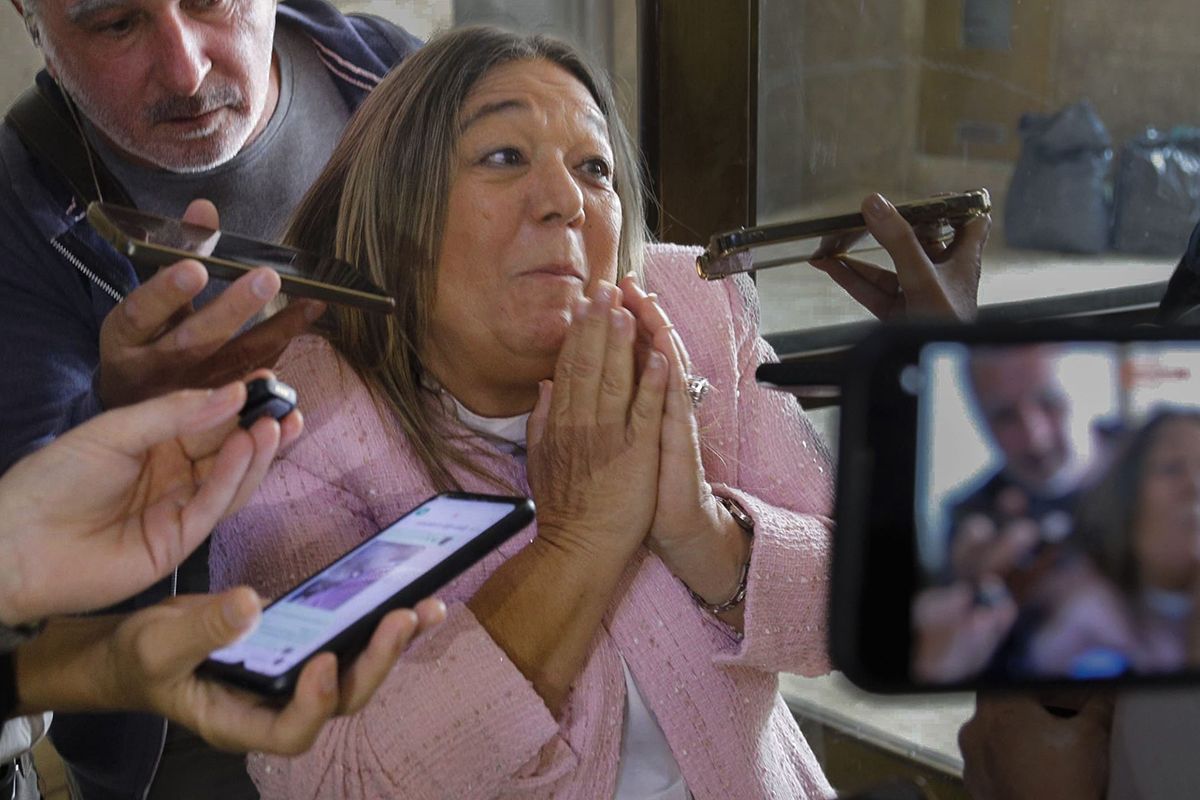
Adriana Monica Nechevenko declared as a witness this Wednesday in the Comodoro Py courts, within the framework of the illicit enrichment case for which the Chief of Staff is being investigated, Manuel Adorni. The notary explained that the purchase of the apartment on Miró Street, in Caballito, was made with an advance of 30 thousand dollars, and that the remaining 200 thousand were in 12 installments. Those fees, according to the professional, were without interest.
The notary had been summoned by prosecutor Gerardo Pollicita, who required her to attend the statement with the notarial documentation linked to her intervention in the purchase of that apartment, which occurred at the end of last year. So he showed up at the courthouse around 9 in the morning, and an hour later he began to testify. Around 1:00 p.m. he came out and declared to the press that Adorni has been a client of his for quite some time and that he did not notice any irregularities in the property sale procedure.
“It was a normal operation“, he assured. He also said that the two retirees who appear as lenders, Claudia Sbabo and Beatriz Viegathey did not lend him the 200 thousand dollars in cash, but rather it was a “mortgage for the balance of the price.” This is a form of financing between buyer and seller, in which the balance remains in favor of, in this case, the sellers.
When asked by journalists about the seven times he went to see Adorni at the Casa Rosada, Nechevenko said that “my client would not like me to explain that.”
The notary was the second witness to testify in the case that has the Chief of Staff under investigation. Yesterday, Monday, former Lanús player Hugo Morales, owner of the apartment, did it, saying that his intentions were to sell for 250 thousand dollars, but he ended up doing it for 200 thousand. He alleged that it was in a significant state of deterioration.
This Wednesday, he learned Timethe woman stated under oath that Adorni did not receive cash for the loan made to him by retirees Claudia Sbabo and Beatriz Viega. On the contrary, always according to the notary’s version, they agreed that the current official would pay them in installments over a year, so those payments would still be in process. Both sellers are summoned to testify this Thursday, also to testify.

More doubts
In principle, the statement adds even more doubts about the assets of the Chief of Staff. The question that resonates is How he faced an acquisition with an economic agreement that is far from having a proportional relationship with his salary as Chief of Staff.
Nechevenko explained that The official agreed with the two retirees to pay the remaining $200,000 after the first advance in 12 installments.. So, each installment would be 16.6 thousand dollars per montha figure well above the 3.5 million pesos that Adorni earned as a civil servant at the time of the purchase, and also above the updated salary, which would reach 7 million pesos. The payment agreement would expire next November.
How the payments were made and why the retirees agreed to mortgage without interest are just a handful of the questions left by the testimonial.
In addition to the process of acquiring the Caballito apartment, Nechevenko also intervened in a previous mortgage that the official made on his apartment on Assembly Street with two other women and in the purchase of the house in the country Indio Cua Golf Club in Exaltación de la Cruz. As this media was able to reconstruct, the notary stated that she had no information about the funds with which the Chief of Staff and former presidential spokesperson carried out these purchases.
Tomorrow Viega and Sbabo will testify, while next week, on Monday, the testimony of Graciela Isabel Molina de Cancio and Victoria María José Cancio is expected, the women who lent him 100 thousand dollars (85 thousand and 15 thousand dollars, respectively) for the mortgage of the apartment on Assembly Avenue.
Adorni is defended by criminal lawyer Matías Ledesma, who has a complex task ahead of him: proving that the official did not illicitly enrich himself. The thing is that in this figure a kind of reversal of the burden of proof operates, and the accused himself must prove the lawful origin of his assets.