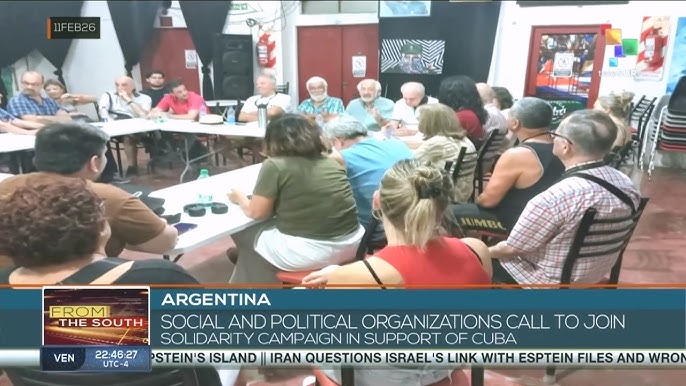
Social, union and political organizations from all over the country launch this March 20 the national solidarity campaign “We are with Cuba”, an initiative that seeks to respond with concrete help to the intensification of the economic blockade and the new energy blockade imposed by the United States against the island. The proposal, coordinated by the Argentine-Cuban Friendship House and a broad articulation of popular movements, aims to raise funds for the purchase of solar panels that will support basic services such as health, education and food production in the midst of the current crisis.
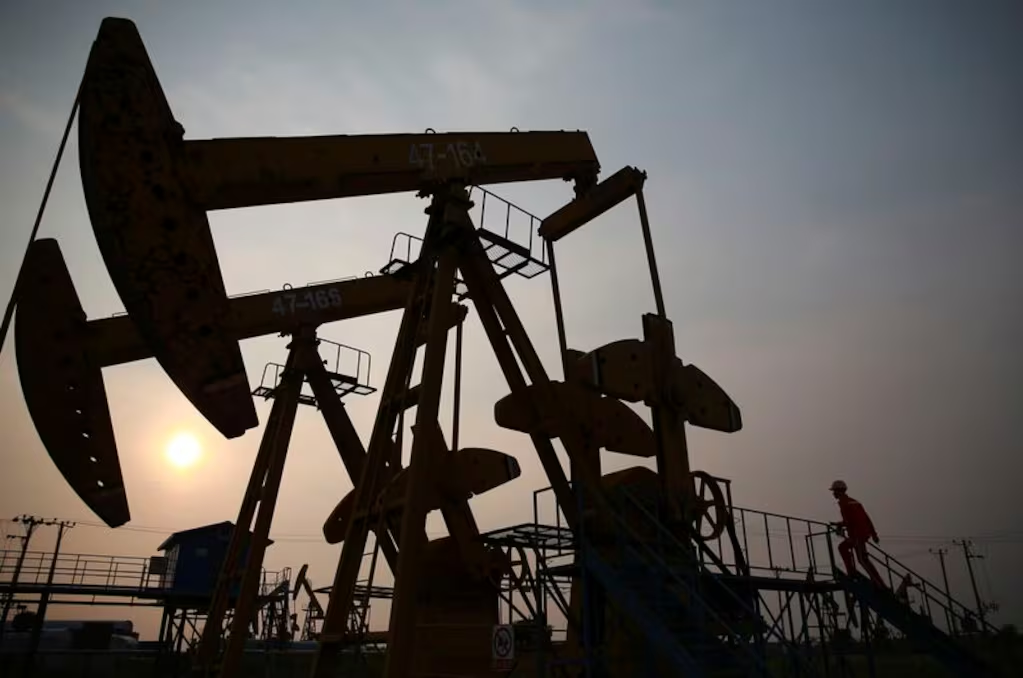
The offensive announced at the end of January by Donald Trump’s government further tightened the historic economic, commercial and financial blockade that weighs on Cuba, by establishing sanctions against any country that sells or supplies oil to the island. This decision, taken unilaterally and outside international legality, constitutes a true energy siege that drastically reduces access to fuel, compromises the generation of electricity and places the Cuban population at the imminent risk of a serious humanitarian crisis. UN human rights experts and rapporteurs have already described the measure as a serious violation of international law that constitutes collective punishment against an entire nation.
The impact of these restrictions is felt in all areas of daily life on the island: from the operation of hospitals and schools to public transportation, the cold chain for medicines and food, and the supply of essential goods. The lack of fuel generates power outages and paralyzes productive activities, while Cuban authorities look for alternatives to keep basic services running and protect the most vulnerable sectors. In this context, international solidarity becomes a strategic resource to help alleviate a situation that the organizers describe as “energy asphyxiation” deliberately designed to break the will of the Cuban people.
Faced with this panorama, Argentine social, union and political organizations resolved to articulate a joint response under the motto “We are with Cuba”, putting at the center the idea that solidarity between peoples is a concrete tool against blockade and sanctions policies. The campaign brings together popular movements, unions, political parties and various civil society organizations, which aim to make the effects of the energy fence visible and generate direct support mechanisms. Among the objectives, the raising of funds for the purchase of solar panels that reinforce the network of photovoltaic parks on the island stands out, a key resource to sustain daily life in contexts of fuel scarcity.
The use of renewable energy has become a centerpiece of Cuba’s strategy to resist restrictions on the supply of oil and fuels. Photovoltaic parks make it possible to guarantee the basic functioning of hospitals, health centers, schools, canteens and productive units in many territories, even in times of severe blackouts or shortages of diesel for thermal generation. According to the articulation that promotes the campaign, reinforcing this energy infrastructure is today a direct way to save lives and sustain elementary rights, by ensuring that the population can continue accessing essential services.
Beyond the energy dimension, the organizations that call for “We are with Cuba” highlight the island’s long history of solidarity with other peoples of the world, from the medical brigades that have assisted health emergencies on different continents to the training of professionals from Southern countries. “Love is repaid with love,” they point out, taking up a phrase that is repeated in the campaign’s dissemination materials to express that, in the face of the new aggression suffered by the Cuban people, it is time to return part of that historical support. The initiative in Argentina is also part of a broader wave of solidarity actions that, in these weeks, are multiplying in Latin America and other continents in the face of the tightening of the blockade and the threats of secondary sanctions.
The launch of the campaign in Argentina includes public activities, press conferences and dissemination actions on social networks and the media, with the purpose of putting the situation in Cuba on the agenda and denouncing the consequences of the energy fence. The promoting organizations point out that this is not just a symbolic gesture, but an effort to channel concrete material aid in a transparent manner, through the Argentine-Cuban Friendship House, which will concentrate the contributions and coordinate the purchase of solar panels for subsequent shipment to the island. In parallel, public debate is promoted on the legitimacy of sanctions and the role of the international community in the face of measures that openly violate the principles of the UN Charter.
Those who wish to collaborate with the campaign can make financial contributions exclusively for the acquisition of photovoltaic equipment, considered “fundamental to sustaining daily life” in the current conditions that Cuba faces.
The coordination of the campaign in Buenos Aires is in charge of representatives of the Casa de la Amistad and organizations that have historically worked to defend the right of peoples to self-determination. From the articulation they emphasize that the commitment is to build a lasting framework of support, capable of sustaining aid to Cuba over time and strengthening ties between Argentine and Cuban organizations in defense of sovereignty and social justice.
To contribute, a current account was set up at Banco Credicoop in the name of the Argentine-Cuban Friendship House: Cta. Cte. 191-173-010100/3, CBU 1910173855017301010032, alias PICO.DAMA.CLIMA. The organizers clarify that transfers are not received through Mercado Pago