Artificial intelligence is advancing in more sectors and applications. Now it was the turn of the photo and video production.
“Our company was born from observing a very specific problem in fashion e-commerce: the image sells, but producing it with the traditional model is slow, expensive and difficult to scale. Brands need to show more garments, more variants, more campaigns and more videos, but the classic system (studio, casting, agenda and logistics) does not keep up with that speed,” explains Ezequiel D’Amico, CEO and co-founder of Delfi, an Argentine startup that uses artificial intelligence to generate content ready to publish. The company uses a platform that trains to learn the characteristics of each brand and is already being used by companies throughout the region.
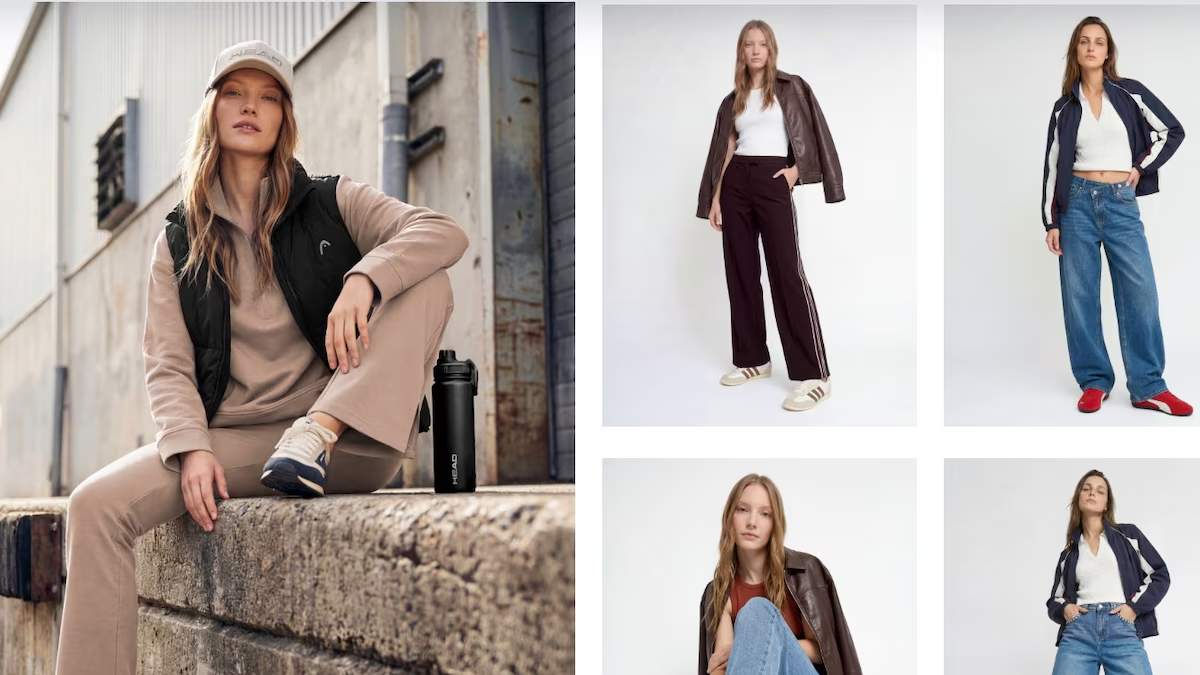
This venture It was founded by three Argentine entrepreneurs: Ezequiel D’Amico, current CEO of Delfi; Federico Vidueiro, CTO; and Rafael Bronenberg, COO. And it is about a virtual photo studio dedicated to fashion. “We deal with clients as if we were a photography studio with models, only On our staff there is not a single photographer or a single model.. We replace traditional production with an AI platform trained on the visual DNA of each brand, so we can deliver photos and videos ready to publish, with much more speed, better scale and a brand consistency that is very difficult to achieve with a traditional scheme”explains D’Amico.
Those who enter Delfi’s office will see that it looks less like a physical studio and more like a creative and technological operating table. “We don’t put together a set or call models. We start by understanding collections, garments, materials, fits, commercial objectives and brand tone. From that our platform produces content and our team supervises it, corrects it, curates it and brings it to a publishable standard. There is art direction, fashion criteria, quality control and client feedback. But The heavy lifting is no longer done by cameras, sets and calls, but by software and AI agents.”, he points out.
Regarding his technological solution, D’Amico says that does not work indicating a generic prompt and then wait for the result. “We ask each brand for references of their garments, materials, fits, charts, previous campaigns, style guidelines and any information that allows us to understand how that brand wants to look. With that we build a kind of brand visual DNA. Afterwards, with use, the platform continues to learn,” he says.
As the entrepreneur explains, each approval and each correction from the client gives him teaches the tool what best represents that brand and what doesn’t. “If a brand says ‘this sleeve has to fall differently’, ‘these pants have to look straighter’, or ‘this attitude doesn’t feel like us’, that correction feeds the system. We don’t use a generic AI, but rather one that is trained to generate content in a brand tone,” he adds.
The base service offered by this company is remote. The client upload the inputs on this platform that are requested, which are usually references of their garments, information on materials, fits, brand guides and previous campaigns, among other information. With this material Delfi carries out the entire production remotely. “But we also offer a premium ‘Concierge’ service. In this case, the client sends us the physical garments to an address that we give them and we solve the entire campaign from end to end, turnkey. This service is more exclusive than the basic one and today we are offering it in several cities, among which Buenos Aires, Medellín, Bogotá, Santiago de Chile, Mexico City and Madrid stand out,” clarifies D’Amico.
Regarding the main benefits that this tool offers, Delfi states that the cost of production drops by half when compared to a traditional one. On the other hand, they highlight that The times are also much shorter: between 25 and 35% compared to the usual ones. “In addition, conversion improvements of around 5% to 10% are recorded when the product is better understood visually. But beyond the quantitative, the most interesting thing is the qualitative. Delfi allows a brand to express itself better. Before, many companies produced what they could based on budget, availability and logistics. Now they can make productions much closer to what they really want to show -points out-. They can have the model, the styling, the attitude, the visual language and the scale that they always wanted, but without depending on the physical limitations of traditional shots.”
Delfi already has clients such as Falabella, Ripley and Paula Cahen D’Anvers. “Much of the content we see every day in e-commerce, networks, product videos and even exhibition pieces is produced with our solution; but the consumer usually does not realize it,” reveals D’Amico.
About the difficulty that currently exists in being able to differentiate between images and real models; and those created with AI, the CEO of Delfi maintains that it will be increasingly difficult to detect this difference. “In some cases, To the untrained eye, it is already practically impossible to know if it is real or AI. But for me the underlying discussion is not so much about whether the model is human or digital, but rather about If the representation of the product is faithful, consistent and useful to buy better. In e-commerce the important question is not ‘was this done by a person or an AI?’, but: ‘does the garment look like it really fits? Can you understand how it fits? Does the image represent well what I am going to receive?’” he says.
“We are pushing a very specific idea: that each garment does not have its three or four photos, but also its own video where you can see how it falls, how it moves and how it is used in real contexts – he adds -. This greatly changes the understanding of the product and, therefore, the purchasing decision. It is something that companies are already doing and will increasingly become more common in fashion e-commerce.”