In Argentina there are more than 170,000 professionals enrolled in careers linked to economic sciences (Public Accountant, Bachelor of Administration, Bachelor of Economics and Actuary), according to data from the Argentine Federation of Professional Councils of Economic Sciences (Facpce). Within that universe, the public accountants They are part of one of the professions with the largest number of enrollees in the country’s universities.
How could a company, a business or even an independent professional survive without a public accountant? In Argentina, the complexity of the tax system makes these specialists indispensable.
In recent years and in the midst of the artificial intelligence revolution (with the promise of automating and alleviating part of their tasks), tools that seek to simplify that work. And this, of course, opened a new discussion in the sector:to what extent AI could replace accountants?
Accounting and professional firms have been using different software tools for some time to streamline their work, but the AI revolution brings different reactions from the professional public.
In October 2025, the Professional Council of Economic Sciences (CPCE) sent a formal notice demanding that it close its activities. Lannis, a digital platform designed by Joaquín Paños, Ricardo Espinosa and Thomas Shaw that promises to centralize tax payment management using AI.
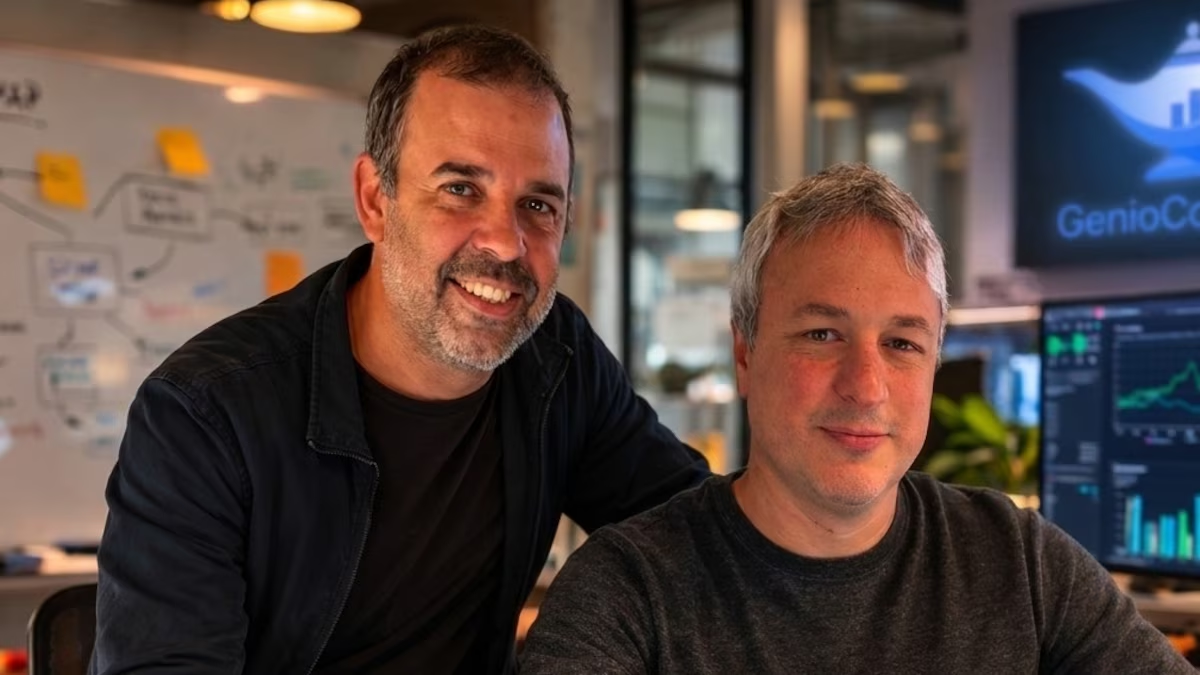
Now, the Argentines Gabriel Sánchez (public accountant) and Pablo Curello (computer engineer) They developed a platform called Accounting Genius that automates the entire tax settlement process, from end to end. But they want to differentiate themselves from other solutions: “The existing tools solve isolated parts of the problem (chatbots, solutions only for monotributistas, ERPs that are difficult to configure and maintain, etc.). Our platform automates the complete process, understanding the Argentine tax complexity: from the import of the raw file of the accounting system, through the reconciliation against the treasury data (ARCA, AGIP, ARBA), to the generation of the file ready to present and the working papers with the support of each settlement,” says Gabriel Sanchez.
The co-founder of the startup assures that its AI platform cuts 83% of tax work. “He accountant stops being an operator to become a strategist. Today, much of the time is spent on mechanical tasks: correcting and transforming files received from clients into a format that can be used for settlement, downloading files from the AFIP portal, loading them into Excel, manually reconciling row by row, or for some clients recalculating withholdings and/or perceptions, putting together texts for presentations. All of that is processing work, not analysis. Today many accountants spend more time processing data than analyzing the tax situation of their clients,” he says.
The accountant assures that they are not coming to replace professionals. “Argentine tax settlement requires professional judgment on points that cannot be delegated to an algorithm. Tax advice – which regime is appropriate, how to structure an operation, how to interpret a regulatory change – is intrinsically human. In practice, AI does not replace professionals: it makes them much more productive“, says.
According to international indicators of ease of paying taxes, A medium-sized company in Argentina can dedicate around 311 hours a year in tax compliance, almost double the average for high-income countries in the Organization for Economic Cooperation and Development (OECD), according to the World Bank’s Doing Business report (replaced by the Business Ready report), which measures the time a medium-sized company spends on tax compliance in 190 countries.
“Argentina historically appears among the countries with the highest workloadand the OECD benchmark for high-income nations is around 160 hours annually. The difference reflects not only the amount of taxes, but the complexity of the presentation processes, the multiplicity of jurisdictions and the frequency of changes regulations,” says Curello, co-founder and engineer of ITBA, with an MBA from Wharton Business School, who currently lives in New York.
Could anyone think that using ChatGPT, Claude or other AIs, with dedication, could be enough to do this job they propose? Curello responds: “A generic tool like ChatGPT does not know what withholdings the company suffered, it does not have access to the files downloaded from AGIP, it cannot automatically reconcile receipts against the ARCA data, and it does not generate the TXT files with the exact formats that SIFER requires to be able to import them into its system. Even a study by OpenAI (“Measuring the performance of our models on real-world tasks” found that these chatbots give inferior responses to accountants in 76% of cases.”
As he explains, the platform uses several technologies, choosing the right one for each problem to be solved. “Not everything is done with AI models. Genio Contable’s artificial intelligence was built using the best available models and we specialized them with the Argentine tax context. We use both Claude from Anthropic and models from OpenAI. What really makes the platform powerful is not just the models, but the tax context and the specialized tools we build around them to achieve accuracy and auditability. “AI can automatically detect the format of accounting files, identify economic activities and corresponding rates, consult updated regulatory information and justify recommendations with legal references,” he points out.
“Our position is clear, We developed a platform to help accountants, not to do without them. The system is not a black box -Sánchez points out-. I am enrolled in the CABA Council in particular and we are open to active dialogue with the Professional Councils of Economic Sciences so that they can evaluate the platform and understand how it complements and enhances the work of the accountant.”