
After having reorganized its commercial operations in Argentina, leaving aside the sale of its local subsidiary and appointing a new CEO to face an expansion process, the Carrefour Group goes for more and aims to become a important player in the world of virtual finance.
The change of scenario leaves behind the idea of ceding operations to Francisco De Narváez’s group to sustain its businesses under the order of the Paris-based parent company of deepen profitability through digitalization and an aggressive financial services scheme. At the center of this architecture is the mutation of the Financial Services Bank (BSF).
The entity, which historically functioned as the engine of the credit card chainis completing its metamorphosis to operate under the Carrefour Banco brand, integrating digital banking services, payment accounts and an ecosystem of benefits that seeks to shield the client from the competition of virtual wallets and traditional banking.
The last step towards that objective was taken last Wednesday, April 8, when the entity began to operate under the trademark umbrella of Banco de Servicios Financieros SAUas the chain authorities informed the National Securities Commission (CNV).
In the note, the head of Market Relations of the bank explained the reasons for the name change and the transformation of the corporate type to a Sole Proprietorship.
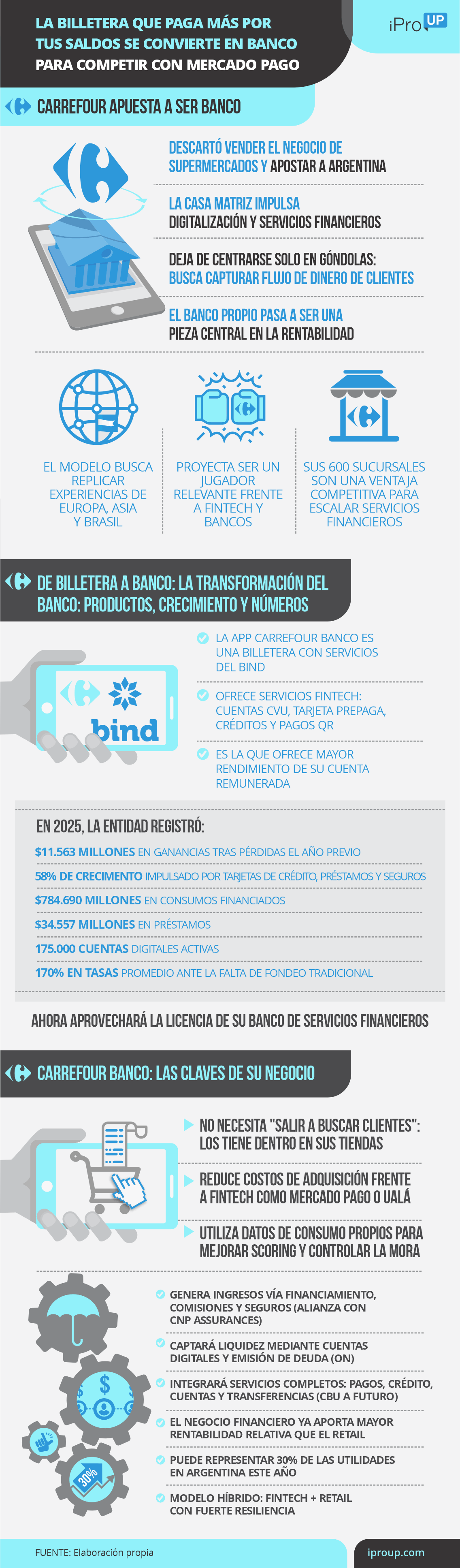
The institution, which in the last annual balance corresponding to 2025, showed a positive result of $11,563 millionagainst a loss of $6.13 billion in 2024, will base its expansion plan precisely on the good results it accumulated last year: 58% growth thanks to the development of its financial products, Mi Carrefour Crédito credit cards and personal loans.
The keys to Carrefour Banco
The promotion of optional insurance and contracting that is not ancillary to the financial benefit also contributed to the entity’s income generation.
Carrefour Banco: its expansion plan
Since last year, the bank has had INC SA as its sole shareholder, a company that belongs to the Carrefour Group, after the departure of BNP Paribas, which sold its stake to the European group that owns the largest hypermarket chain in Argentina.
In fact, the bank contributed to sales in stores and the chain’s online channel, with a participation as a means of payment of 9.3%through the use of credit cards and prepaid cards. On the other hand, the consumption that customers made with these plastics in other stores at a national and international level was increased 50.4%.
Considering total consumption, in Carrefour stores and in the rest of the businesses, the bank financed purchases for $784,690 million during 2025in addition to having granted personal loans for $34,557 million, at an average rate of 172.4% and an average term of 8.7 months.
As part of the expansion plan in the virtual financial business, it also launched the product Digital Accountwhich is associated with the prepaid card with CVU provided by BIND.
In this case, the objective is to achieve greater fluidity by allowing top-ups and withdrawals of funds through immediate transfers. The account rewards daily returns, grants exclusive discounts every day at Carrefour, allows you to purchase with a QR code in any store, pay for services, as well as pay the credit card statement and the bank’s personal loan installments.
It also allows customers who qualify to provide financing and quote consumptions that were made with the prepaidthrough the granting of a loan.
Currently, the bank operates 175,180 digital accounts and, as a near goal, it will continue with its activity of consumer financingin addition to investing resources to increase the offer of services and options for its clients.
Future new businesses are being analyzed to include, for example, a Uniform Bank Code (CBU) that allows you to collect salaries: the loans it grants are not funded with deposits. This will allow you carry out financial intermediation and improve rates.
To support the activity, it will try to advance in the diversification of financing sourcesfocusing on interbank loans, funds collected in digital accounts, and Negotiable Obligations (ON).
The transformation strategy towards the digital banking business also includes implementing a core banking system that allows, in stages, enhance businesses with new commercial options for both individuals and companies, through savings accounts and checking accounts.
Carrefour Banco: the global model in Argentina
The now Carrefour Financial Services Bank was created as a public limited company in 1998. On July 30, 2025, BNP Paribas Personal Finance transferred its entire packagethat is to say, 44,713,864 Class B non-endorsable registered sharesfrom $1 face value to INC SA
Thus, the entity was transformed into a Unipersonal Joint Stock Company (SAU), a change that was authorized by the BCRA at the end of last year, but conditioning the process to the registration of the reform of the corporate statute before the CNV, which on March 4 approved the modification.
The main commercial activity focuses on providing financial services to the Carrefour Group’s clients in Argentina, through consumer financing for purchases of any product in all formats of the chain’s stores.
In this sense, the scheme replicates the model implemented for more than two decades in other countries where Carrefour also operates, mainly in Europe, Asia and Brazilalthough adapted to the characteristics of consumption and local regulations.
Its main product is the “closed” credit card to be used exclusively in Carrefour stores and participating businesses. In 2019, it replaced them with a Mastercard international credit cardenabled to pay in businesses in the country and abroad. In 2024, financing with this means was distributed between a 65% on consumption in Carrefour stores and 35% in other businesses, while last year, the shares were 55% and 45%, respectively.
To a lesser extent, the bank also offers personal loans to credit card customersbut also to new users who want it and meet the requirements. This product already reaches a 8% share within the total Loans and Other Financing category, compared to the 3.8% registered in 2024.
For customers who did not qualify for credit, in 2023 it launched a Prepaid Mastercard to pay with preloaded balances in any business. But also for prove a personal loan granted by the entity and as a previous step to the credit, since it allows the bank to evaluate payment behavior.
Since the end of last year it has offered the digital account, which is associated with the prepaid card with CVU and offers the paid account with the best rate on the market. All these products are provided through BIND PSP.
This new wallet also allows you to access exclusive discounts every day at Carrefour, buy with a QR code at any store and pay for services. It also allows you to quote payments made with your prepaid card.
Carrefour Bank: the business plan
In the case of the new strategy that has just begun, it is not a name change or rebranding but rather a transformation that responds to three pillars that the new local management (appointed after ratification of continuity in the country):
- Digital Account Consolidation: stop being a mere card issuer and become a payment service provider (PSP), a field that Mercado Pago dominates
- Financing at the point of sale: in a context of hard-hit consumption, the ability to offer exclusive installments and discounts (up to 35% in key categories) is the Most powerful chain retention tool. Thus, they seek to make Carrefour Banco the main payment method for the more than 500,000 customers who transit their shelves.
- Synergy with the RIGI and large investments: take advantage of the current regulatory framework to modernize your logistics infrastructure (with Meli Log and other agreements) and technological.
Thus, the idea is to leverage the flexibility that the “Banco” brand gives it to raise liquidity and finance its own expansion.
The decision has a commercial basis that shows Carrefour retaining a solid 21% sharedisputing inch by inch for leadership with Coto. But the Bank also allows you diversify income to stop depending only on the shelf margin.
Carrefour’s move comes at a time when the local financial map is being redrawn. With the arrival of new digital banks such as Revolut, Banco Inter, Nubank and the license requested by Mercado Pago, plus the consolidation of the financial verticals of other retailers, the French chain knows that The business is no longer just selling food, but managing the financial flow of its customers..
It is clear that the “new” Carrefour is, strictly speaking, a technology and finance company that uses its 600 branches as the largest local network to deploy its banking artillery. The BSF, that old card issuer from the ’90s, is today the heart of a survival and growth strategy in Argentina.
Digital account integration allows you raise funds at a lower cost than traditional financing. In recent years, an increase in the mass of demand deposits has been observed, which gives it financial “muscle” to finance its own loan portfolio without eroding working capital.
Additionally, with the issuance of ON, the bank demonstrates that the Institutional investors see Carrefour’s financial arm as a solid corporate riskdecoupled from seasonal fluctuations in mass consumption.
Furthermore, the analysis of the financial statements shows that the financial services vertical provides a proportionally higher share of profitability (EBITDA) than the sale of mass consumption products (FMCG).
While the retail margin is narrow by nature, the BSF does not need to go out and “hunt” clients on the street since it has them within its 600 branches every day. This drastically reduces marketing and recruitment spending compared to a pure fintech.
In the same sense, by having full traceability of the customer’s consumption in the supermarket, the BSF’s risk algorithm is much more accurate than that of a traditional bankallowing controlled default even in recession cycles.
For the head office in France, the BSF acts as an efficient cash management tool. In a country with inflation, the speed of money turnover is key. This Financial efficiency is, in large part, the reason why the group decided not to sell the operation in Argentina.
In fact, the projected balance for 2026 shows that the Bank can represent about 30% of the company’s net profits in the country, making it an extremely resilient “hybrid” operation.
In short, the metamorphosis towards Carrefour Banco is the culmination of a process of balance sheet cleanup and optimization. For city analysts, the message is clear: Carrefour is no longer just the place where you buy bread; It is a financial platform that also has shelves.