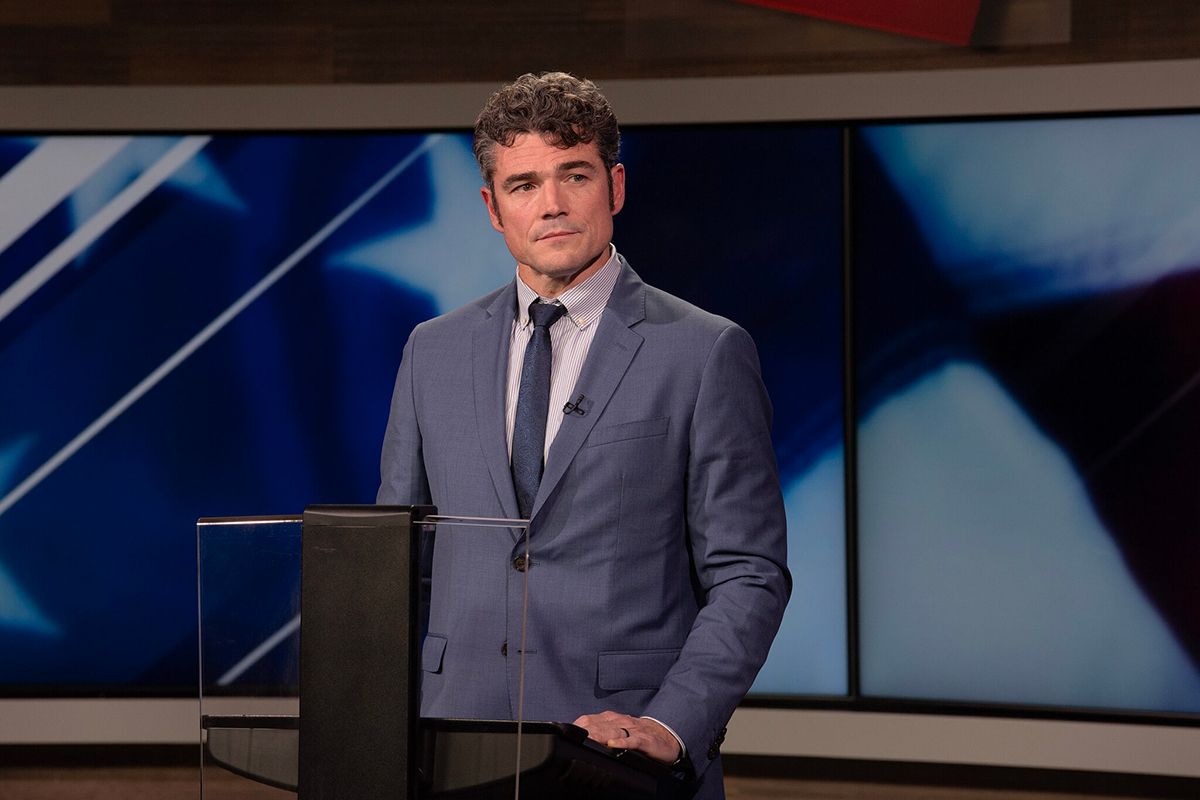
The resignation of Joe Kent as director of United States National Counterterrorism Center It was not a minor event in American politics. When a senior intelligence official leaves his position in the middle of a war—and does so with a public letter in which he accuses his own government of having started the conflict due to external pressures—the crack that opens is not only political, but also moral and institutional.
“I cannot, in good conscience, support the ongoing war in Iran. Iran posed no imminent threat to our nation, and it is clear that we started this war due to pressure from Israel and its powerful American lobby,” argued Kent, in his public resignation.
After much reflection, I have decided to resign from my position as Director of the National Counterterrorism Center, effective today.
I cannot in good conscience support the ongoing war in Iran. Iran posed no imminent threat to our nation, and it is clear that we started this… pic.twitter.com/prtu86DpEr
— Joe Kent (@joekent16jan19) March 17, 2026
In his first interview after resigning, granted to the former Fox News host Tucker CarlsonKent reiterated that Senior Israeli officials and influential members of the US media deployed a disinformation campaign which, he said, “completely undermined President Donald Trump’s ‘America First’ platform, fueling warmongering sentiments to fuel a war against IranHe also insisted that “there was no intelligence” indicating that Iran was planning a “major sneak attack” against the United States.
Kent’s resignation, however, was not the end of his public exposure, but rather the beginning of a new controversy. American media revealed that The FBI is investigating the former official for alleged leaking of classified informationan investigation that was already underway before his resignation, according to Washington, in what was interpreted by analysts as an information manipulation maneuver.
Beyond the plausibility of the justifications, and that Trump himself dismissed Kent as someone “very weak in terms of security,” the words of the former director of the National Anti-Terrorism Center force us to analyze who defines the foreign policy of the United States.
The relationship between the US and Israel

Photo: Hu-Yousong/Xinhua
To answer this question, it is necessary to look back. The relationship between the US and Israel is not a makeshift pact. As historian Hal Brands has noted, “contrary to popular belief, the United States and Israel have not always been so close.” In 1956, Washington forced Israel to stop its war against Egypt. The strong alliance emerged only in the 1970s, when the United States needed “well-armed regional sheriffs” to manage its global reach.
Since then, the relationship has been institutionalized to an unprecedented extent. Through the Foreign Military Financing (FMF) program, Israel receives $3.8 billion in military aid annually. But most significant is the principle of “Qualitative Military Advantage” (QME), codified in US law since 2008. Under this provision, Washington is legally obligated to ensure that Israel maintains military superiority over any regional adversary.
This means that before selling weapons to other Middle Eastern countries, the US must evaluate whether such a sale could erode the Israeli advantage; If so, Israel must be compensated with more advanced systems.
The result is that Israel has become, in Brands’ words, a “force multiplier.” It has its own military, intelligence and technological capabilities that make it an indispensable partner, but also an actor with the capacity for self-initiative. This independence, however, comes at a price for Washington.
In June 2025, Israel destroyed Iran’s command and control systems, air defense and missile capabilities, in an operation that left the US in a position to “end the war with an attack on their nuclear facilitiesBut cooperation in the current war has reached a historic level: officials from both countries planned a combined offensive to eliminate the Iranian leadership and paralyze its military.
While the United States focuses its attention on Iran, Israel has taken advantage of the strategic window to expand its operations on other fronts. The Israeli army has intensified its attacks in southern Lebanon, where it has deployed troops to new positions and ordered the evacuation of more than 1,470 square kilometers, affecting more than 800,000 people.
The bombings on Beirut and the south of the country have left more than 800 dead, while the Israeli government warns that it could establish a “security zone” up to the Litani River if the Lebanese State does not disarm Hezbollah.
In doing so, Israel advances goals that have long been limited by practical constraints. As analyst Ben Reiff has pointed out in Guardianthe rhetoric of Israeli leaders suggests a determination to reconfigure the strategic environment while international attention remains focused on Iran.
In this sense, Israel emerges as the main beneficiary of the conflict: While Washington bears the political and military cost of the war, Israel consolidates territorial gains that were previously unattainable.
The antecedent of Iraq 2003
In this geopolitical context in which Kent decided to resign, the comparison with the invasion of Iraq in 2003 is inevitable. At that time, the United States went to the United Nations with false information and had a “coalition of the willing” that included more than 40 countries.
On this occasion, Washington has acted with the support of only one ally, Israel. Political analyst Michael McFaul of Stanford University has noted that the recent attack is even worse, since there was no authorization from the UN Security Council or Congress, and the “imminent threat” narrative appears to crumble in light of US intelligence itself.
A few days ago, the US intelligence services concluded that Iran was not rebuilding nuclear enrichment capabilities which were destroyed last June, contradicting the narrative used to start the war.
This finding, added to Kent’s resignation, suggests that there are already concerns within Washington’s security apparatus that the current trajectory carries the risk of strategic overreach.
Kent, in his resignation letter, stated that the orchestrated campaign to incite a conflict with Iran dated back “to the beginning of this administration,” which was defined by Senator Mitch McConnel as an expression of “virulent anti-Semitism.”
But beyond the Republican adjective, the question it leaves floating is uncomfortable: to what extent does the foreign policy of the United States reflect its own national interests, and to what extent does it show those of an ally with lobbying power institutionalized in the structures of the State?
Because perhaps most significant is what Kent’s resignation reveals about Washington’s true capacity for political analysis. “A good number of key decision makers were not allowed to come and express their opinion to the president“said the former official.
In a democracy that prides itself on having checks and balances, This statement should set off all the alarms.. If the country’s top counterterrorism official cannot express his objections to the president before a war starts, then the system of checks and balances has stopped working.
The underlying question—who is in charge of American policy in the Middle East—remains open. Kent has an answer, and he has expressed it clearly. That his resignation was met with disdain rather than public debate on the substance of the matter says as much about the state of American politics as it does about the motivations that led Kent to resign.