Last Monday the family Samsung Galaxy S26 went on sale in Argentina and in the world, with local prices of 2.2 million pesos for the Galaxy S26; $2.8 million for the Galaxy S26+ and $3.4 million for the Galaxy S26 Ultra (Prices are all for the 256 GB storage version; there are other options.)
I was using the Galaxy S26 Ultra in the last days; Here are some details for those who are thinking of buying one (or their younger siblings). The focus on the Ultra is because beyond being the most sophisticated of the three, It is the variant that is historically the most popular of the family.
Those who want the best Galaxy S possible, and have the money, the Ultra is the model to choose: it has the best cameras of the three, and the most powerful processor in the family (and in the Android world), a Snapdragon 8 Elite Gen 5 for Galaxywhich is a tweaked version of the same chip used by its competitors, and which in laboratory tests is 10% faster than the Exynos 2600 that use the Galaxy S26 and S26+ that are sold in the country. That 10% will be imperceptible in daily use; But those who want the Snapdragon chip can buy a Galaxy S26 or S26+ in the US ($1.5 or 2.2 million on Amazon with shipping to Argentina included, but without fees or old equipment as part of the payment), the only country where all three models have that processor. This does not mean that the local S26/26+ are bad, or slow: even with that difference, they have excellent performance. But the absolute top is the Ultra.
That of the Galaxy S26 Ultra remains superlative, especially thanks to its double zoom (one 3x and one 5x)although it has more and more competition, and the differences in the photos and videos obtained with other phones of the same size (especially from Xiaomi, Google, Vivo, etc.) are increasingly difficult to detect. One of the telephoto lenses uses a newly designed periscope (ALoP, puts all the elements on top of the prism and not between the prism and the sensor) which allows a more compact camera module that allows more light to pass through (that is, with better performance in photos in twilight, dark environments, etc.).
Furthermore, now it adds a horizon-blocking video recording mode and allows you to change the position of the phone (from vertical to horizontal and infinite points in between) without rotating the video or losing resolution.
The company continues to make cameras with very solid performance, although there are no major variations in quality compared to the Galaxy S25 Ultra (it uses the same 200 megapixel main sensor and the same wide angle); Where it did improve a little is in the extreme digital zoom (above 30x) thanks to a more efficient AI when reconstructing the lost detail.
The phone has the Same approximate size and weight of the S25 Ultra (just 0.3mm thinner)with rounded edges to make it more similar to its younger brothers. He left titanium and returned to aluminum in the team’s frame; keeps the anti-glare screen protected by Gorilla Glass Armor 2so it should be almost unbreakable.
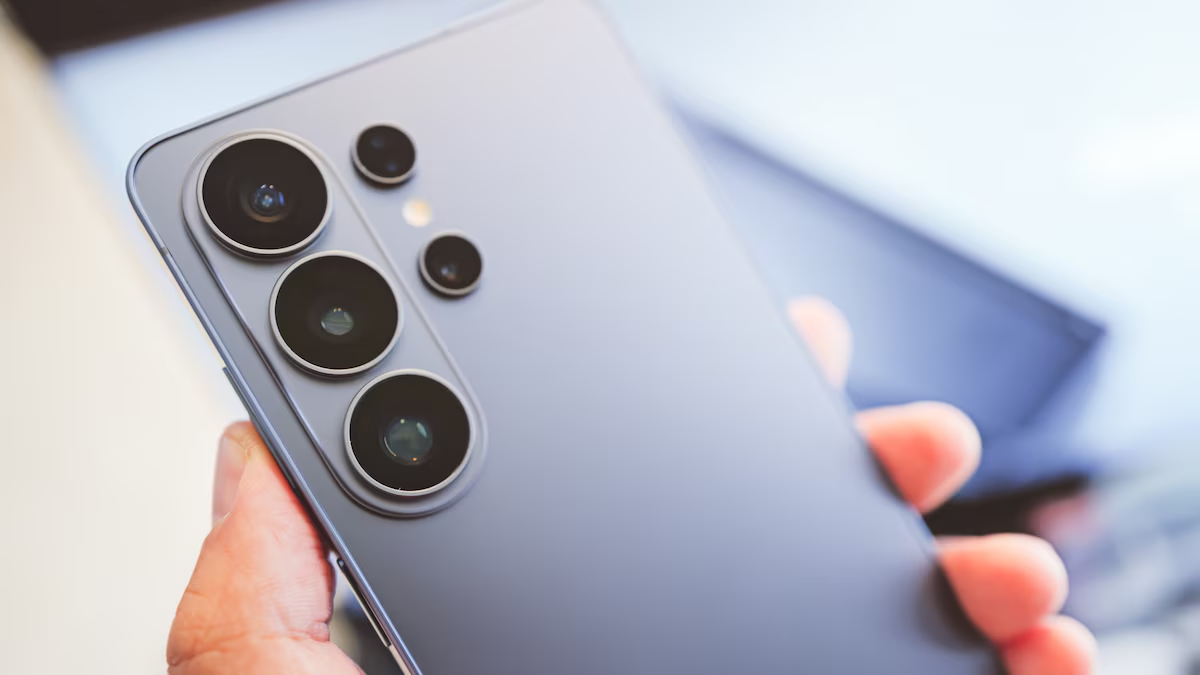
The camera block (with the same design as the Fold7) protrudes even more than on the S25 Ultra, which means that the team is very unstable on the table. Most people will use it with a caseof course, which will neutralize this point.
By the way: the Galaxy S26 family is Qi2 compatiblethe same wireless charging standard as the iPhone, so with the help of a case (official or third-party) that adds a ring-type magnet, it will be compatible with any MagSafe magnetic accessory (chargers, car mounts, rings to support the phone, etc.). If it is an unbranded case, it is important to verify that the camera protection does not “invade” the MagSafe area, so that the accessories attach well. In some cases there are people who reported that the phone warned that this added ring was interfering with the pencil, the S-Pen.
The S26 Ultra maintains the S25 Ultra stylus (it does not have Bluetooth, it is very thin), with the typical functions for making notes or drawings on the 6.9-inch screen, with minimal latency and excellent sensitivity. The end opposite the tip follows the curvilinear contour of the edge of the phone, so care must be taken to insert it correctly so that it does not protrude.
It did not change in size (6.9 inches with minimal edges) or quality compared to the previous version, except for the inclusion of the “Privacy” mode that opaques areas of the screen so that they can only be seen if we are in front of it and it works super well. Unlike the polarizing that can be added to any phone, with this one we can turn it off at will or have it only hide specific areas of the screen, such as the place where we enter a password, or with certain apps.
That privacy mode turns off some pixels on the screen, so when active it will appear slightly darker and with lower resolutionbut it’s only noticeable if you’re looking for the difference. Beyond that, and as is typical of the company, the quality is excellent, even if It only reaches 120 Hz refresh rate (today there are 144 or 165 Hz; it is the number of times per second that the information on the screen can update; above 90 Hz is considered ideal for games and animations).
Samsung continues to shy away from the use of higher capacity carbon silicon batteries, and in the Ultra uses a 5000 mAh batterylike last year. I didn’t have any major problems reaching the end of the day with some charge, although that, logically, will depend on the use that each person gives it. Yes, it is good news that it now admits a 60 watt charger to recover 75% of the energy in half an hour. Requires a compatible USB-C charger, which does not come in the box. It may be from other brands; It is enough if it is 60, 65 watts or more (if it is less, it will charge the same, but slower). The Galaxy S26+ only reaches 45 watts of wired charging speed; the Galaxy S26, at 25 watts. In the Ultra it also improves wireless charging to 25 watts (in the S25 Ultra it is 15 watts).
Galaxy AI is still very useful for some thingssuch as processing photos in the camera and helping with some tasks, such as editing images (to modify them or to ask Gemini to find certain photos in the phone gallery just by describing them) or texts (including the use of text descriptions to explain what we want to achieve), or the transcription of recorded audios, an ideal function for meetings, classes, etc.
Also includes a filter for unwanted calls that delegates to AI managing the conversation to decide whether to attend; It is an evolution of a function that was already present.
For other tools, AI is a lottery with few prizes: it is supposed to Bixby should be able to combine tasks and applications to respond to complex commands, but is still under development; it is possible to ask Perplexitywhich is also installed, helps with managing content within the phone. Another addition that promises, but that for now does not generate much, is Now Nudge, a kind of second look at what happens on the screen and that suggests actions based on the content (search for something on Google Maps or create a reminder, for example, following a mention in a chat). In his ideal performance he is the assistant who knows what we want before we think about it, but does not always achieve it. It requires the phone’s AI to always be watching what we do, but it can be disabled.
Samsung sells the phones in Argentina with local prices of 2.2 million pesos for the Galaxy S26; $2.8 million for the Galaxy S26+ and $3.4 million for the Galaxy S26 Ultra. The prices are all for the version of 256GB storage; There are other options with greater capacity, up to 1 TB. The company takes old smartphones in part payment (up to 45% of the total; depends on the model and its condition) and offers financing in installments.
The alternative is to buy it abroad: Amazon sells it in the United States, with taxes and shipping to the country included, for US$1,095 (Galaxy S26 256 GB), US$1,238 (Galaxy S26+) or US$1,580 (Galaxy S26 Ultra). Then, the American Ultra will be the same price as the local S26, but without fees or discounts for delivering old equipment.
The same way, in the official Samsung Chile store it is between 20 and 30 percent cheaper than in Argentinadepending on the chosen model: the Galaxy S26 Ultra has a price in the neighboring country of 2.4 million Argentine pesos.
In addition, the Galaxy S26 Ultra competes against its predecessor (the S25 Ultra is not that far away in performance) and other players of various prices, such as the Motorola Signature that is already sold in the country, the Xiaomi 17 Ultra or proposals from Google, Nubia, Oppo or Vivo, with very competitive features.