Journalist. Bahía Blanca Sports Journalists Circle. He was editor of the magazine Encestando (1985-2000). Since 1987 he has worked in the newspaper La Nueva Provincia (today La Nueva.). He went through the Sports, The Region and The City sections, where he currently works. He has specialized in agricultural journalism since 2001. Member of the Buenos Aires Association of Agricultural Journalists. Responsible for the websites of the Livestock Breeders Association (AGA) and Abopa.
“We could help create tools or strategies to prevent, because if the mother reaches pregnancy with metabolic syndrome, although the diet can be changed, pharmacological tools could also be designed to block the routes through which damage is being generated at the level of the nervous system.”
The explanation corresponds to Dr. Sofía Vallés, researcher at the Bahía Blanca Biochemical Research Institute (INIBIBB), dependent on the National University of the South and Conicet and, also, professor at the UNS, regarding the objectives of the research work on metabolic syndrome and its impact on the formation of the brain of the fetus during gestation.
This is a project awarded by the International Brain Research Organization (IBRO), an entity that encourages research in the field of neurosciences and assists, especially, scientists from developing countries, to which Vallés appeared to —finally— obtain the Early Career Award and funding of 5,000 euros to continue the work.
“The laboratory is called Nutrition and Neurodevelopment because we study, precisely, how a dietary factor, which is fructose, to which we are all exposed, can affect the formation of the brain from pregnancy,” he explained.
Vallés recalled that last May there was an IBRO call, which consisted of financial aid for a laboratory that was recently formed; That is, it had to be new for the purposes of encouraging and helping in the development and acquisition of the first inputs.
“There were different requirements. And our laboratory had them, because we started studying metabolic syndrome (MS) between the end of 2018 and the beginning of 2019,” he said.
“We wrote based on what we knew, since we have two publications in the laboratory in this line of work. Every time one does research, different questions arise; some we answer and others are always missing and based on the knowledge we had acquired we had new hypotheses and questions to solve. And for this project the economic part is a limitation,” he said.
Vallés’ team presented the plan, specifying the reagents needed to check whether the clues they had were leading them down the path they suspected. He was finally selected.
—In any case, had they already reached some conclusions or possible presumptions?
-Clear. Some things are known, not because of us, but because they have been published in scientific journals. One is that fructose is one of the components that is present in the sugar molecule. Sugar is a glucose molecule with another fructose molecule. It is known that fructose alters cellular metabolism, promoting a decrease in energy production and increasing lipid production; and that is not beneficial at all.
“It is known,” he added, “that people who have diets rich in added sugars and fats and those who consume many ultra-processed foods have metabolic problems throughout their lives.”
“In science one has many ideas, but one cannot always carry them out due to economic limitations.”
Vallés recalled that the diagnosis of MS is made when a person presents – at least – three of the following signs: blood pressure greater than 130 mmHg; blood glucose greater than 100 mg/dl; waist circumference greater than 80 cm in women and 90 cm in men; total cholesterol greater than 200 mg/dl; HDL cholesterol less than 40 mg/dl in women and 50 mg/dl in men and triglycerides greater than 150 mg/dl.
“Having three of these characteristics indicates a diagnosis of SM. The association between fructose consumption and the development of SM was already made and, when a person has this SM, their metabolism is altered and promotes a pro-inflammatory state. That was known,” he recalled.
“What we wanted to investigate is whether when this SM is induced in women, when they become pregnant they can expose the unborn baby to pro-inflammatory substances,” he said.
—Can this have any impact on the development of the pregnant woman’s brain that, later, cause consequences in her life?
—It may be yes or it may be no; we had to try it. The answer is found in the laboratory, where we use rats of a particular strain called Wistar. We made two groups: one that always drank water and another that did so with water with fructose at a concentration equivalent to that found in soda,” he explained.
“Mothers should know that what they consume, or their metabolic condition, can affect the development of a future generation.”
The research lasted 10 weeks and, after that time, blood was drawn to determine triglycerides, cholesterol and others that define MS and it was found that MS was induced in the group of rats that had drank fructose.
“We mated these animals with normal males, they became pregnant and we continued with the same feeding scheme. The group that ate fructose continued doing so and the one that had been drinking water continued the same. And when those calves were born we did behavioral and molecular studies and we looked, in the brains of these calves, in what conditions they were in,” he said.
The researcher recalled that, in a work that she had published in 2023, she saw that the lipids in that brain were oxidized, and clarified that it is one of the organs with the most fat in the body, since the neurons are covered by myelin sheaths that have a high lipid content.
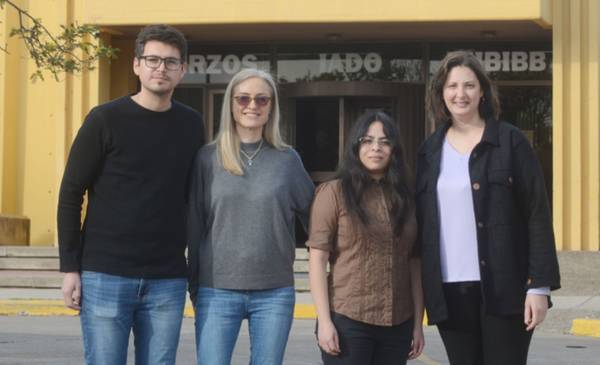
In the workplace: Sofía Vallés (left); Natalia Furland Marié Cuervo Sánchez and Facundo Prado Spalm.
“There we noticed that the lipids in that brain were altered and, also, many enzymes that increase when there is inflammation were stimulated; then, we had neuroinflammation and lipid oxidation in the brain of those babies only because the mothers had taken fructose. We saw this at birth. We followed them throughout their development and we noticed that the same thing that happens with a human being when they are born, when the neonatologist goes and tests their reflexes, can be done with rats with studies called brain reflexes. neurodevelopment,” he said.
“In the offspring of the rats that had taken fructose we saw that, although these reflexes developed, they took much longer; those that had to do so on day 3 did so on day 5. There was a greater latency or a delay in the acquisition of these reflexes and the significance of this happening shows us that there is a deterioration at the level of the brain. They are closely linked,” he said.
“Then we evaluated, also with behavioral tests, the levels of anxiety, how sociable these animals were and how they had memory. We saw that the offspring of mothers who had taken fructose were the most anxious and those who socialized the least because it was difficult for them to interact with peers,” he indicated.
The different visions
The researcher added that there are different ways to analyze the topic. And in animals, for example, what we call eye contact from one person to another in rats is nose-to-nose contact.
“We noticed that they did it less. We also did memory tests and saw that, as they grow and become adults, they have deterioration in memory. This caught our attention if one thinks that it is only due to the exposure to fructose in the drink that the mother had, since the rats at birth had a normal diet and were never exposed to fructose,” he stated.
The team from the National University of the South of Vallés is made up of Marié Cuervo Sánchez, Lic. in Biology; Facundo Prado Spalm, PhD in Pharmacy and Natalia Furland, PhD in Biochemistry.
—How is the investigation continuing?
—The conclusion would be that if the mother has SM, all the characteristics in this model develop. Now, what we want to find out is the objective of this project: how this happens and what is happening at the molecular level for this connection to occur between what the mother does and what happens in the brain of the offspring, since there we have to introduce ourselves to see different factors or molecules that are inside the cells.
“Now, what the project will allow us to do is buy imported kits and look at a molecular level at what is happening in the brains of the babies for these manifestations to occur and what transmission through the mother would be like, as well as the mechanism by which the mother is causing these alterations in the brains of the babies.”
About context, resources and research
—Dr. Vallés, it is not a minor fact to obtain funds for research in the current economic context…
-Of course. It is essential to move forward. In science it happens that perhaps one has many ideas, but cannot always carry them out due to economic limitations and, therefore, hypotheses cannot be tested in the laboratory. Sometimes it is extremely frustrating, but the truth is that awards are incentives so that you can really contribute to society.
—How will it impact health if the hypotheses of this research are realized?
—This is basic science. We are testing everything in animal models and then we have to see if the results obtained can be transferred to humans. You always have to take that precaution. What we believe is that, if we find a molecular mechanism by which we understand how the brain development of offspring is altered by a maternal diet rich in fructose, we can contribute in different ways.
“How? First with knowledge to generate prevention. Mothers must be informed that what they consume, or their metabolic condition, can affect the development of a future generation. In addition, this new knowledge will be useful to generate strategies for translational application to preventive medicine.”
Precisely, on nutrition, metabolism and behavior, from knowledge to transformation, a training meeting will be held next Saturday, September 7 at Casa Coleman (Alem 41) starting at 9, with the organization of the UNS Nutrition and Neurodevelopment Laboratory.
Likewise, the next day, Sunday the 8th, there will be a talk to the community about metabolic syndrome and the increase in cases in all ages and around the world. It will also be at Casa Coleman, from 6 p.m. In both cases, consultations can be made at (email protected)