He Central Bank (BCRA) published this Wednesday the Survey of Market Expectations (REM), 46 economists participate, including consulting firms, research centers and local banks.
They projected, among other aspects, how inflation will evolve in the coming months, contemplating the impact that the war in the Middle East may have on prices. They also outlined what the path of the dollar will be towards December.
What will happen to inflation, according to more than 40 experts
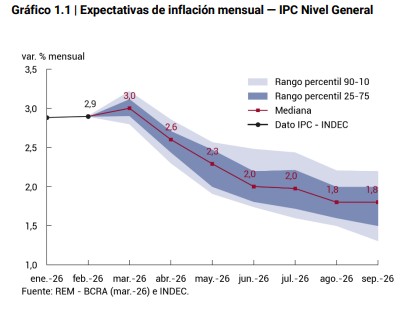
This is how inflation will evolve, according to REM experts
One of the highlights of REM is the variation of the CPI. Experts estimated inflation of 3% for March, a month marked by seasonality and – this year – the transfer of geopolitical tension due to the war in the Middle East to prices. The INDEC will announce the official data next Tuesday the 14th.
inflation estimated for March presented an increase of 0.5 pp compared to the REM previous report and those who best projected this variable in the past reported inflation of 3.1% monthly.
The CPI trend will be downward in the coming months, according to the REM. The consultants estimate that it will be 2.6% in April, 2.3% in May, 2% in June and July and 1.8% in August and September. That is to say that, according to experts estimate, 2% will only be drilled in the eighth month of the year.
In all cases, Higher variations are expected than those anticipated in the previous REM: The impact of the war on prices can surely be one of the factors that experts take into account.
2026 would close with an inflation of 31.8%according to the consulting firms, which represents 3.1 pp more than the previous REM.
What will happen to the dollar, according to the experts consulted by the BCRA
Meanwhile, regarding the value of the wholesale dollar, experts indicated that the April average will be at $1,420, which is $32 less than the previous REM. In fact, this Wednesday the official exchange rate fell again and closed at $1,387, to remain within 20% of the ceiling of the exchange rate band.
For December of this year, the group of participants predicts a nominal exchange rate of $1,700which gives an expected interannual variation of 17.4%. In the coming months, it would evolve as follows:
- May: $1,449
- June: $1,481
- July: $1,504
- August: $1,553
- September: $1,572
- December: $1,700
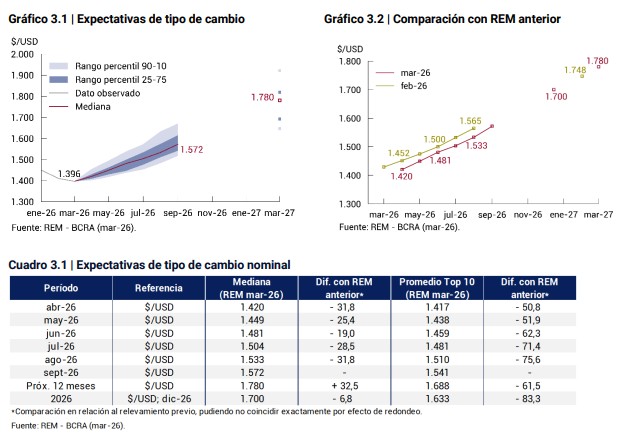
REM estimates for the dollar in the coming months
Economic activity, rates and other analyst projections
Besides, The REM also published estimates for the variation of GDP and detailed that the Seasonally Adjusted Product would expand 1.3% in the first quarter of the year and 0.8% in the second quarter (+0.3 pp and -0.1 pp compared to the previous survey, respectively).
For the third quarter, The seasonality-free growth projection of REM analysts was 0.7%. For 2026, those who participated in the REM expect on average a level of real GDP 3.3% higher than the average for 2025 (-0.1 pp compared to the previous survey).
Meanwhile, the open unemployment rate for the first quarter of 2026 was estimated by those participating in the REM at 7.6% of the Economically Active Population (+0.3 pp compared to the previous REM). The group of REM participants expects a rate of 7.3% for the fourth quarter of 2026 (+0.6 pp than in the previous survey).
On the other hand, experts predicted a TAMAR rate from private banks for April of 26.8% TNA (-3.2 pp compared to the previous REM), equivalent to a monthly effective rate of 2.2%. For December 2026, the group of REM participants projected a nominal annual TAMAR of 23.4% (-0.6 pp in relation to the previous REM), equivalent to a TEM of 1.9%.
As for the foreign trade of goods, Those participating in the REM projected for 2026 that exports (FOB) will total US$93,235 million (+US$498 million than in the previous survey) and imports (CIF) US$79,121 million (-US$1,083 million than in the previous REM). The expected annual trade surplus is US$14,114 million (US$1,581 million more than in the previous REM).
Finally, the fiscal result projection The primary contribution of the National Non-Financial Public Sector carried out by those participating in the REM was a surplus of $16.0 billion by 2026 (-80 billion compared to the previous REM).