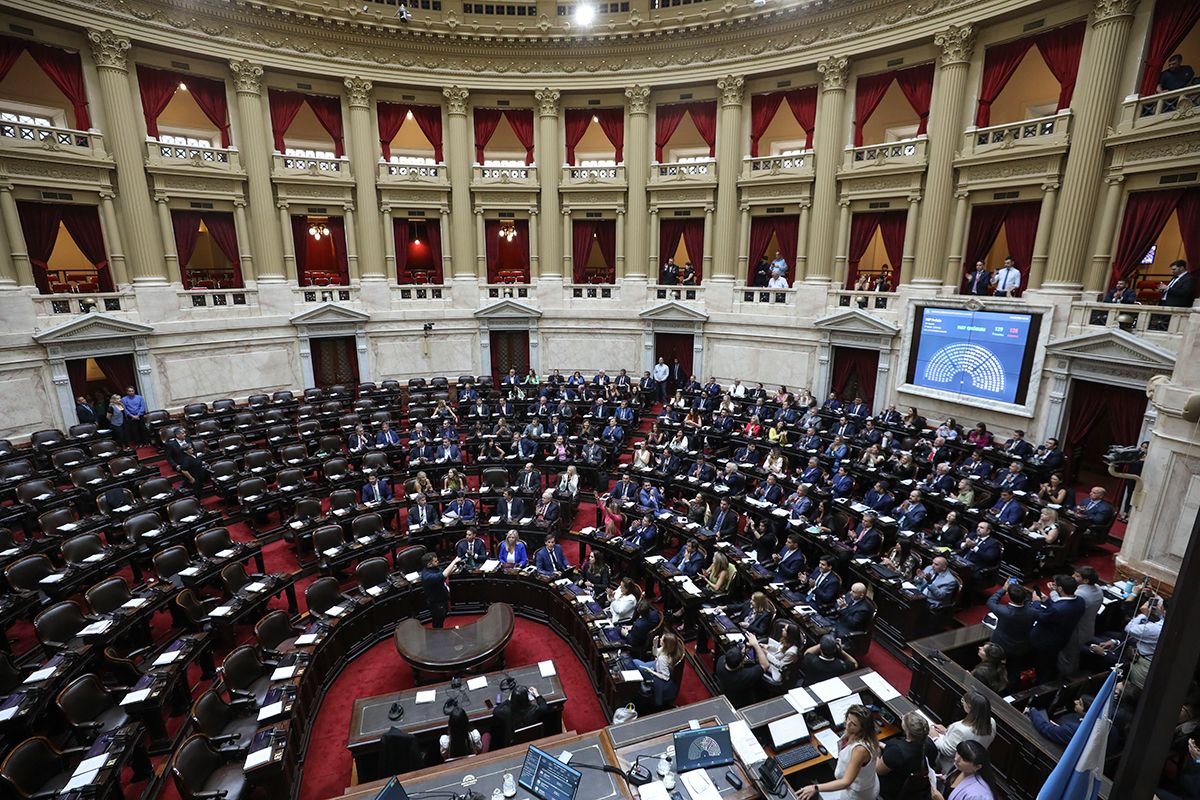
The opposition once again recovers the agenda this 2026 in Congress. This Wednesday, in the Chamber of Deputies, the debate on projects presented by different political spaces will begin to alleviate the pockets of families throughout the country that are in a situation of over-indebtedness.
The debate will take place in the Consumer Defense commission chaired by the deputy of Unión por la Patria Hugo Yasky. The opposition can find in this issue, which crosses the concern of all blocks, a common point that allows it to gather a majority to bring an initiative to the venue. In this way they would put pressure on the government again, as happened with the law that declared an emergency in the disability sector and that of educational financing in the university environment.
The meeting will begin at 10 in the morning and expects the presence of about seven guests who will present on the subject. On the committee’s table they have 18 initiatives under study that seek to propose different payment alternatives that allow families to regularize the situation of delinquency, which is already a record in Argentina.
Along these lines, there are projects that propose mechanisms for partial forgiveness, refinancing and state assistance for debts linked to consumption that originated in credit cards and personal loans.
There are also initiatives that propose the creation of a National Consumer Debt Recovery Fundan organization administered by the Ministry of Economy and which is intended to provide partial guarantees to financial entities, in addition to financing the reduction of interest rates for low-income debtors and covering bad loans derived from compliance with the law.
The project, presented by the deputy of Unión por la Patria, Andrea Freitesproposes that the fund be financed with 0.5% of the total amount of interest collected annually by financial entities on credit card operations, which must be deposited in the fund as a mandatory contribution to the financial inclusion system.
As well as with resources allocated by the General Budget of the Nation, as a specific allocation, voluntary contributions from public or private entities, national or international, aimed at strengthening financial inclusion, among others.
On the other hand, the deputies of Unión por la Patria Gabriela Estevez, Julieta Campo and Lucia Campora presented a draft Family Debt Law that proposes the creation of a program in which, at the request of debtors, financial entities (banks) and non-financial entities (virtual wallets) must sit down to renegotiate citizens’ debts.
“There are several UxP projects presented, and that is good because it speaks of a concern on the part of Peronism about this issue. Cristina was the first to identify this problem before it began to make headlines in the mainstream media. A problem that for us goes hand in hand with the country’s indebtedness to the IMF,” said Campora.
Likewise, the deputy stated: “Everyone is in debt; friends, family or co-workers, all in debt. It is not even necessary to go to the statistics, it happens in all social sectors and much more in the popular sectors.”
“There are debts with the credit card to go to the supermarket, debts with virtual wallets to pay the card, debts with friends to pay the virtual wallets. This is a generalized problem that has to do with Javier Milei’s economic model,” he added.
Meanwhile, Estevez expressed: “What we are proposing is the possibility of restructuring family debts, fundamentally those that are oriented toward consumption.” The Córdoba deputy referred to the situation in her province, where inflation “this month has been 3.3% and 88.3% of families had to go into debt to be able to buy food,” she commented.
In that sense, he stated: “We know that the vast majority of families are going into debt to be able to sustain daily consumption needs, and based on that and the degree of delinquency that we are noticing, which is reported by both banks and credit cards and also virtual wallets, we understand that we must provide a second possibility for families to restructure their debts.”
“We seek to give families the possibility of not being marked in a registry of defaulters, as happened in the 90s, and that this allows them to continue maintaining their credit capacity going forward,” he added.
The data that worries
According to a report from the consultant 1816 published in recent days, delinquency in families rose for the sixteenth consecutive month, and went from 10.6% in January to 11.2% in February. The deterioration in payment capacity occurs in a context of still high interest rates, loss of purchasing power and economic growth that is concentrated in sectors with low impact on employment.