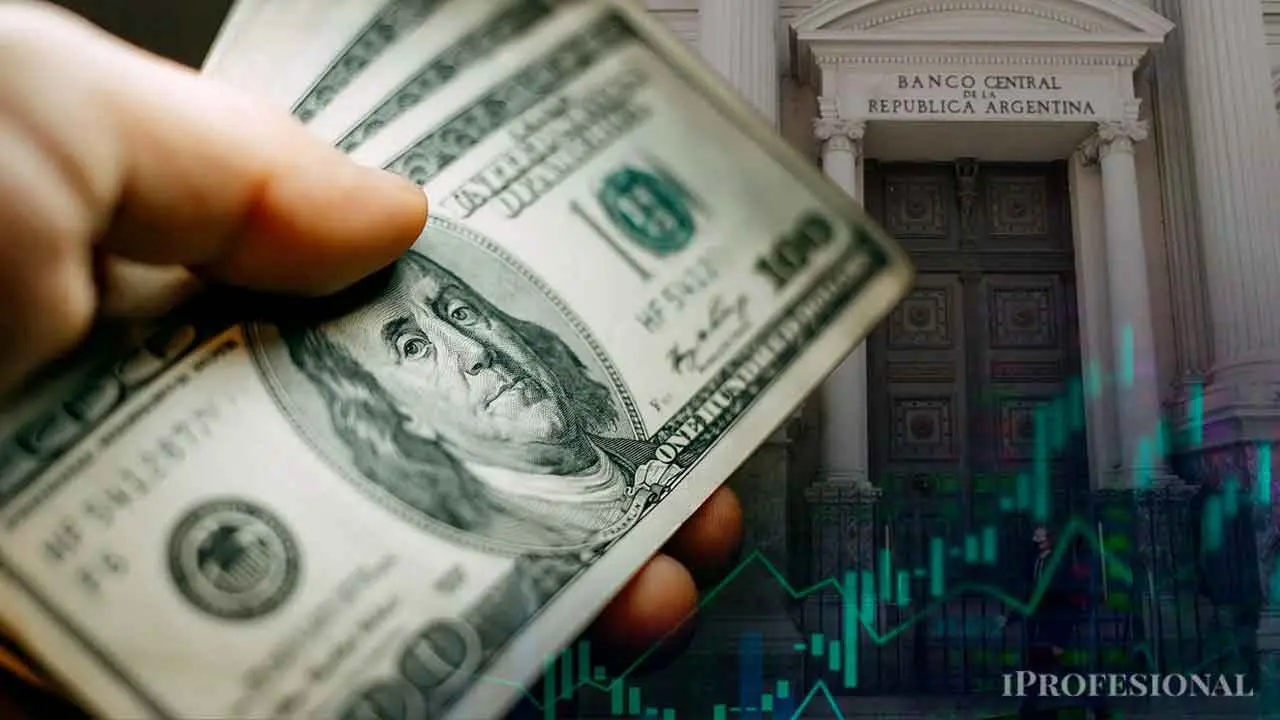
The Central Bank added reserves again this Tuesday, taking advantage of the supply of foreign currency that comes from agriculture. The BCRA bought others US$185 million and it already amounts to US$5,718 million so far this year. In this way, the Gross reserves rose to US$45,873 million.
The Central Bank thus extends an unstoppable streak of dollar purchases, which began in the first days of January and was not interrupted again. And it does so in a context of the calm dollar, which remains below $1,400 and at the lowest levels in six months.
The dollar remained below $1,400
He official exchange rate cut its downward streak and registered an increase in the last roundalthough it remains near the lowest levels since October. In this context, the appreciation accumulated in recent weeks once again put the discussion of a possible exchange rate delay on the table.
In the wholesale segment, The dollar advanced $10 and closed at $1,364after having fallen about $16 in the previous day. In this way, the gap with respect to the ceiling of the exchange rate band – currently located in $1,677.45– remains around 23%. The volume traded in cash reached US$550 million, reflecting sustained activity in the market.
As for future dollar contracts, they showed mixed behavior, with increases in the shortest terms. Market projections place the exchange rate at around $1,377.5 towards the end of April, in a day in which approximately US$1,270 million.
On the retail side, Banco Nación Argentina set the sales price at $1,385, which takes the dollar card to $1,800.5. Meanwhile, the average surveyed by the Central Bank of the Argentine Republic was $1,389.01.
Among parallel exchange rates, the cash with settlement (CCL) is trading at $1,469.51, while the MEP dollar is trading at $1,408.89. In turn, the blue dollar rises to $1,410, and the crypto dollar reaches $1,458.54 according to sector platforms.
The consulting firm Criteria highlighted that in the second week of April a short-term financial stability scenario was consolidated, driven by a combination of exchange rate appreciation, strong official intervention and rate compression. However, they warned that challenges persist: the monetary front exhibits excess liquidity and rates at minimum levels, while disinflation advances at a slower pace than expected, which generates pressure on real rates and inflation expectations.
Thick harvest, accumulation of reserves and abundance of dollars in the market
The decline in the price of the dollar and the BCRA purchases respond to a combination of factors that enhance the supply of foreign currency and favor the accumulation of reserves. According to the Rosario Stock Exchange, in the first three months of the year some US$5,735 million. Although the figure is below the US$6.2 billion from the same period last yearmaintains a high level. Along these lines, the organization foresees a total income of US$35,375 million for the remainder of 2026.
According to Quintana, income from sectors such as mining and energy is added to these flows, along with the placement of Negotiable Obligations and the export of services. “Demand is not enough to balance the forces in the market and, consequently, prices fall,” he explained.
Along the same lines, the economist and teacher Federico Glustein pointed out that “there is a glut because in January the Government managed to cover its obligations with external financing, which facilitated the dynamics of the exchange market. Added to this is “the drop in activity, the lower demand for imports, the sustained income of foreign currency from agricultural exports and mostly successful tenders.”
One of the pillars of economic policy is accumulation of reserves by the Central Bank. The consulting firm LCG detailed that, in the week of April 6 to 10, the BCRA bought about US$986 millionwhich took the total of international reserves au$45,431 million.
However, from Invecq they warn that the 67% of what was purchased so far this year was used to pay debt maturities. According to the consulting firm, gross reserves grew US$2,326 million between January 2 and April 10while net reserves fell US$865 million. This is explained by the Treasury’s lack of access to international credit, which forces face commitments with their own currencies.
The dollar in real terms does not stop falling
Despite the acceleration in prices in recent months, the exchange rate remains stable. Fabio Rodríguez, managing partner of M&R Asociados, maintains that the Government seeks to keep the currency in the $1,400 as an “exchange anchor”.
“This has generated a delay in the real exchange ratesince the nominal practically did not move after the elections, while inflation was around 3% monthly. The price is at one of the lowest levels of the Milei era, which generates concern in terms of employment and production,” he explained.
In the market there is consensus that the real exchange rate presents a delay of between 15% and 20%. In the first three months of 2026, accumulated inflation was 8.7% (assuming that March repeats February’s 2.9%). In that period, the wholesale dollar went from $1,475 to $1,370.
If the year-on-year comparison is taken, at the end of April 2025 the wholesaler was trading at $1,170. From then until March, the CPI accumulated nearly 28.1%which also suggests a lag of the exchange rate compared to inflation.
“Many forgot the exchange bands, but one upper band above $1,600 would imply a dollar between 15% and 20% higher,” Glustein said.