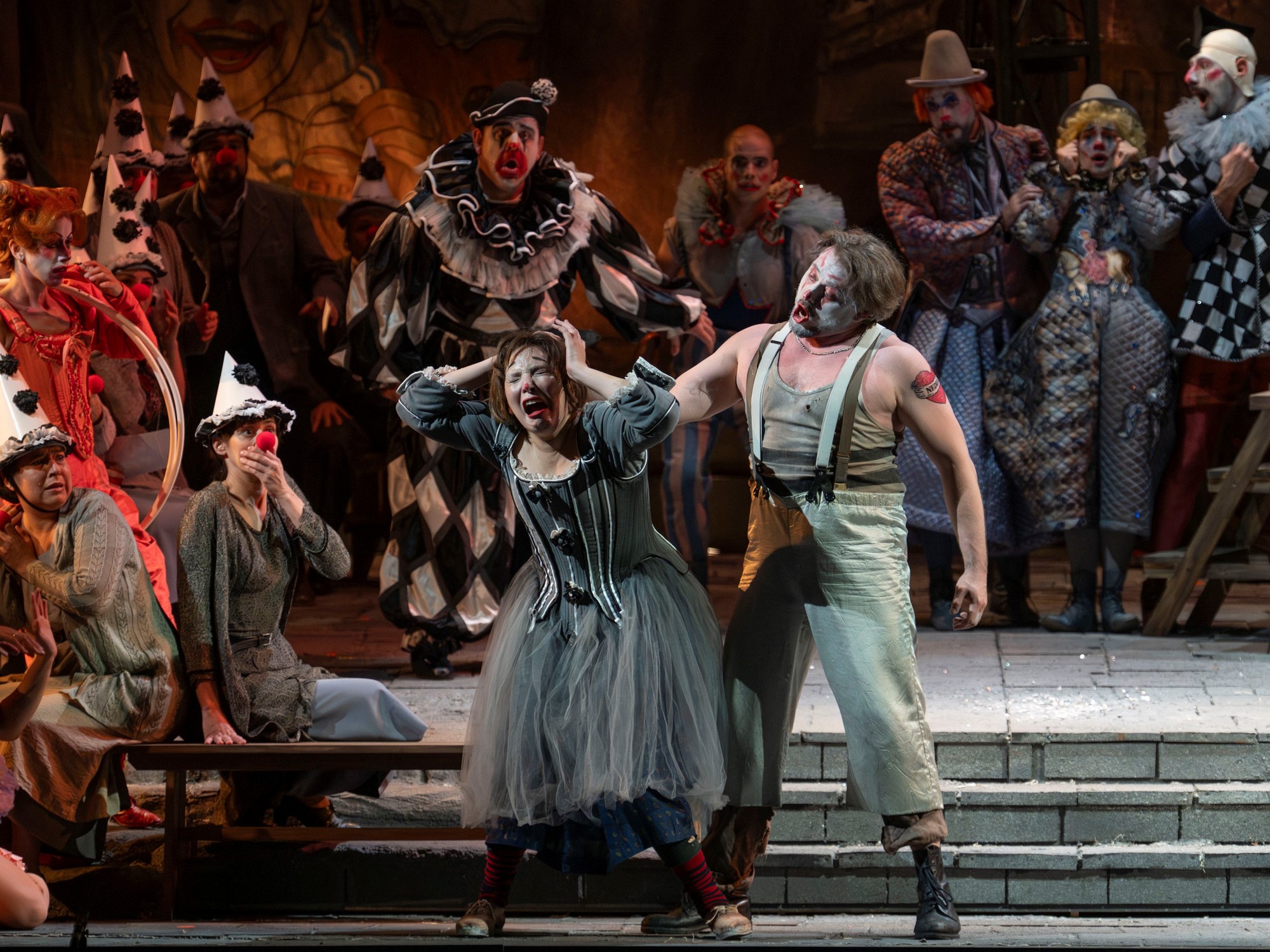
The lyrical season of Colon Theater opened with the verista diptych –Pagliacci (Ruggero Leoncavallo) and Cavalleria rusticana (Pietro Mascagni) – under a premise that does not seek to reconcile the irreconcilable, but rather to strain it. With a new production of the Theatre, the régisseur Hugo de Ana inverts the traditional order and opens the night with Pagliacci, proposing from the beginning a key to reading: verismo not as an illusion of reality, but as a conscious artifice, as theater that knows itself to be theater. His idea of a “global spectacle” is not based on dramatic continuity but on a shared atmosphere.a visual patina that attempts to amalgamate two works of diverse nature without erasing their frictions.
The unique scenography – conceived as a cinematographic set articulated by a rotating disc that multiplies simultaneous shots and actions – functions as the axis of that sought-after unity. Scaffolding and metal structures exhibit the scenic device.
Hugo de Ana shifts the center of gravity towards the language of cinema: a Pagliacci of an openly Fellinian imprint, with echoes of The Strada in the precariousness of that traveling company, and a Cavalleria of more Viscontian affiliation, anchored in a harsh Sicily, between rural tradition and a post-war period of barefoot bodies and eroded dignity.
If in the first the accumulation of visual stimuli – figuratives everywhere – at times saturates and dilutes the dramatic focus, in the second the proposal finds a more organic balance between image and action.
The projections by Martín Ruiz – some generated through artificial intelligence – are integrated naturally into the scenic device and They reinforce the idea of a mental space rather than a geographical one.. However, the inclusion of a film sequence – with images of religious life in Sicily – during the famous Intermezzo, added to the presence of a director on stage, introduces a redundant element that seems to distrust the autonomous power of music rather than expanding the meaning of the scene. In a passage already intensely associated with the cinematographic imaginary, the visual intervention ends up underlining the obvious: it would have been enough, perhaps, to let the music speak.
The costumes, in tune with the stage proposal, build an austere and credible palette that reinforces the social anchoring of the characters, while the lighting – also by the régisseur – effectively models the dramatic climates, alternating expressive chiaroscuros that accompany the tension between the intimate and the theatrical.
 In “Pagliacci” there are no redeeming characters. Photo: Teatro Colón Press /Juan Bruzza
The difference between the works
The contrast between both works becomes particularly effective on the acting level. Pagliacci It unfolds as a territory of exposed violence, without comfort zones or redeeming characters.
In this framework, the Nedda – stripped of all idealization – of Maria Belen Rivarola It is built from fragility, with correct vocal performance, although at times of insufficient flow. In Stridono lassùone of the few lyrical respites in the work, Rivarola offered an accomplished poetic suspension. But the construction of the character does not fully settle: the figure remains halfway between vulnerability and a dramatic tension that is not fully defined.
The Canio de Denis Pivnitskywhich is among the most successful of the function: an instrument with good flow, firm projection and a convincing dramatic progression that finds in I dressed the giubba a high point of expressive concentration, resolved effectively both vocally and theatrically.
Fabian Velozlike Tonio, provides solidity and clarity in the prologue, outlining a character with a cynical accent who authoritatively establishes the conceptual framework of the work. His Yes può? It is resolved with vocal authority and clarity in the emission, supported by a well-bodied instrument that flows with solvency in the room.
 An image of “Cavalleria rusticana”, Hugo de Ana’s setting in the Colón. Photo: Teatro Colón Press /Patricio Cortés
Without positive characters, andIn radical pessimism, the opera finds an uncomfortable crudeness, at times excessive but consistent with its reading..
In Cavalleria rusticanainstead, violence retreats into a more contained, almost ritualized dimension. There, the Santuzza of Liudmyla Monastyrska is imposed with a large volume instrument, solid low register and notable expressive density, as heard in Voi lo sapete, o mammaalthough at times inclined to sonic excess. Yonghoon Lee he composes a Turiddu with a firm line and determined temperament, but with a tendency toward gestural exaggeration.
The duet between the two functioned as one of the most successful nuclei of the work: there, the dramatic tension found a convincing channel, sustained in the contrast between Monastyrska’s vocal intensity and Lee’s more direct impulse, achieving moments of true emotional density.
Veloz, in his double participation, builds here a convincing Alfio, with a clear stage presence, while Guadalupe Barrientos she brings sobriety and efficiency like Mamma Lucia. Javiera Barrios resolves a Lola of suggestive and functional presence to the conflict, and Ramiro Maturana he composes a musically solid and expressively sober Silvio, effective in his role. Santiago Martinez, Mariano Crosio and Ariel Casalis They were on par with the rest of the cast.
Beatrice Venezi At the head of the Stable Orchestra he manages to give flight to the musical richness of the two scores. It proposes a reading with a clear outline, attentive to the architecture rather than the expressive overflow. His direction achieves moments of good balance, especially in Cavalleria. The Stable Choir under the direction of Miguel Martínez, and the Children’s Choir prepared by Mariana Rewerskithey fulfill their role more than enough.
 Contained density, in “Cavalleria rusticana”, the staging of Hugo de Ana. Photo: Teatro Colón Press /Juan Bruzza
The result is uneven but stimulating. Among the overflowing crudeness of Pagliacci and the contained density of Cavalleriawhat emerges is not a synthesis, but a productive friction.
File
Pagliacci and Cavalleria rusticana
Interpreters: Stable Orchestra of the Teatro Colón, Stable Choir of the Teatro Colón (Miguel Martínez, director) and Children’s Choir of the Teatro Colón (Mariana Rewerski, director) Musical direction: Beatrice Venezi and Marcelo Ayub Stage direction, set design, costumes and lighting: Hugo de Ana
Pagliacci (Opera in a prologue and two acts)
Music and libretto: Ruggero Leoncavallo (1857-1919) Distribution: Denis Pivnitsky and Alejandro Roy (Canio); María Belén Rivarola and Marina Silva (Nedda); Fabián Veloz and Youngjun Park (Tonio); Ramiro Maturana and Samson McCrady (Silvio); Santiago Martínez and Sergio Spina (Beppe)
Cavalleria Rusticana (One Act Opera)
Music: Pietro Mascagni (1863-1945) Libretto in Italian: Giovanni Targioni-Tozzetti and Guido Menasci, based on a story by Giovanni Verga Distribution: Yonghoon Lee and Diego Bento (Turiddu); Liudmyla Monastyrska and Mónica Ferracani (Santuzza); Fabián Veloz and Youngjun Park (Alfio); Guadalupe Barrientos (Mamma Lucia); Javiera Barrios and Daniela Prado (Lola).
Upcoming features: Wednesday the 15th, Thursday the 16th, Saturday the 18th at 8pm; Sunday 19th at 5pm; Tuesday the 21st, Wednesday the 22nd, Thursday the 23rd and Friday the 24th, at 8pm. Place: Colon Theater.