
In the world of economics and politics, an important debate is taking place about the interpretation of the numbers of these two and a half years of Milei’s management. In this discussion, traditional variables are usually analyzed: GDP, inflation, salaries, etc. But what these analyzes do not capture is that we are facing a change of regime. Therefore, what we must mainly observe is the variation in relative prices, the performance of the sectors and the characteristics of the employment that is produced/destroyed. Many analysts believe that some numbers shown by the government do not match what is perceived on the street, with the “social thermometer”; while the government states that these communicators give their opinion from their square meter without looking at the aggregate data. We are going to show to what extent the aggregate numbers are in line with the social thermometer that we perceive daily.
A first important methodological issue to resolve is the starting point: December 2023 is usually used as the base year. We are going to use November 2023 as a base. The choice of this cut is because we believe that those who use December underestimate the initial impact of the policy shock that the government implemented as soon as it took office. Those policies had an immediate effect on December numbers. Therefore, to be methodologically rigorous, we must take November 2023 as the last data from the previous government and compare Milei’s management against that value.
The reset
In December 2023 the economy was reset. The government took a set of shock measures that paralyzed the economy, plunged salaries, deteriorated consumption and put savings, investment and spending decisions on hold.. Therefore, it is necessary to analyze from that point how the dynamics started after the general stoppage, in order to understand the change of regime.
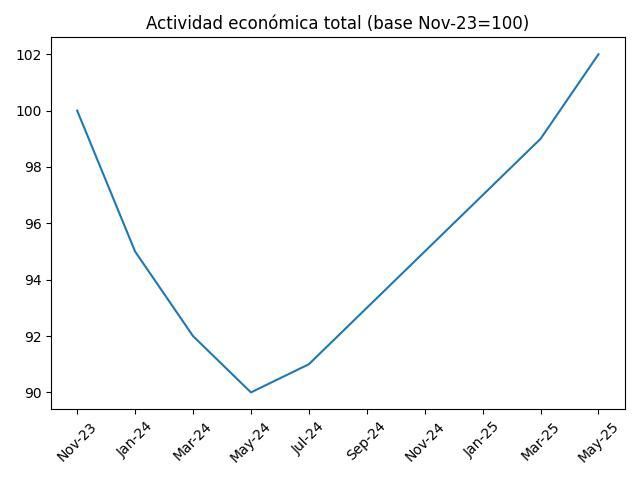
The economy collapsed following the structural adjustment implemented by the government in December, the devaluation and the drastic fiscal adjustment (the largest in history, in the president’s words). After the first four months, activity began to rebound. In the peak-to-peak series, we can see that, after two and a half years, the economy rebounded and today is one point above the GDP of November 2023. But, as we said previously, the interesting thing is to analyze the sectoral dynamics.
We have to identify which were the sectors that drove this aggregate rebound and which were left behind; which sectors felt “comfortable” with the rules of the new regime and what implications this new normal has.
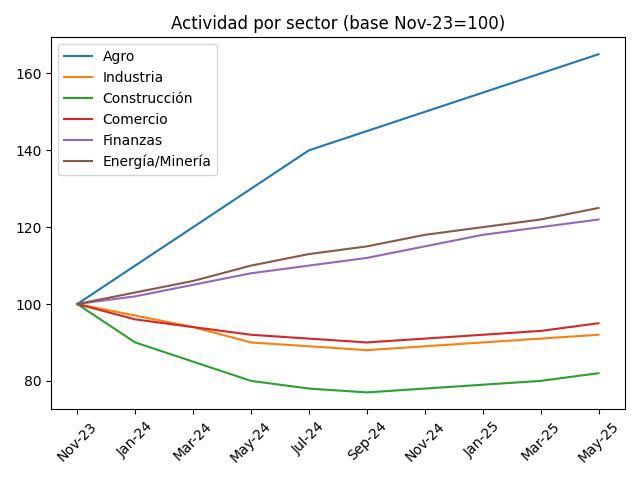
Agriculture, finance and energy had an advantage: These are the sectors that explain the rebound and the slight end-to-end recovery. Meanwhile, industry, commerce and construction are well below the initial point (November 2023 =100).
That is, the reset of the economy implied the emergence of a new regime: an economy driven by agriculture, finance and mining, to the detriment of commerce, industry and construction.
What does the new regime imply?
As in any regime change, there are winners and losers. From the above it follows that the sectors linked to the export of grains and the small group that “trades” securities (operates with financial assets) are the big winners of the new economic regime. Also the companies that extract crude oil and minerals.
Who loses? On the fiscal side, we know that retirees explain one third of the adjustment, while public works and transfers to provinces explain the other two thirds. But, what interests us for the purposes of this analysis, we can observe the following:
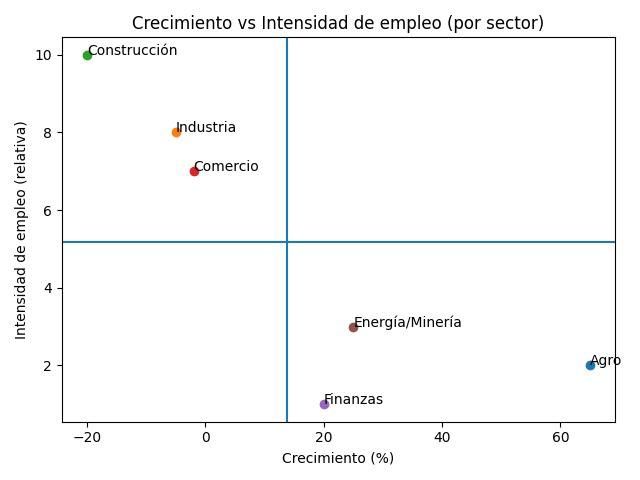
The previous table shows, on the X axis, the percentage of growth of each sector and, on the Y axis, the employment intensity of each of them. What we can see is that finance and agriculture, the most benefited sectors, are the least labor intensive. That is to say, The sectors that demand less work grew more. This happens to the detriment of highly labor-intensive sectors, such as commerce, industry and construction.
What implication does this have?
The change of regime implies, then, that the economy can rebound and recover, and that this can happen while formal jobs are lost, which pushes down the salaries of those who keep their jobs, but also makes new jobs precarious.: Pressured by the lack of quality work, people are willing to accept jobs in worse conditions. That is to say, an enclave economy like the one proposed by Milei can rebound and even grow, while a large part of the population sees their living conditions worsen.
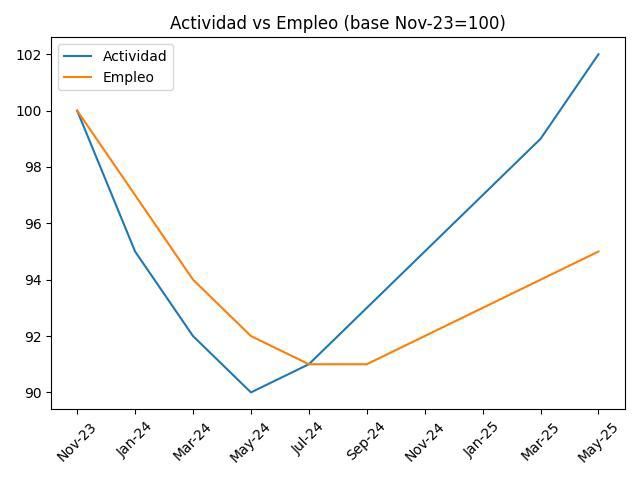
Activity rebounds, driven by the growth of agriculture, finance and mining, but employment lags behind. The sectors driving the rebound do not have the capacity to absorb labor. This brings us to the central problem of the Milei-Caputo model: it is a c Argentina for a third of the population.
The sectors that the economic project prioritizes do not have the capacity to contain the Argentine workforce. In the 90s, those excluded from the productive system began to increase the unemployment rate. In times of platforms, those displaced, those laid off, those laid off and now the new modality of “voluntary retirements” begin to swell the platforms of Uber, Rappi and PedidosYa, as well as online sales, ventures on Instagram and a long etcetera of highly precarious markets, which are also beginning to show signs of saturation.
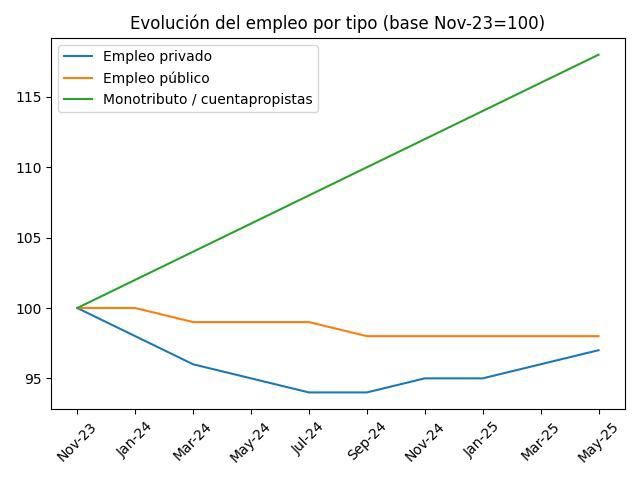
The graph is eloquent in showing that, in Milei’s Argentina, the only thing that grows
It is precarious employment. Those who came to value the private sector do not do
rather than destroying quality private employment. Indeed, it is a
reissue of Argentina’s Centennial, that of 1910, that of the social question. The
Pre-Peronist Argentina of castes and privileges; the Argentina of the owners of
the land; the Argentina of which none of us are part.
Country model
The panorama described takes us to the initial question, to the trigger of these lines: to think again and discuss what model of country we want. We Peronists campaign for a country of production and work, of industry, commerce and construction.
There are Asian or African countries, even Latin American ones, that on a basis of macro solidity and export of natural resources are stratified and crystallized societies, with popular and middle classes that no longer even have the desire to be able to improve their economic situation. We know that Argentina is very different, in Argentina Peronism passed and generated a popular class and middle sectors with pretensions and the capacity for mobilization and struggle.
We also want an Argentina of the countryside, of course. Of public works that guarantee the necessary infrastructure for millions of families who live in precariousness, but also to improve the competitiveness of our companies. Companies that generate quality jobs, jobs that allow a higher level of consumption and drive commerce and private work. You have to move the wheel again. Also finances that are at the service of the productive sector and that channel savings into productive investment.
But, for that, First we have to dialogue with a part of our population
who trusted this experiment that seemed neweither; people who in good faith believed that the future was coming. We must be able to explain that an Argentina that is based on the extraction of natural resources and the speculation of a few is neither desirable nor possible. A country where the majority of Argentines live off platform economies and self-employment on social networks is neither desirable nor possible. We need, once again, to reignite Argentina’s productive capacity: exploit our natural resources, yes, but at the service of our agroindustry and the national interest; oil and gas too, but at the service of our national industry and our supply of foreign currency.
It is even necessary to dialogue with part of our people who have been made to believe that their difficulties are solely the responsibility of their individual failure or lack of talent. It is necessary to rebuild the spirit of those Argentines and summon them to a new dream, of which they are not disposable material, but a central part. That must be the spirit of Peronism.
Originally written for www.nuevascanciones.com